
10 Incredible Inventions of 2025 You’ve Never Heard Of (But Will Soon Use Every Day)
From Mind-Reading Music to Self-Healing Roads — Discover the Tech That Will Transform Your Life Before 2026.
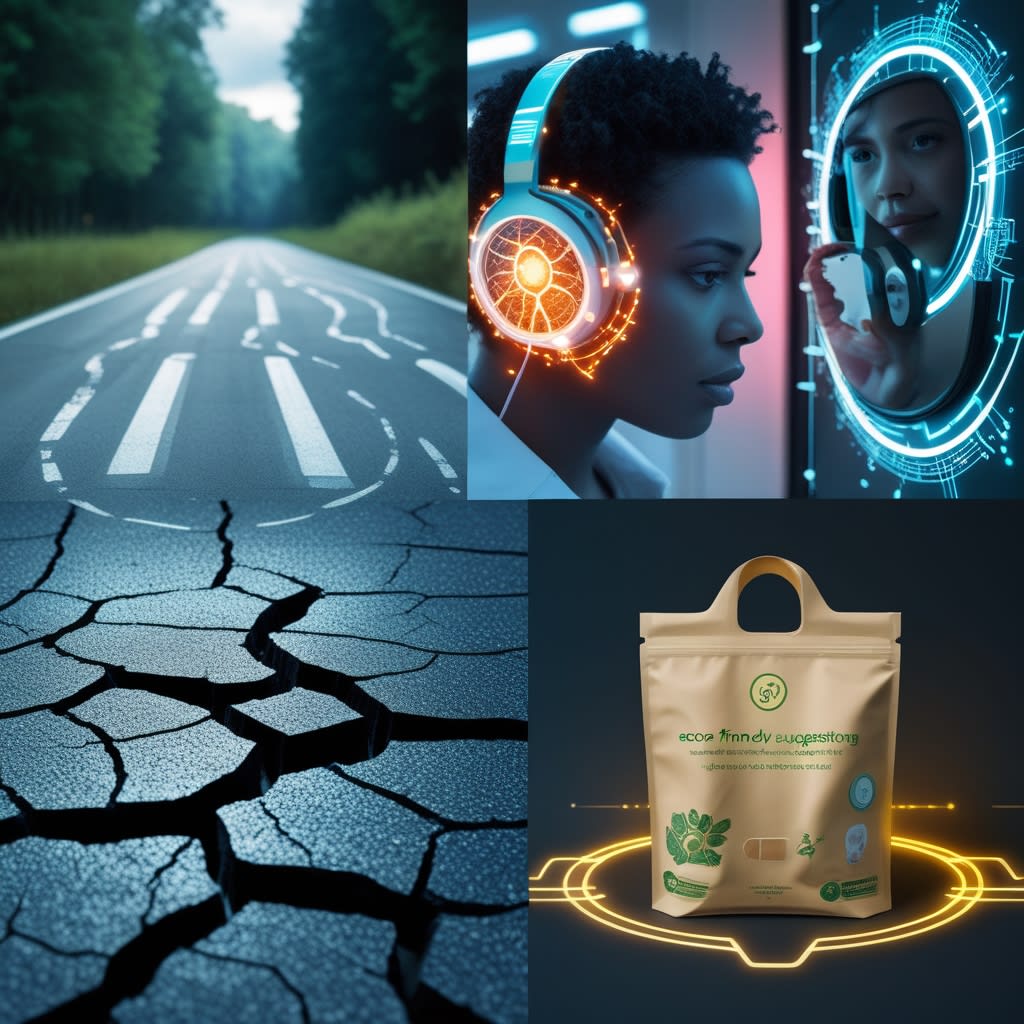
The year 2025 is shaping up to be a landmark in human innovation. While some technological advancements are well-publicized and widely anticipated, others quietly emerge in labs, garages, and think tanks, poised to transform our lives in ways we can't yet imagine. This article dives deep into 10 groundbreaking inventions of 2025 that are flying under the radar now but may soon become part of your everyday routine.
From self-healing infrastructure to emotion-sensitive AI companions, these technologies aren't just science fiction. They're real, they're here, and they're ready to change everything.
1. Self-Healing Concrete: The End of Potholes & Cracks Forever
The Problem It Solves
Every year, countries spend billions repairing aging infrastructure. Roads, bridges, tunnels, and buildings are constantly deteriorating due to weather, traffic, and seismic activity. Traditional concrete has a fatal flaw: it cracks.
How It Works
Self-healing concrete uses bio-reactive bacteria spores embedded in the mixture, specifically Bacillus pseudofirmus. These spores remain dormant until water infiltrates a crack. Once activated, they feed on calcium lactate, producing limestone, which naturally fills and seals the crack.
The healing process starts within hours and completes in 24-48 hours, depending on the size of the fissure. Microcapsules containing healing agents are also embedded in the concrete for structural integrity.
Real-World Applications
Highways in the Netherlands already use pilot versions.
Earthquake zones benefit from automatically reinforced foundations.
Underground pipes can self-seal leaks, reducing water waste.
Future Potential
By 2030, it's expected that 90% of new global infrastructure projects will adopt self-healing materials, slashing maintenance costs by up to 40% and extending the lifespan of construction projects by decades.
2. Neural Headphones: Music That Reads Your Mind
The Problem It Solves
Listening to music is therapeutic, but everyone has different emotional and mental states. What if your headphones could adapt the music to how you're feeling in real time?
How It Works
Neural headphones incorporate electroencephalography (EEG) sensors to detect brainwave patterns, such as stress, fatigue, focus, or excitement. They use AI algorithms to adjust tempo, genre, and rhythm accordingly.
Need focus? The device plays low-BPM, instrumental tracks with alpha waves.
Feeling stressed? It triggers calming ocean sounds or binaural beats.
Sleepy? It plays theta-wave inducing soundscapes.
Real-World Applications
Therapeutic Use: Anxiety and ADHD treatment in clinics.
Education: Helps students focus during study sessions.
Productivity: Used in workplaces to increase efficiency.
Future Potential
The next generation will sync with smart homes, adjusting lighting, scent, and temperature based on your brain activity, offering a full-sensory experience.
3. Smart Mirrors with AI Stylists: Your Personal Fashion Guru
The Problem It Solves
Choosing outfits is time-consuming, and fashion choices can be overwhelming. Many people struggle with matching styles, colors, or fitting the day's occasion.
How It Works
These AI-driven mirrors scan your body in 3D and use machine learning to suggest clothing from your wardrobe or online stores.
Weather & calendar integration helps the mirror pick outfits for meetings, events, or gym sessions.
AR makeup simulation lets you try new looks virtually.
Fitness tracking adapts clothing choices based on changes in your body shape.
Real-World Applications
Used in retail stores for virtual try-ons.
Integrated into smart closets that reorder your favorite items.
Paired with 3D printers for custom clothes.
Future Potential
By 2030, mirrors may design entire outfits using AI-generated fashion, adjusting designs in real-time based on trends, body metrics, and user feedback.
4. AirCarbon: Plastic Made from CO₂ (That Actually Saves the Planet)
The Problem It Solves
Plastic pollution is one of the planet's most urgent crises. Even "biodegradable" plastics can linger for years. AirCarbon offers a solution that is carbon-negative and biodegradable.
How It Works
AirCarbon is created by feeding methanotroph bacteria with captured CO₂ and methane, which they convert into polyhydroxybutyrate (PHB) — a natural, strong, biodegradable polymer.
This material can be used like plastic but decomposes naturally in soil or water within months.
Real-World Applications
Food packaging and utensils used by companies like Nestlé and IKEA.
3D printing materials.
Fashion: Bags, belts, and accessories that are stylish and sustainable.
Future Potential
AirCarbon could replace up to 30% of all global plastic production by 2035, removing millions of tons of CO₂ from the atmosphere.
5. AI Emotional Companions: Machines That Feel with You
The Problem It Solves
Loneliness, especially among the elderly and socially isolated, is a silent epidemic. While AI chatbots exist, they're often emotionally flat.
How It Works
Using Natural Language Processing (NLP) combined with emotion recognition, these AI companions:
Detect emotional cues in voice, facial expression, and body language.
Respond empathetically, offering comfort, motivation, or advice.
Learn user preferences and history to build meaningful interactions.
They are equipped with robotic facial features to mimic human expression.
Real-World Applications
Elder care facilities in Japan are using them for companionship.
Children with autism use them to develop social skills.
Used in mental health therapy as supplementary support.
Future Potential
In 10 years, they may become standard home devices, integrated with smart homes to monitor well-being and mental health.
6. Foldable Solar Roof Tiles
The Problem It Solves
Traditional solar panels are bulky, expensive, and difficult to install. Foldable tiles solve that by being sleek, efficient, and modular.
How It Works
Made with perovskite solar cells on flexible substrates, these tiles:
Unfold to cover roofs, patios, or windows.
Store excess energy in built-in microbatteries.
Withstand extreme weather due to graphene coating.
Real-World Applications
Tiny homes and RVs use them for mobility.
Disaster-struck areas deploy them for instant power.
Cities integrate them into rooftops and bus stops.
Future Potential
Could make every home energy-independent by 2040, reducing carbon emissions dramatically.
7. 4D-Printed Medical Implants
The Problem It Solves
Traditional implants often don’t adapt well to the human body. They're rigid, static, and sometimes rejected by the immune system.
How It Works
4D printing creates implants that change shape or function in response to body temperature, pH, or motion.
A spinal implant can expand once inserted.
Heart valves can open and close more naturally.
They’re printed using biocompatible materials tailored to the patient.
Real-World Applications
Orthopedic surgery: Adaptive bone implants.
Cardiology: Dynamic stents.
Neurology: Soft electrodes for brain interfaces.
Future Potential
By 2030, most surgeries could involve 4D implants, reducing recovery time and surgical risk.
8. Quantum Dot Displays: Beyond 8K Visuals
The Problem It Solves
Current display technologies are limited in color accuracy, brightness, and efficiency.
How It Works
Quantum dots are nanocrystals that emit pure, vibrant colors when exposed to light. These displays:
Offer 30% better color saturation than OLED.
Consume less energy.
Last twice as long.
Real-World Applications
Smartphones and tablets.
Virtual reality headsets.
Professional displays for film editing.
Future Potential
Could become standard in all consumer electronics, enabling holographic displays and true-to-life color fidelity.
9. DNA-Based Data Storage
The Problem It Solves
The world is drowning in data. By 2025, we'll produce over 175 zettabytes. Traditional storage is space-hungry and energy-intensive.
How It Works
DNA molecules can store millions of gigabytes in a single gram. Scientists encode binary data into the four base pairs (A, T, G, C) of DNA.
Ultra-dense: 1 gram can store the Library of Congress.
Stable for thousands of years.
Real-World Applications
Archiving ancient documents.
Cold storage for corporations.
Secure, tamper-proof backups.
Future Potential
Could replace hard drives in data centers, reducing energy use by up to 95%.
10. Holographic Telepresence: Attend Events Without Leaving Home
The Problem It Solves
Remote work and virtual meetings lack presence. Even with video calls, there's a disconnect.
How It Works
Using LIDAR, holographic projectors, and 5G networks, holographic telepresence allows you to:
Beam your 3D hologram into a room in real time.
Interact with people using motion-capture gloves.
Attend concerts, weddings, or work meetings from your living room.
Real-World Applications
Remote surgeries with surgeons in different countries.
Corporate board meetings.
Live hologram concerts.
Future Potential
Expected to become mainstream in virtual classrooms, workspaces, and entertainment by the end of the decade.
Final Thoughts
The future isn’t coming—it’s already here. These 10 inventions represent just a glimpse into how technology is quietly reshaping our daily lives. From emotional AI to climate-saving materials and beyond, 2025 might be the most revolutionary year yet.
Are you ready to embrace it?
About the Creator
How to Choose the Right Hosting for Your Elementor Website in 2026
Elementor is a WordPress page builder with over 10 million active installations in 2026. It gives website owners full visual control over their page layouts, sections, and design elements. However, no matter how well an Elementor website is designed, its performance depends entirely on the hosting environment running underneath it. The wrong hosting choice produces slow load times, unreliable uptime, and poor Google search rankings that no amount of design optimization can fix.
By Shane Smitha day ago in Futurism
Babbling Dixie
The short form of tomorrow is never the whole story. Abbreviations mean nothing when we are born to die and we all are aren't we? Being spoken for before birth is something we're not supposed to remember like some kind of karma after effect. Still here we are spending our lives looking for each other.
By Canuck Scriber Lisa Lachapelleabout 6 hours ago in Fiction



Comments (2)
Self-healing concrete sounds amazing. I remember dealing with potholes growing up. This tech could really change things. Wonder how long it'll take for it to be more widespread. And those neural headphones? Gotta say, I'm intrigued by the idea of music that reads your mind.
nice writting