
Writing on Books
Become proud of your heritage.
I, Laura Fern, committed a sacrilege: I wrote on a book. Yes, a lot of people circle words they don’t understand, highlight sentences that thrilled them and what not. For me, pressing a pen against a book was like dropping the flag on the ground. I even fought with my mom over writing my name on my textbooks back in middle school. She won, but I sweated trying to draw my handwriting as neat and straight as possible.
My mom ended the argument by retreating to her home office. “Why do you care so much? It’s just a book!”
Because a book contains the soul of an author, I answered her and everyone else who ever asked me. I felt like interfering if I did. My grandmother’s handwritten cookbook should not have been an exception, but for some reason it was.
It was part of my inheritance from my grandmother, the most precious one. I received it a week ago, the day of her third and last funerary mass. I could still feel her soft, wrinkled hands on the crimson raffia that she’d tie carefully around the fading cream-colored journal to keep it closed. Her jasmine perfume touched the tip of my nose as I flipped through its pages. I could hear her gentle, high-pitched voice reading out loud her recipes, written in blue ink for luck.
I just couldn’t help it. The moment I read her empanadas con pollo recipe I had to write down a memory I shared with her: we cooked this together to celebrate my elementary school graduation. It was a true mystery how I did not feel guilty but rather exhilarated about writing memories on it. An even truer mystery was the key I found tucked between the notebook’s pages. Before I could ask about it, my mom let out a sigh.
“I remember that day,” she said from across Grandma Luz’s kitchen table. Her voice was like the highest key in a piano, as usual. But today it was not accompanied with the confidence and energy of a fiery immigration lawyer but with the heaviness of a grieving daughter. She pointed at my note with a finger bare of the usual cream-colored manicure she adorned it with. It was the first time I’d seen it colorless since her divorce.
“But we didn’t cook them to celebrate your graduation, it was to calm you down. You were wailing about the teacher calling out your full name: Laura Maria Fernandez.” She rested her chin on a balled-up hand. “Or at least it was until you decided to change it.”
“Laura Fern sounds more graceful,” I defended myself, writing down my mother’s revision next to my own note.
My mom broke into a tired chuckle. “Remember what Abuelita said when you told her that?”
“Yes it was right under that pear tree in the backyard,” I reflected my mom’s smile. “She said I was a pear trying to act like an apple. And throughout the years she came up with even more metaphors to voice her disagreement during our picnics under that tree.”
“She had the soul of a writer, like you.”
“She even wanted me to become one… first time I see a relative get mad about their offspring tackling biomedical engineering.”
“She was a romantic, you are practical.”
“Yep, only a romantic would leave us a treasure hunt,” I replied, holding up the golden key. It reflected the light coming through the kitchen windows. “Any idea what this could be for?”
“It’s probably a key to one of the drawers in the closet,” my mom replied, turning her attention back to the boxes near the entrance of the house. She’d decided to put our old house up for rent and move into Grandma Luz’s. “She was too busy with her shop and her art to come up with something like that.”
The key felt warm with Grandma’s soul. “Grandma Luz would definitely come up with something like that. It was tucked in her cooking book, on top of this.”
I held up a photograph of my mom as a child, her arms wrapped around my grandma’s waist. They were in front of a roaring waterfall that broke through the mountains.
My mom held her breath and tears. “Oh.”
I tried to read what Grandma had written in the back. “Memorias de Honduras: Cataratas de Pu.. pu-“
“Pulhapanzak, Hija. It says Memories of Honduras, Pulhapanzak Waterfalls,” she choked out. She cleared her throat. “That was near your Grandma’s hometown. Look, you’re 25 and busy, isn’t it time for you to learn your family’s mother tongue?”
“I have a lock to find first.”
“Feel free to entertain yourself while I unpack my stuff.”
I did. I tried to open every single item with a lock in the house using the key. No shiny treasure, no message from Heaven. I forced myself to leave the house and get some rest for work once I figured out there was no other lock for me to try and open.
I had plans that night to sleep early and review some papers for work. Instead, I ended up feeling like a college student again, wrapped in a blanket on my sofa as I circled, highlighted, and wrote memories on the cookbook. My plan was to search for any clues within the listed dashes of salt, cups of flour, and chopped cilantro. It fell through the moment I allowed my hand to reach out for the pen and bring to life a memory each recipe evoked. I gave them voice with dialogue, color with vivid descriptions. This was the first time since high school writing did not give me a headache. It felt automatic, like breathing. I ended up watching the sun wake up and stretch out its arms to color its good morning on the sky.
I found no answers about the key, but I discovered something precious: an old photograph, clipped to one of the pages detailing instructions to make the sweet Honduran bread, semita. The picture captured white houses with red rooves that grew on tropical hills like wildflowers. On the back, Grandma had written: Santa Lucia.
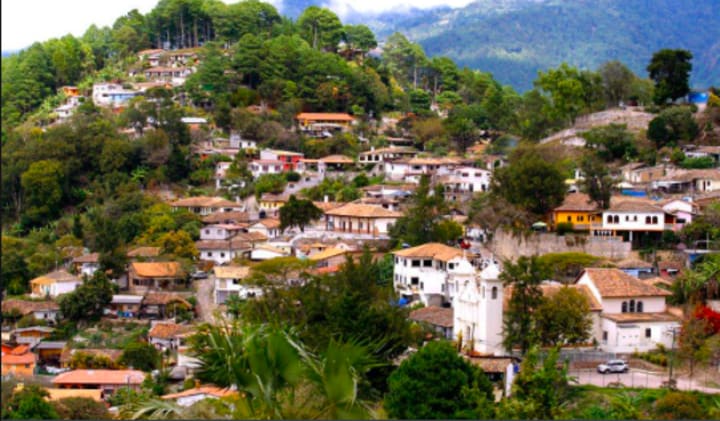
“That’s Honduras?” my friend and roommate, Fannie Vernus, asked that afternoon in my car as we drove again to Grandma Luz’s house.
After work I needed Fannie and her wake-up herbal beverages to continue my search. “I googled it. It’s a village near the capital.”
“It’s beautiful,” she whispered, her French accent adorning her words. “You don’t talk much about your country.”
“I was born and raised here in Oregon, never gone there,” I replied, pulling up to my grandmother’s front yard. “Not sure if I can even call it my country.”
“It’s your roots, your ancestors rest there. Be proud, Laurie.”
It was easy for her to say. When I met her back in St. Joseph’s High School for Girls, all our classmates flocked around her the moment she said she moved from Reims in France.
“I'd love an exchange program in France!” one too many girls would squeal in Fannie’s face.
Professors would comment on France’s rich culture in the middle of class and girls would try to dress like her during casual Fridays. My situation was different. Nobody thought Laura Fern, the freckled girl with straight hair the color of sunsets, would come from anywhere outside the United States. That was until they heard my mom talking to one of her clients over the phone in Spanish, dropping me off at school.
“Honduras?” one of my classmates confirmed, her face darkening with confusion. “I think my maid’s from there… but you don’t look like her.”
“Your work is not what I would expect a Latina’s to be like,” another professor chuckled during office hours, skimming through my essay. “Please don’t let your family ever influence how neat and structured you write.”
And the most frequent one: “What is there to do in Honduras?”
There is a lot according to my family. To everyone else, it’s just crime, poverty, and drugs.
I gazed at Fannie as she walked up my grandmother’s door, her tall and lithe body graceful and elegant even in a simple cardigan and baggy jeans. She had the air of the girl who’d be the main character in the innocent romantic stories I used to read in seventh grade. With my short stature and curves that persisted even through extreme diets, I looked like the girl the main character would befriend to show readers her charitable nature.
“So you say we are looking for some sort of hidden lock,” Fannie stated in the kitchen, assembling dried leaves into reusable tea pouches. They smelled like eucalyptus and mint.
“Very hidden,” I replied. “My mom’s moving here next week so we’ve cleaned up absolutely everything and there is no lock in sight that fits this key.”
“Your grandma will guide you,” Fannie said, drowning the tea pouches in steaming water from Grandma Luz’s old kettle. “Forgive me if this is disrespectful, but don’t you think that maybe she’s inspiring this whole journey?”
I grabbed the mug, careful not to burn my fingers. “Journey?”
“Ever since you got that cooking book you’ve become so… magical,” she said. “Now you’re writing and immersing yourself into your family history, what your grandmother always wanted.”
“I wish. Before, I’d help her mend the garden often. We’d rest under the pear tree and she always had something to teach me.”
“Then let’s go there and think.”
When Fannie reached the tree, she asked for the cooking book and hugged it close to her chest. Eyes closed, she touched the tree. I knew there was some spiritual motive behind it. Before I could ask her, the photograph of Santa Lucia slipped through the pages. Silently to not interrupt Fannie, I picked up the photograph resting on the dewy grass. I held it in my hands, leaning against the tree and admiring the light green pears dancing with the breeze. The wind carried a hum that sounded like my grandmother’s favorite song, a Honduran folk song she’d sing while cooking.
And that’s when I saw it: a new birdhouse-like wooden structure standing tall among the rose bushes. Half of it was painted. The brush strokes and colors looked just like the houses in the photograph. As I got closer to it, my grandmother’s hum grew stronger. I felt my heartbeat sprinting out of my chest as I reached out for the key in my pocket. It opened the door to the birdhouse. Inside was an old shoebox with photos and another journal inside.
“You found something?” Fannie exclaimed from the tree, rushing towards me.
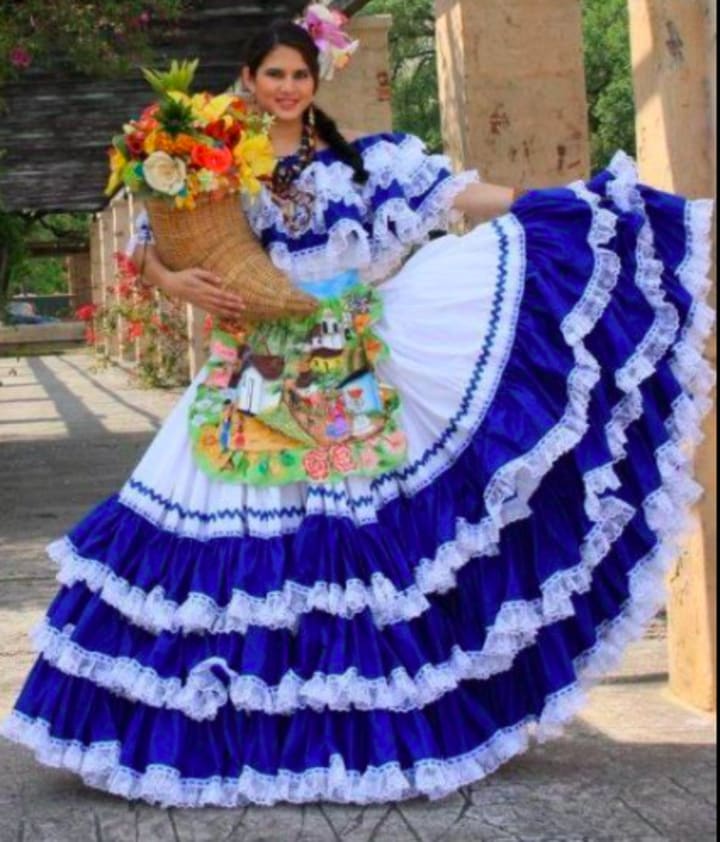
The first photograph was my grandmother, maybe nineteen, with one of her friends. She was wearing a Honduran traditional dress, its ruffled fabric cascading down into layers both girls extended outwards. They’d weaved their hair into braids with flowers as boldly colored as their lips. Their arms were fleshy and their noses were round, like mine, but they still looked as graceful and radiant as the women I dreamed to become in high school.
I opened the journal to find written tales by my grandma, similar to the ones I’d written in the journal.
“Memories of Honduras: My Life Story by Luz Gomez,” Fannie read over my shoulder. “She was working on a book!”
I flipped through its pages. “She didn’t finish it.”
Something told me it wouldn’t remain incomplete, not with the abundance of memories I’d written down.
“Look at the dedication,” Fannie said, pointing at my grandma’s message under the title. “For my daughter, Ana Gomez, and granddaughter, Laura Fernandez. Let’s celebrate our heritage.”
It was the first time I looked at my real name and found it as beautiful as the photos of Honduras in the shoebox, a chapter of my life waiting for me to read it.
About the Creator
Keep reading
More stories from Elizabeth Rojas and writers in Fiction and other communities.
Luna
I was not supposed to find out everyone outside the Academy would die. That night started just like any other: the glare of the moon preventing my eyes from closing into a much-needed slumber; the heart-shaped locket around my neck, colder and heavier than usual, interrupting my breathing; the picture inside the necklace, the one of my family before The Great Storm years ago took half of them away and left the rest of us with injured souls.
By Elizabeth Rojas5 years ago in Fiction
So You Decided To Become a Nurse Practitioner:
So you decided to become an "Advanced Practice" nurse. Congratulations!... is what I would say if this was a good idea. Grad school? In this economy? What were you thinking? Likely it was something along the lines of either 1) “I've seen these other chucklefucks do it— Why can't I?” or even 2) “I've got a nice career, I should shake it up. I miss feeling like I have no clue what I'm doing.”
By Sandor Szabo4 days ago in Fiction



Comments
There are no comments for this story
Be the first to respond and start the conversation.