
When Water Swallowed The Light
Love, Loss, and the Summer the Wasn't

The house had been in the family for five generations. Built by hand on the banks of the Rappahannock, it stood tall and white, with weather-worn shutters and a wraparound porch that had seen more rocking chairs than most old Southern homes. The boards creaked like they remembered everything, and maybe they did.
Out front stood the great oak; a wild, proud thing, gnarled and sprawling, its limbs reached like a prayer, roots growing into the banks of the river like a permanent drinking straw. When I was a child, I used to shout "Good morning, Oakie!" from the front porch before bounding down the steps barefoot, my hair still sleep-tangled. Now, at thirty-eight, I greet it silently with a steaming mug and a heart full of memory watching the river glistening just beyond, as familiar as breath.
Every summer used to smell like honeysuckle and river water. I learned to swim there, baptizing myself in its murky currents, for surely this was heaven. Grandpa taught me to fish off the bank, baiting hooks with nightcrawlers we dug up ourselves, his tobacco-sweet voice whispering secrets about patience and the pull of the line. One summer he tied a tire swing to one of Oakie’s low limbs and we flung ourselves from it, yelping into the warm air before hitting the water with a splash, surfacing with a laugh. That river raised me as much as the family in my life did.
This year, though, I came back to the house trying to stitch something back together. My husband, Mark, had died in a car accident in January and I'd become a recluse of sorts, functioning within the 'have-tos' and 'must-dos' of adulthood, but refusing to surface for fun, as if it would somehow betray his memory to smile. After a several months in hiding, my sister Ellie came to me, "Rebecca, you need air. You need family. Come on, let’s go home this summer."
She helped me pack up my grief, and drove me, her seven-year-old daughter Junie, our mama, and our ninety-one-year-old grandmother Big Lou to the house. A girls trip, we called it, knowing it was something deeper. There was something sacred in the intended mending of a torn apart life. They were determined to fill the week with smiles, laughter, and all of my favorite things, to give me new memories, and envelope me with a sense of hope they'd feared I had forgotten.
The first day there morning light spilled across the breakfast table, golden and soft. The cantaloupe glistened, freshly sliced by Mama, its scent sweet and sticky in the air. She set large slabs of it in front of me, and knowingly passed me the salt shaker - the movement of a thousand summer mornings just like this one. Ellie leaned lazily against the kitchen counter, nonchalantly flipping pancakes and teasing Junie about her bedhead. Big Lou stirred her coffee with patient gratitude, summoning memories in her quiet subtle way. She patted my hand;
"Tomato sandwiches for lunch" she stated, "and I don't want to hear nothing about no fat free mayonnaise. There's only Duke's in this house". Her tone was soft as worn leather though her voice creaked like the old floor boards.
"Weather says it might flood a bit," Mama announced, flicking on the little TV by the fridge. "Storm's gonna send water down the mountain."
"Happens every summer," I said, sipping from my chipped mug, the one with a faded cardinal painted on it that had been my grandpa's favorite.
Big Lou grunted. "This house has seen more water than Noah’s ark and she's still standin'."
We laughed, easing into the breakfast table and the morning. It was easy to, surrounded by sunlight and the smell of maple syrup on butter-topped pancakes. Junie had syrup on her chin, and Ellie wiped it away with a napkin and a motherly smirk. Laughter, we knew, holds a house together better than nails, and they were hoping it would hold me together too.
That afternoon, the sky shifted. It was slow at first, a shy gray creeping over the rich blue. We were outside, barefoot in the grass, playing a lazy game of red light, green light, while Big Lou watched from the porch.
"Feel that?" Ellie sighed, arms stretched out, welcoming. "Gosh, the cool breeze feels amazing!"
"Smells like rain," Mama said. "Like it always did when we were girls."
And she was right, the earthy scent of rain cut the air sharp like a knife, and the Oak tree's leaves had turned over as if hunkering down for a storm.
The first drops came like spit from a cranky child. We laughed, scooping up toys and folding up chairs, giggling, screeching with delight as the sky split open and poured. Junie squealed, arms wide, spinning in the rain. We let her, for a moment, remembering rain-soaked afternoons twirling with the falling water as if we were sky sprites. Then we ran inside, dripping, breathless... happy.
We peeled off wet clothes, changed into dry as our skin prickled from water-drenched skin meeting the air conditioning. We wrapped ourselves in blankets, Ellie popped popcorn, and we curled up together to watch an old black and white movie. The house felt like a ship; we were safe and warm inside, sheltered from the storm.
I got up halfway through the movie to refresh the empty popcorn bowls, tossing M&Ms in as a special treat for Junie and glanced outside as I passed by the back door. Something in my chest clenched tight. The river was high. Too high.
I opened the sliding door and stepped onto the porch. Rain lashed sideways, the kind that finds its way into your bones no matter the season. The tire swing was submerged below the waterline. Only the rope was visible now, pulled sideways by the fast moving current.
"Ellie!" I called, feeling my voice crack from the weight of worry.
She came quickly, squinting into the dusky shades of sunset. "It’s been that high before. Don’t panic." She soothed, her hands squeezing my shoulders reassuringly.
"But it’s still rising."
She took my hand. "We’ll keep watch. It’ll be fine." Her eyes pleaded with me to relax, but my gut said otherwise. I remembered Grandpa saying, "When the Rappahannock gets hungry, you better listen."
By twilight, the river was on the front steps. The power flickered; Junie clung tight to Ellie's leg, letting out an audible whimper as the house went dark.
Mama paced. "We should’ve gone to higher ground. We need to go. Now."
Big Lou clutched Ellie's arms in her hands, glancing between her and I, nodding down at Junie. "You get her out, you hear? I’ll be alright."
"No, we stay together," Ellie said, fiercely. She'd always been the voice of calm and reason in any crisis, as if she'd been made from a special glue, purposed to be the pragmatic chain-link of us all while we dangled like adored charms.
Then the windows burst with an acute crack. Water exploded into the house filling the floor around our feet. It was not the calm river waters I knew that had long been my friend, my saving grace, my companion. This was water that had forgotten its place, become possessed, determined to take and destroy. It roared like a beast and gobbled everything in its path.
The house groaned, echoing our dread, as it lifted, and began to drift, swirling in the water as if carried by a tornado. We screamed. I reached for Mama as a beam cracked and saw the knowing fear I felt reflected in her bright blue eyes as the floor split between us. I was thrown backward, filled with a mouthful of cold water, mud and the resounding cries of my family hitting the water.
I crashed into the oak tree. Oakie. Somehow, I had been flung there, and I clung to him, half-conscious. My arms wrapped around a half-broken limb, my legs scraped, bleeding, my soul cracked open. I mustered the strength to climb, pulling myself as high out of the water as I could manage. I watched helplessly as the house splintered like matchsticks down stream. Porcelain, photographs and years of mementos floated past in a surreal saturated blur. Dented cars, logs, dumpsters crumpled like ripped pieces of notebook paper, Jon boats folded in half like some kind of evil origami, and metal things unrecognizable churned in the current. A house slid past, whole, defiantly intact, a family watching from inside, pale as ghosts, hands pressed against the glass, pleading, looking as helpless and powerless as I felt.
"No, no, no," I sobbed. "God, please. Please make it stop. Please." I begged in whispers, praying against the rain, against the insurmountable water, against death, as if I could some how barter with fate. My Oak tree held me steadfast, caught my tears in the roughness of its bark, kept me out of reach of the waters clawing grasp, its branches shuddering in the drenching wind as if it too felt the horror of it all.
I called out for Ellie, Junie, Mama, Big Lou, hoping they'd found their own trees to cling on to, reassuring myself that Ellie was strong, that Junie was on the swim team, one of the stars of it even, that Mama's faith and Big Lou's stubbornness were enough to pull them through anything. Only the pouring rain answered me back until it ceased and left behind it an empty, aching silence.
When the sun rose, it felt delinquent. How could the morning break open with golden ribbons? How could there be any light left in the world at all? Everything was washed in shades of brown where the silt had taken over everything.
I was still clinging to the tree like a runover, rabid koala. My knuckles were white. My fingers numb. My whole body and spirit ached. The river was slower now but still angrily churning past, simmering now instead of boiling. Where the house had been, there was only a muddy hill adorned with scattered trees and bits of dingy metal as if the mountain waters had finished their meal and lazily laid down her forks.
"Help!" I shouted feebly.
Nothing responded with a haunting quiet. Not even a cricket chirped to break the damp gloom.
I thought of Junie’s laugh. Of Ellie singing in the kitchen. Of Mama humming gospel. Of Big Lou telling stories in the twilight as we caught fireflies. I thought of Mark, and for the first time since his death, I wished he had been here, even if it meant I lost him still, even if it meant we both went under.
"Help!" I screamed again, my voice shaking with the desperation resounding from deep within my bones.
This time a low deep voice answered, "Hold on!" It was our neighbor, Earl. He lived next door to us, alone, and higher up from the bank. He held a round pink blow-up kiddie pool that had seen better days below me. "Let go! I gotcha!"
I did, my body instantly limp, battle-worn, and defeated. When he got me to the grass I collapsed in his arms, sobbing. "They’re gone," I said. "They’re all gone. It's all gone."
He didn’t argue. He didn’t say anything at all, just wrapped me in a blanket and gifted me one of his old flannel shirts and a pair of sweatpants while he poured whiskey into a coffee cup and urged me to drink by a crackling fire that offered no warmth, though it burned hot and bright by the caring, selfless hands that tended it. He cleaned my scrapes, made sure the EMTs found their way to me to check my vitals, made sure I had something to eat, knowing nothing but time, if anything, could mend what the river had broken for us all.
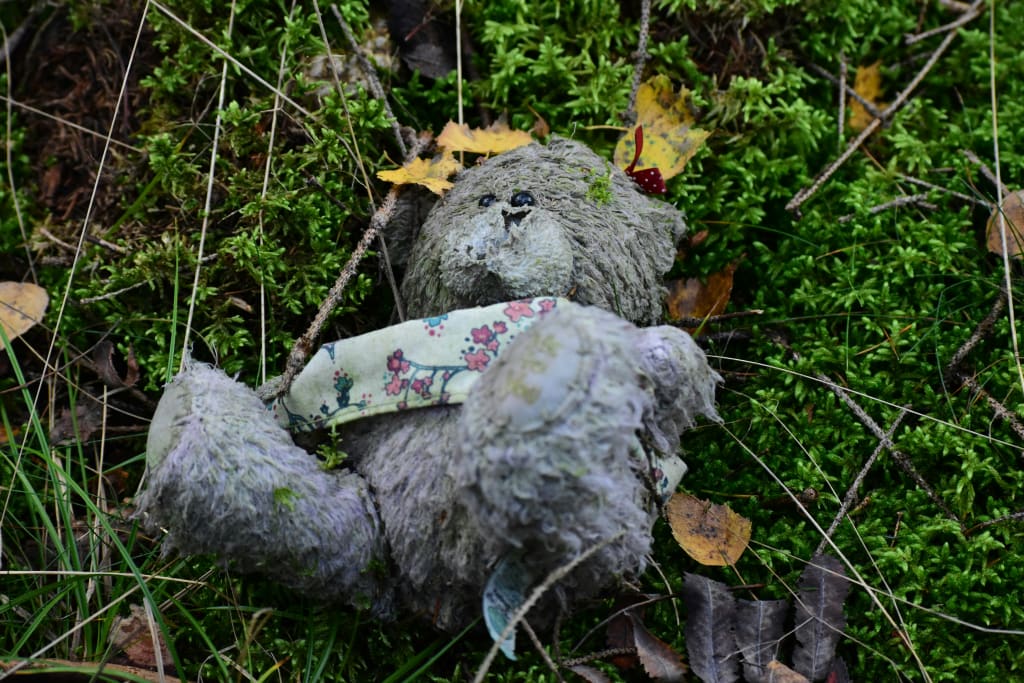
They found Ellie and Junie the next day, half-buried in a tangle of branches. A waterlogged teddy bear rested atop Junie's shoulder, leaning delicately against her peaceful pale face. It wasn’t hers. It belonged to someone else's child, another mother's sorrow lost to the river. They found Mama three days later; a young volunteer from Tennessee found her hand sticking out of a muddy bank as if reaching for help that wouldn’t come. He held her hand the whole time others dug her out, perhaps to let her soul know she wasn't alone or perhaps because he was trying to hold on to something himself.
They never found Big Lou. I like to think she went deep into the silt with the house, becoming a part of the river where she’d always said she wanted her ashes to be spread, where she'd always said she'd belonged, a part of the land that had given so much to us all for so many years, reunited with Grandpa, their rocking chairs guarding the banks - him fishing, her fussing over a knitting project, and Jesus laughing a the juxtaposed, yet somehow perfect, couple that they made.
I returned weeks later to the blank slab on the bank that had been home. No porch. No rocking chairs. No laughter. Just the Oak tree, and somehow, still, the tire swing. It hung, as it always had, as if nothing had changed - a tethered miracle, or maybe it was a reminder that someday there might be joy here again.
I sat beside it and cried until there were no more tears, just dry heaving sobs that broke against the hush of the still river water and the ghost of home. The tire swing was all that remained of the summers that were. This summer that wasn’t. And the summers that would never be. A black silhouette against the cerulean sky, a memory dangling over the river, a monument to the day that the water swallowed the light.
About the Creator
Ellie Hoovs
Breathing life into the lost and broken. Writes to mend what fire couldn't destroy. Poetry stitched from ashes, longing, and stubborn hope.
My Poetry Collection DEMORTALIZING is out now!!!: https://a.co/d/5fqwmEb
Keep reading
More stories from Ellie Hoovs and writers in Fiction and other communities.
Day 17: July's Poetry Prompt Challenge
Sun-Soaked Dreams and the Softness of Summer In the heat of summer, when the days stretch long and sun-drunk, sleep becomes heavier, more golden, more earned. “Sleepy Head” might sound like a nickname shouted across a breakfast table, but it’s also an invitation from this magical space; to slow down, to soften, and to write from the quiet liminal moments where memory blurs with dream.
By Ellie HoovsExclusive • 6 months ago
So You Decided To Become a Nurse Practitioner:
So you decided to become an "Advanced Practice" nurse. Congratulations!... is what I would say if this was a good idea. Grad school? In this economy? What were you thinking? Likely it was something along the lines of either 1) “I've seen these other chucklefucks do it— Why can't I?” or even 2) “I've got a nice career, I should shake it up. I miss feeling like I have no clue what I'm doing.”
By Sandor Szabo2 days ago in Fiction


Comments (1)
Such a tragic, and incredibly timely story (with the extreme weather/flooding that has occurred in several countries around the world). I love how descriptive you are able to be without making your work FEEL like you're describing a setting or visual.... you give a lot of life to your characters' surroundings and help me imagine it as though it's real. I don't think you need to use metaphor quite as often as you do, as your writing already does a great job of building imagery, and sometimes it can feel like it is a little too "busy," but overall this was a very captivating, easy read. One little edit! - "Happens ever summer," I said.... (every?)