
The Violin Case
He thought music had abandoned him—but one small mysterious sound pulled him back from the edge.

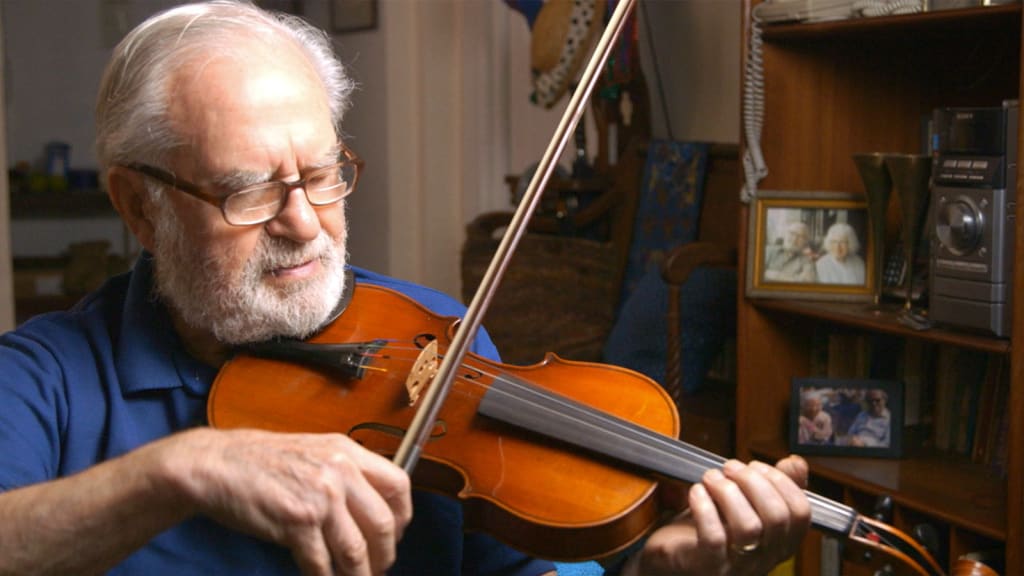
The bridge was old. Stone arches flanked by corroded railings, weeping rust into the river below. It had carried horses and carts once, then cars, and now only memories. Nothing more.
Elijah stood at its center, the cold wind slicing through his coat, the violin case trembling in his hand like a secret.
He glanced down. It wasn’t far—but far enough. Thirty feet to the dark current. Not too high. Not too low. Enough.
He wasn’t sure if he believed in God anymore. Or ghosts. Or second chances. But if they were real, he hoped they’d forgive him.
He had played his last concert seven years ago. Seven years since his hands stopped trembling from excitement and began trembling from age. Seven years since a standing ovation still meant something. Now, applause came in the form of a voicemail from his pharmacist confirming a refill.
He used to be a name. Elijah Roan, first chair of the National Symphony. He had toured Vienna, Prague, Tokyo. At his peak, critics called him the “Thread Between Heaven and Human Hands.”
Now, even his fingers betrayed him. Arteries stiffened, joints cracked. Music still lived in his mind, but his body had filed for retirement.
The silence was what hurt most.
Not the lack of noise—but the silence of purpose.
He’d buried his wife three winters ago, the only person who truly understood his devotion to music. She used to say, “Your violin is your second voice. You just don’t know how to scream without it.”
They had no children. They never had time. He had given everything to the orchestra. She had understood. Too well, perhaps.
The streetlight buzzed overhead, casting long shadows behind him. His fingers brushed the violin case one more time. He hadn't opened it in three years. Didn’t have the heart.
But tonight, he brought it with him. Not out of sentiment. But guilt.
If he was going to leave this world, he thought he should take every part of himself with him.
He stepped closer to the edge. Wind slapped against his back, urging him forward like a rude usher in a theater.
Then—
A sound.
Not a siren. Not a voice.
A note.
One, pure, innocent note. Played awkwardly, but sincerely.
He turned.
Beneath the bridge, in the shadow of a concrete pillar, stood a girl. Maybe twelve. A streetlight flickered near her shoes. She held a toy violin, crooked on her shoulder. Her fingers were out of place. Her bowing technique, all wrong. But her face—her face glowed.
She was trying to play. Trying hard.
He watched her struggle through a crooked rendition of “Twinkle, Twinkle, Little Star.”
It was awful. But it was everything.
His chest tightened. Something inside cracked—not like a bone, but like a door.
She hadn’t seen him yet.
He stepped back from the ledge. The world did not change. No thunder rolled. No choir sang. But something shifted.
He waited until she finished, lowered the plastic violin, and looked around, disappointed.
“Elbow up,” he said softly, walking slowly toward the stairwell down the bridge. “And less pressure on the bow.”
She blinked. “You scared me.”
“You scared me first.” He smiled faintly. “Are you learning alone?”
She nodded. “YouTube.”
“Hmm. Brave soldier.”
“I want to get good like… like that guy. Elijah Roan.”
He stopped mid-step.
“I heard him on an old video. He played like… like he was crying without tears.”
He exhaled. “People used to say that.”
She tilted her head. “You know his music?”
“I knew him pretty well.”
“Do you still play?”
He looked down at the case. “I used to. The music left me.”
“No, it didn’t,” she said. “It just… got quiet. Sometimes music does that.”
He stared at her. A stranger. A child. With his words in her mouth.
“Come back tomorrow,” he said, almost whispering. “Bring your violin. I'll show you how to hold it properly.”
Her face lit like the streetlight above her. “You mean it?”
He nodded.
They stood there in silence for a moment. Then she ran off—plastic violin bouncing at her side. She disappeared into the night like a little miracle.
Elijah stood in the shadow of the bridge, heart pounding. He opened the case slowly. The scent of rosin and old wood hit him like perfume from the past.
He tucked the violin under his chin. Bow to string.
Silence.
Then—
A sound.
It wasn't perfect. His fingers stumbled. But it was his. His voice. Returning.
The river kept flowing. But now, it wasn’t waiting to carry him away. It was simply music, underneath a bridge, on a cold night, where a man decided he wasn’t done teaching the world how to cry with sound.
Author's Note:
This story means more to me than I can express in words.
We all carry invisible music inside us—memories, losses, unfinished symphonies of love, regret, and hope.
“The Violin Case” was born from a quiet question in my heart:
What if the one thing you thought had left you forever… quietly waited for you to return?
If you’ve ever felt abandoned by your gifts, your youth, or your purpose,
please know this:
You’re not forgotten. Your story isn’t over.
Thank you for reading. May we all find the courage to open our violin cases, whatever form they take.
Support Me:
If this story touched you in any way, you can support me and help keep stories like this alive in simple, meaningful ways:
🖤 Tap the little heart below—it's totally free and tells Vocal this story matters.
📝 Leave a comment—I'd love to hear your thoughts or your own story.
🔁 Share it with someone who needs a little hope today.
📬 Subscribe—it’s free, and I’ll keep writing for you.
💸 Leave a tip or monthly pledge—if you feel moved to support me as a writer, it truly means the world.
Thank you for walking through this story with me. You’re part of its music now.
About the Creator
Muhammad Abdullah
Crafting stories that ignite minds, stir souls, and challenge the ordinary. From timeless morals to chilling horror—every word has a purpose. Follow for tales that stay with you long after the last line.
Reader insights
Outstanding
Excellent work. Looking forward to reading more!
Top insights
Compelling and original writing
Creative use of language & vocab
Easy to read and follow
Well-structured & engaging content
Excellent storytelling
Original narrative & well developed characters
Expert insights and opinions
Arguments were carefully researched and presented
Eye opening
Niche topic & fresh perspectives
Heartfelt and relatable
The story invoked strong personal emotions
Masterful proofreading
Zero grammar & spelling mistakes
On-point and relevant
Writing reflected the title & theme
Keep reading
More stories from Muhammad Abdullah and writers in Fiction and other communities.
The King’s Garden of Shadows
Once upon a time, in a kingdom surrounded by seven rivers and veiled in the perfume of eternal jasmine, there reigned a King known by the title "Raheem the Wise." His rule was not forged in blood but in books, not sustained by swords but by silence and soul-searching. His palace had no iron gates, only whispering wind-chimes and vines of lilies climbing its golden pillars.
By Muhammad Abdullah7 months ago in Fiction
Affection and Healing for Yourself
During the night of the last quarter moon, I gathered my ritual supplies. I carefully handled the chunk of black tourmaline that would protect me from your overall negative and narcissistic energy. I carefully walked the house with my stick of selenite in hand, asking the universe to cleanse our working space.
By Alisha Wilkins ✒️🦋🖋️5 days ago in Fiction


Comments
There are no comments for this story
Be the first to respond and start the conversation.