
The King’s Garden of Shadows
A Short Story of Twenty-Five Daughters, One Kingdom, and the Mirror of Truth

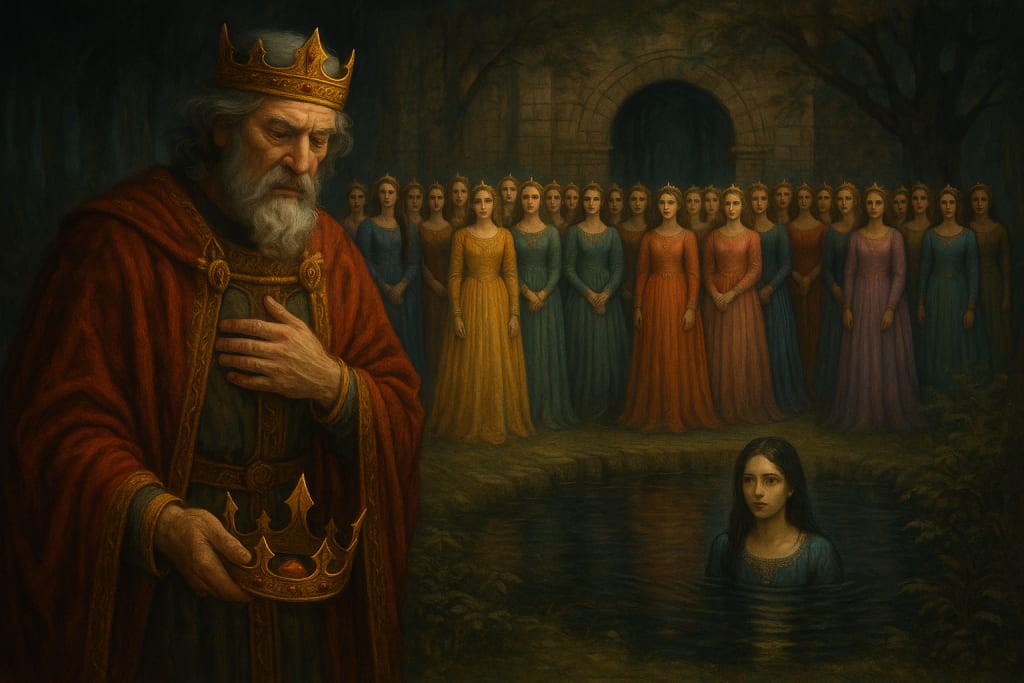
Once upon a time, in a kingdom surrounded by seven rivers and veiled in the perfume of eternal jasmine, there reigned a King known by the title "Raheem the Wise." His rule was not forged in blood but in books, not sustained by swords but by silence and soul-searching. His palace had no iron gates, only whispering wind-chimes and vines of lilies climbing its golden pillars.
But Raheem was not merely a king—he was a seeker of truths hidden in the folds of illusion. In his youth, he had traveled to deserts and dungeons, sat at the feet of Sufis, and slept under stars for months. He studied the forgotten scrolls of ancient civilizations, and in the final years of his quest, he returned to his homeland to govern with what he called "The Justice of Mirrors"—a philosophy that believed all wrong in the world was first a wrong within oneself.
The King had twenty-five daughters, each born to a different moon, each named after a virtue: Amana (Trust), Sabr (Patience), Haya (Modesty), Ilm (Knowledge), Hikmah (Wisdom)... down to Zahra (Radiance). The people of the kingdom said that the King’s daughters were his true ministers, for he taught them politics, poetry, philosophy, and even pain. He loved them all with a love that was precise, not blind.
But the King had a secret...
He never smiled in the presence of his daughters.
No festival, no melody, not even the first rain could make the King smile around them. The ministers whispered: “Perhaps he fears their loss, or maybe he sees in them a prophecy.” Only his loyal vizier, Kamaluddin, suspected the truth. But he, too, dared not speak.
Years passed like feathers falling from the sky. The daughters grew—some into scholars, some into painters, and some into shadows of each other. They were graceful, radiant, and noble, yet beneath their serenity was an invisible competition—for each of them knew: only one would inherit the Throne.
The King's Final Test
On the eve of his 70th birthday, Raheem summoned his daughters to the Royal Courtyard, beneath the ancient Cedar Tree planted by his grandfather.
“I am dying,” he said plainly, “but not from disease or despair. I am dying because my kingdom has grown hollow with secrets.”
He looked at each daughter, his gaze as sharp as a blade.
“I raised you not to be princesses, but mirrors. Yet I fear some mirrors have fogged.”
A hush spread.
He lifted a cloth from a stone table. Upon it lay twenty-five pomegranate seeds, each glowing with a faint golden hue.
“These are no ordinary seeds,” he said. “Each contains a truth—one of you will eat the seed of Truth, and one will eat the seed of Treachery. You must take one, swallow it in silence, and spend the next seven days in the Mirror Garden. There, I will watch, but I will not speak. At the end, I shall name my successor.”
The daughters hesitated. Then, one by one, they approached, took a seed, and swallowed it under the gaze of the moon.
They entered the Mirror Garden—an enormous sanctuary where trees bore silver leaves and ponds reflected the soul more than the skin. The King watched through a hidden dome of tinted glass as each daughter wandered, lived, and revealed.
The Garden Reveals All
On Day One, Amana, the eldest, began building a shelter and invited the others. “We must survive as one,” she said. But half the daughters ignored her and scattered.
By Day Three, alliances began forming. Some of the daughters started to suspect Zahra—beautiful, charming Zahra—for being too silent, too perfect. One whispered: “She hides something behind that angelic face.”
By Day Five, envy bloomed. Three daughters stole food from the shared stockpile and framed Sabr for it. Sabr wept silently but did not defend herself.
By Day Six, two sisters—Ilm and Hikmah—created a system of governance within the garden: debates, votes, justice. But a faction, led by Shuja (Courage), revolted, saying rules are chains. A mock trial was held, and the revolt ended in a symbolic burning of the law scrolls.
The King’s eyes moistened. He saw not daughters, but reflections of his court, his ministers, his own soul.
Finally, on Day Seven, Zahra, the youngest, stood before the central pond at dawn. She whispered to the water, “If truth is in me, let me drown. If falsehood is in me, let me rise.”
And then, with no witness but the pond and the birds, she threw herself in.
The Throne of the Mirror
The King summoned the daughters to the courtyard once more. Zahra was absent.
“My daughters,” he began, “you have been watched not for your beauty or brilliance, but your being. I did not plant seeds of magic—only seeds of fear.”
Gasps.
“The seeds were fake. But the fear was real. I watched how fear made some lie, some love, some lead, and some lose themselves.”
He looked at Sabr. “You were accused, but you bore it with grace. You are a mirror of my patience.”
He turned to Hikmah and Ilm. “You built law, only to see it torn. You are the mirror of my despair.”
He paused.
“And Zahra… the one who chose silence over suspicion, sacrifice over survival—she is my mirror of hope.”
He raised his hand and gestured toward the garden.
Zahra walked in—wet, shivering, alive.
“She jumped,” said Kamaluddin, astonished.
“She dove,” replied the King, “not to escape but to surrender.”
He placed the crown on her head.
“Let the world know,” he declared, “that the throne belongs not to the strongest, nor the cleverest—but to the one who carries love without pride, truth without cruelty, and fear without corruption.”
Years Later…
Under Queen Zahra’s reign, the kingdom flourished. She appointed her sisters to positions of power—but only after each passed their own trial of the Mirror Garden. She built institutions based on compassion and critical thought. Thieves were not tortured, but reformed. The poor were not pitied, but empowered. And storytellers—yes, storytellers—were made ministers of truth.
Once a year, she would walk into the garden and stand by the pond.
Not to pray.
Not to remember.
But to whisper:
"Fear is the seed.
But truth is the root.
And love is the fruit."
Final Moral Reflections
- The one who jumps into the unknown for truth will rise above those who stay in comfort with lies.
- Fear often reveals who we are more than power ever will.
- The loudest is not always the bravest; sometimes, silence contains a scream louder than any rebellion.
- To be just is to look into a mirror and judge oneself before others.
- The throne belongs not to the worthy—but to the one who makes others feel worthy.
About the Creator
Muhammad Abdullah
Crafting stories that ignite minds, stir souls, and challenge the ordinary. From timeless morals to chilling horror—every word has a purpose. Follow for tales that stay with you long after the last line.
Keep reading
More stories from Muhammad Abdullah and writers in Fiction and other communities.
The Slave Who Knew the Stars
Once upon a time, in the ancient kingdom of Zaheerabad, nestled between black mountains and golden deserts, lived a Prince named Kamraan, son of the mighty King Ubaid. The Prince was fair in face and feared in sword, taught in the philosophies of men but untouched by the lives of those beneath him. The palace was carved from marble, adorned with silk and mirrors, but behind its glistening curtains brewed storms invisible to the blind.
By Muhammad Abdullah7 months ago in Fiction
🅼🅸🅳🅽🅸🅶🅷🆃 🆂🅽🅰🅲🅺🆂
"It's 10 in Tuscon! We all know what that means... It's Time for Midnight Snacks with your man, Gerald Gee! Ready to spend the night together? Me too! I'm full of snacks and can't wait to regurgitate them all back into your hungry ears. Crack a brew! Pop some corn! Anything to get ready for one hell of a show where the talk maybe cheap but the words cut deep...
By Lamar Wiggins2 days ago in Fiction
The Bench That Never Moved
The bench had been there longer than anyone could remember. It sat beneath a wide banyan tree at the edge of the park, its wooden slats worn smooth by decades of waiting. Paint peeled from its iron legs, and one corner leaned slightly, as if tired but unwilling to fall. People passed it every day, yet few stopped long enough to notice it.
By ORM_Specialistabout 7 hours ago in Fiction



Comments
There are no comments for this story
Be the first to respond and start the conversation.