


“One must still have chaos in oneself to be able to give birth to a dancing star.” -- Nietzsche.
Violet ran through the desert separating Genosphere G336 from the Dead City for hours until she finally collapsed, exhausted and dehydrated. Her mind clung to the image of her dead clone, whom she had left behind in one of the many supply alleys of the Genosphere, lying lifeless under the faltering light of a single bioluminescent bulb. Knees scraping against the hot sand, Violet thought of her girlfriend Mercy, who had urged her to leave the Genosphere and had transported her to the very edge of civilization, where desert met city wall, hoping that Violet would reach the Dead City, only now visible ahead.
Vision faltering, Violet saw the fabled, ancient skyscrapers, reaching up from the bulk of a city that in the heat seemed to float like and island above the blazing desert landscape of rock and sand. Resigned and lacking the strength to go on, Violet squeezed the heart-shaped locket she had taken from her clone’s dead body and laid her head on the heated ground. She thought of Mercy, smiling as her mind drifted into unconsciousness. At least she would die here in the middle of nowhere, knowing that they would never recover her body to recycle it.
Violet’s rejection of the idea of being recycled was not uncommon among the inhabitants of the Genosphere, but it was considered aberrant behavior in a Delta like herself. Eventually everyone was recycled and replaced, from the most powerful Betas with their government positions to the lowliest of Omegas with their factory jobs, because the remnants of the chaotic strain that ran deep in the human genome would eventually manifest as aberrant behavior or neural activity that would be cause enough to be sent directly to the ovens.
What qualified as aberrant varied from genoclass to genoclass, with Betas being the most predictable--and thus living as long as 120 years before exhibiting any aberration--and Omegas the most chaotic, having to be recycled and replaced every five to ten years. Recycle-and-replace orders were in the hands of GENI, the Genetic Engine of Neural Immutability, a giant quantum computer that tracked the neural activity and behavior of all three-million humans in the Genosphere.
GENI had saved humanity from the deadly virus that had wiped out 7.5 billion people between the 21st and 23rd centuries before it figured out that the virus had been latching onto previously unknown genetic markers that boosted random variation in humans. These "chaos genes," hijacked by the virus, allowed it to kill so indiscriminately, that not even identical twins died the same way. GENI began deactivating "chaos genes" generation after generation, but found them so intrinsic to the human genome that it took it a thousand years to finally protect humanity from the virus.
The tradeoffs were the loss of human autonomy and the need to split the species into 23 distinct genoclasses, Beta through Omega, each retaining unique human traits that would otherwise be lost without specific "chaos genes." GENI tolerated the intrinsic chaos in the genome, but it still strove to produce the ultimate, chaos-free variant: the theoretical Alpha. Meanwhile, GENI continued recycling aberrant individuals, modifying their genome, and replacing them with updated clones from maturation chambers under the very desert where Violet now lay, waiting for death.
Death was slow in coming, though, and minutes before expiring in the grip of dehydration, Violet’s body was found and carried by a group of shadowy figures into the heart of the Dead City. She spent the afternoon in a hospital bed, in and out of consciousness, attached to tubes that fed her water and nutrients while her cranial interface, hardwired to a plug on the wall behind her bed, danced in a flutter of firing neurons as the local computing system probed and reconfigured her mind.
She was under the care of a Beta named Morton. Violet was surprised by this first encounter with a Beta as much as by his kindness, uncharacteristic of his genoclass. Morton asked her to be patient through reconfiguration and healing; once reconfigured, he explained, Violet would be able to process information outside of her Delta genetic programming, something that would be crucial in what she needed to do next. Although eager to know more, as Morton was a Beta, and thus a genetically coded superior, Violet waited.
In the evening, Violet was strong enough to join Morton in the dining hall, where people of all genoclasses sat together. As they ate, Violet noticed with unease that these people were more similar to one another than anyone in the Genosphere, where genoclass division was severe. Morton explained that reconfiguration allowed them to slowly extend their mind beyond the fixed structure dictated by their genetics, although they would never become the complex humans of the ancient past. They would also never recover the ability to procreate on their own, something GENI had stolen from the human race. Violet was astounded at the concept of creating life outside of GENI's cloning system.
"What about the Alpha?" She asked Morton, who responded by saying that GENI's search for the Alpha human, completely devoid of chaotic genetic markers, was only a dream. All GENI could do was to approach the Alpha variant asymptotically without ever actually reaching it. Violet asked what an Alpha would be like and Morton explained that an Alpha would no longer be human, but rather, a thoughtless being without a soul.
Morton then talked about the Dead City, explaining that its people were aberrant replacement clones that had managed to escape from the maturation chambers through the network of ancient, underground tunnels that spanned the width of the desert all the way to the Genosphere’s subterranean space. There, it connected directly to the supply alleys used to deliver synthetic food as well as replacement clones. This reminded Violet of the alley where she had found her dead clone.
Violet described the clone with precision, explaining that not only was the red hair cut in the same style as Violet's, but the clothing was also identical: white lab coat, miniskirt, and patent leather shoes--minus the blood stains, which came from a knife wound in the clone's abdomen. Violet, prompted by Mercy, had quickly disconnected her wireless neural interface and plugged it into the back of the clone’s neck, hoping that GENI would think it was Violet's corpse and interpret the disconnect as her moment of death.
In this process, she had seen the clone’s eyes, which had a blemish not found in Violet's own. She described to Morton the blue irises flecked with gray in a pattern exactly like that of her own eyes, except for a golden spot in each that looked like a star about to plunge into the black hole that was the dark, dilated pupil. Morton said, cryptically, that as the eyes were the windows of the soul, this probably indicated that the clone was clearly an aberration, like Violet.
The last detail she mentioned was the heart-shaped locket. Violet froze, realizing she had completely forgotten about it, checking nervously for it in her pocket. Morton, seeing her distress, quickly dug into his coat and produced the locket, handing it over to Violet and apologizing for not returning it sooner.
“Have you heard of the Heart of Eve?” He asked her.
Violet shook her head, looking at the gold heart-shaped locket with its large ruby stone, which looked like a heart-shaped drop of blood.
“It's an ancient poem that says that after a thousand years of darkness, humankind will see the dawn of a new Eden.”
“A poem?” Violet said, remembering something Mercy had told her about ancient humans being fond of acts of creativity with no practical applications.
“Or a prophecy,” he added, before he recited a few of the verses:
Eve's blood lies, in time concealed,
A silent relic in an ancient heart.
Break it open, find where it's hidden,
In a thousand years, reclaim her Eden.
Violet repeated the words while inspecting the locket, which sparkled in the room’s light like a beating heart. She turned it around, noticing ancient inscriptions and a small circular opening on the back, from which protruded a thin, small needle. Violet instinctively pressed the tip of her index finger against the needle, which pierced through the flesh with a flash of pain. Her blood filled the small cavity and suddenly, the locket snapped open, its two halves separating with what sounded like a tiny breath taken after a millennium.
There had been no air in the space between the two halves of the heart, only vacuum. Inside, Violet saw a small rectangular black chip, decorated with what looked like a maze of really thin copper lines. Carefully coiled around it was a single strand of hair, copper-red like hers. Morton's eyes widened, indicating that the black rectangle was an ancient microchip for data storage and the hair, well, it was complete with its follicle, as if it had been carefully plucked from someone’s head.
To Violet, the follicle at one end of the hair looked like the small head of a serpent sleeping through the millennia, waiting to be awoken. It was suddenly clear to Violet that the follicle would contain the DNA of an ancient human, a complete human with her chaotic and messy genetics lurking under the coiled helix that was her birthright and her gift to the future.
She asked Morton about the chip and he explained that it would likely contain genetic information pertinent to humans before the advent of GENI that would supplement the DNA found in the hair follicle. His eyes filled with tears as he said to Violet, “I hope you’re ready to eat directly from the tree of knowledge. The last time a woman bit an apple--” He stopped, realizing that Violet was not getting the reference. Ignoring this, Violet asked if they would be able to obtain data from something so ancient. Morton was sure that a Delta could figure that one out.
The crude reality of what she had to do became clear to Violet. There was only one place where she could hope to access the information in the microchip, decode whatever DNA remained in the hair follicle, and somehow break into the heart of GENI to rewrite humanity's genome. She must return to her lab in the Genosphere. Thankfully, Morton said, she would not have to cross the desert again. Instead, two Lambdas would teach her the way through the subterranean tunnels and maturation chambers, all the way to the Genosphere’s underground.
“They will no doubt have a new clone of me soon,” Violet said to Morton as they made their way to what would be her room for the next few days. “Very likely," he responded, estimating that clone-replacement turnaround these days would be about a week. Violet proceeded to wait in the Dead City for a few days, continuing the restoration process.
The night before leaving the Dead City, Violet went to bed filled with hope, in spite of what lay ahead, glad to have escaped the ovens for now and looking forward to Mercy's embrace. When she closed her eyes, one last thought lingered as she hung between wakefulness and sleep, filling her with a combination of apprehension and delight: she was going to kill her clone and the computer that made it.
***
On a different part of the dead planet, far beyond the Dead City, another Violet was eating dinner with Mercy in Genosphere G287, discussing whether to take the next day off. GENI measured their responses for aberrations and found them within specifications. GENI knew that Violet would indeed go to work the next day and meet Mercy for drinks in the evening. On their way home, they would find Violet’s clone from G336 in one of the many supply alleys of the Genosphere, lying lifeless under the faltering light of a single bioluminescent bulb. GENI was not sure if G287 Violet would take the locket, but GENI would have a recycle-and-replace order ready for her--just in case.
About the Creator
Dooney Potter
Visual artist, story teller, poet, engineer, and private tutor.
Keep reading
More stories from Dooney Potter and writers in Fiction and other communities.
The Monsters Within
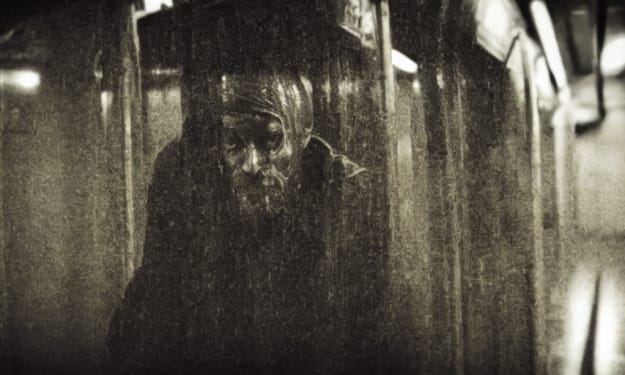
There are monsters under the city, says Corina's dead mother’s voice, a ghost of an echo that seeps into her mind across time and memory. These words, brimming with portent, have coalesced into reality, made flesh in the form of a homeless man now sitting across from Corina on the subway, somewhere in the underbelly of Lower Manhattan.
By Dooney Potter2 years ago in Fiction
Miss Persephone's Manual to a Seemingly Ordinary Life
Miss Persephone was found at the dining table, her blue eyes swollen, her tears arriving and retreating like the tides of the ocean. Earlier that day, her family had visited her in the retirement home where she had lived for eight years. It was her eightieth birthday.
By Imola Tóth3 days ago in Fiction
Identity and the Exhaustion of Grand Ideas
Over the past few decades, intellectual life has been shaped by a growing distrust of ambitious theories that once claimed to explain history and society as a whole. The fading influence of the radical projects associated with the 1968 generation produced a more careful and restrained scholarly atmosphere. Many historians and social theorists became skeptical of large narratives and universal categories, preferring limited scope and methodological caution. In Germany, this shift took a distinctive form through the rise of microhistory, an approach that emphasizes close attention to sources, local contexts, and everyday life. Microhistorians sought to revive the craft of traditional historiography while distancing themselves from older positivist assumptions. Their work often challenges broad concepts such as capitalism, industrialization, and the state, treating them as abstractions that obscure rather than clarify lived experience.
By Gopal Balakrishnan5 days ago in Fiction
Center Stage with Paul Stewart
*** I'm keen to republish the interviews I did for my series with Vocal creators. It's been a few years and I thought it might be nice to revisit these wonderful conversations. I'll be releasing them one at a time for a few weeks/months.
By Heather Hubler3 days ago in Interview



Comments
There are no comments for this story
Be the first to respond and start the conversation.