
The Perfume of the Slave
A Fable of Truth Spoken in Chains, and Power Humbled by Wisdom.

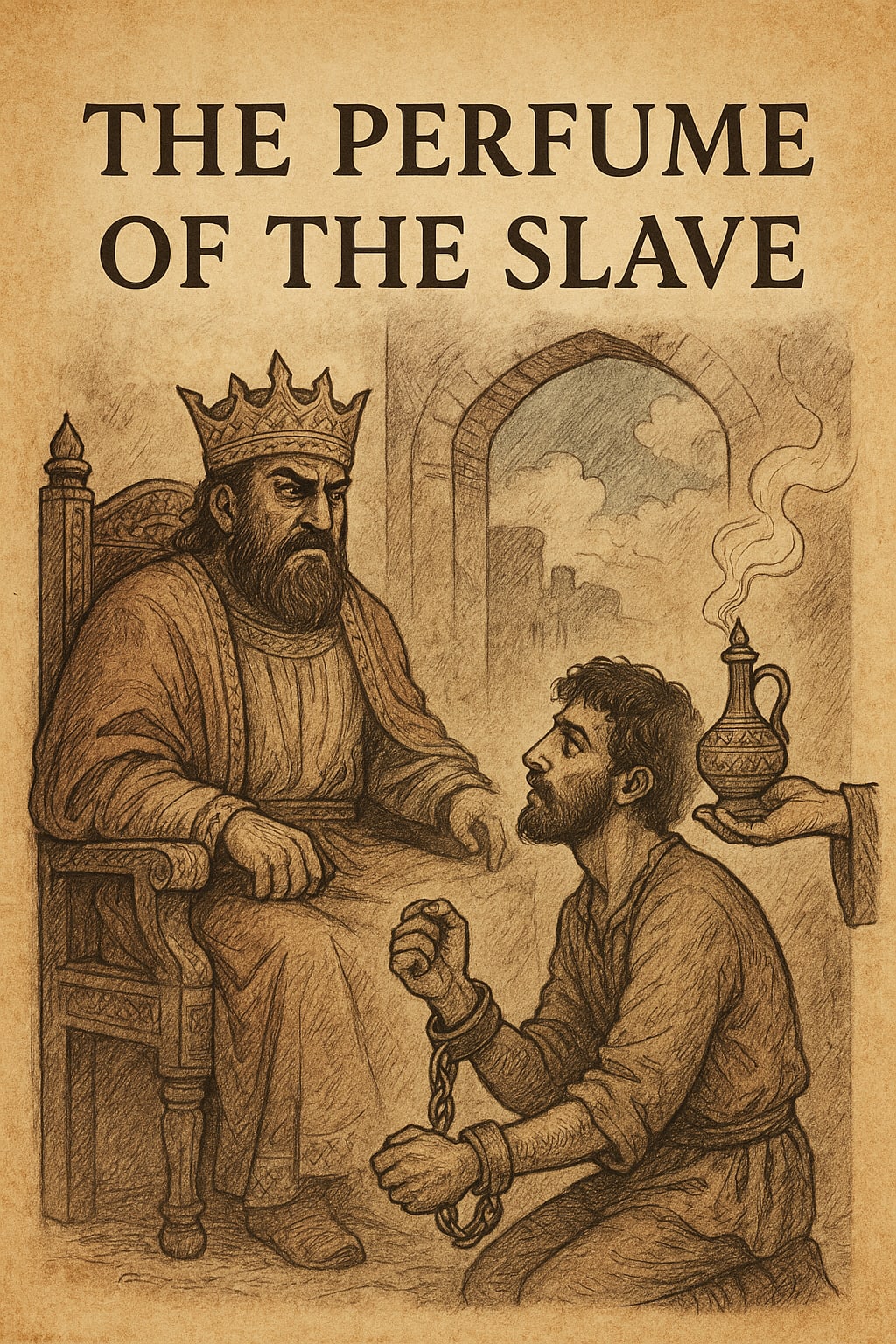
Once, in the time when kings ruled with iron fists but claimed to wear velvet gloves, there was a land called Khumyar, veiled in gold but rotting beneath. Its courtyards echoed with poetry while its prisons bled with silence. The king, Jalib the Proud, had a beard as thick as his cruelty and eyes that glistened with suspicion. His court was filled not with wise men but with flatterers dressed as philosophers. The pen was praised, but the sword decided justice.
In this realm of hollow glory lived a young slave named Baheer, born to a free woman but sold in his infancy for the price of a rug. He grew in the shade of the palace walls, learning not only to serve but to observe — for what is denied to the tongue sharpens the eyes. Though chained in duty, his soul wandered free, and his heart stored the suffering of others like a secret library.
The tale begins on a day of judgment — or rather, of spectacle.
A poet had dared to write:
“The king’s shadow is long,
But only because the sun avoids him.”
The ink was still drying when the poet was dragged to the court. The king, ever fond of punishments that delighted the mob, ordered a public execution with drums, dancers, and refreshments — for nothing pleases tyranny like a smiling crowd.
Baheer was among the attendants, carrying a silver tray of rosewater for the guests, though the scent could not cleanse the stench of injustice.
At the sight of the poet, his face bruised but eyes proud, Baheer’s heart burned like oil set aflame. He whispered under breath:
“He who smells of truth is burned at the stake, while flatterers perfume the air with lies.”
His words, caught by a eunuch with a jealous ear, were reported that very night. Baheer was summoned before the king.
The court was lit with torches that made the gold walls glow like the gates of heaven — though only devils walked within.
The king stared down at the young slave.
“You who were bought like bread, dare whisper against your master?”
“O King,” Baheer replied calmly, “the bread may be stale, but the worms it carries still bite.”
Laughter broke in the court — some from amusement, others from fear.
The king frowned.
“You speak with wit. But wit is wasted on the lowborn. I shall test your tongue with fire.”
Baheer was imprisoned, not in the dungeons, but in the palace garden — among the peacocks and date trees — a torment of beauty without freedom. A curious punishment, for the king wished to break not only his body, but his pride.
And yet, Baheer did not break.
Over weeks, the princess — a pale and veiled girl named Samaa, who spoke more with her eyes than her mouth — came to the garden to see the strange slave who dared speak in metaphors. She brought him fruit, then books, then questions.
“Do you not fear death?” she asked once.
“More than I fear silence,” he said.
“Why speak at all, if none listen?”
“Even trees speak when the wind is right.”
She began to listen.
And love, that unwelcome guest, slipped into the king’s own house like a thief through a window. Samaa fell for the man her father called unworthy. Baheer, though cautious, could not harden his heart against the only soul in the palace who saw him as more than a vessel.
Then came the night of the spring feast.
The court swelled with guests, their robes wide and their minds narrow. Jugglers spun fire. Wine flowed like rivers of forgetfulness.
Baheer, now given a servant’s role again, stood behind the king with a silver jar of perfume.
As tradition demanded, each guest was to be anointed with a drop behind the ears — “so that even liars may smell sweet,” Baheer whispered.
The king, half drunk on mead and ego, demanded Baheer speak a tale — “a fable from your pitiful class,” he sneered.
And so Baheer spoke, before a thousand eyes.
**“There once was a mad lion who ruled a forest. He demanded that all animals flatter him, or face his teeth. One day, a crow cawed honestly: ‘You are large, but not wise.’
The lion laughed, then devoured him.
A turtle saw this and painted the lion’s face on its shell.
The lion, pleased, spared him.
But as time passed, the lion found himself lost, for none dared tell him where the rivers flowed or dangers lay. Surrounded by praise, he drank poison, thinking it was wine.
And so he died, proud and thirsty, while the animals danced over his bones, still praising his name.”**
The silence that followed was deeper than a grave.
The king’s hand trembled.
“You mock me,” he said softly.
Baheer bowed.
“O King, I merely told a story. The meaning, if any, belongs to the listener.”
In rage, the king ordered Baheer’s execution at dawn.
Samaa wept, begged, and was cast into the women's wing like a prisoner.
But that night, word of the tale spread through the city. The baker, the butcher, the shoemaker — all repeated the fable of the lion. And when the sun rose, thousands stood outside the palace walls, not with swords but with silence — the kind that frightens tyrants more than steel.
The execution was stayed.
The king, fearing rebellion masked as reverence, offered Baheer a choice: exile or service as royal adviser.
Baheer chose the third path.
He walked out of the palace, free.
He left behind Samaa, though her eyes pleaded otherwise. But love chained in gilded walls is no love at all. He kissed her forehead and whispered:
“If you ever rule, rule with ears.”
Years passed.
The king, unloved and unlearned, died of a poisoned grape — given by a cook who once lost his brother to a wrongful hanging. No one mourned. Even the birds flew quieter that day.
Samaa rose to power not as queen but as judge, for the people chose her for her wisdom, not her womb.
She ruled with ears.
And Baheer, from afar, wrote stories.
His most famous?
“The Lion and the Perfume.”
Moral:
“A wise king smells of justice, not perfume. For fragrance pleases the nose, but fairness saves the soul.”
This story, like the scent of rosewater, is fleeting in form — but if it lingers in the conscience, then truth has bloomed again.
Dear friends,
If you found value in this story, share it with a friend or let it sit with you like old wisdom in a new skin. In an age of loud lies, may subtle truths still be heard. Kindly support me if you found it interesting!
Thanks for reading!
About the Creator
Muhammad Abdullah
Crafting stories that ignite minds, stir souls, and challenge the ordinary. From timeless morals to chilling horror—every word has a purpose. Follow for tales that stay with you long after the last line.
Keep reading
More stories from Muhammad Abdullah and writers in Fiction and other communities.
The Last Garden Beneath Glass
In the Year 2149, under the sterile gleam of steel skies and synthetic suns, the world was no longer earth—it was Earthware™, trademarked, monetized, and managed by the United Nations of Automation. The rivers were silicone, the trees were polycarbonate, and the clouds floated not on water vapor but on encrypted data packets.
By Muhammad Abdullah7 months ago in Fiction
So You Decided To Become a Nurse Practitioner:
So you decided to become an "Advanced Practice" nurse. Congratulations!... is what I would say if this was a good idea. Grad school? In this economy? What were you thinking? Likely it was something along the lines of either 1) “I've seen these other chucklefucks do it— Why can't I?” or even 2) “I've got a nice career, I should shake it up. I miss feeling like I have no clue what I'm doing.”
By Sandor Szabo7 days ago in Fiction




Comments
There are no comments for this story
Be the first to respond and start the conversation.