
THE GHOST IN THE RING: A PLANETARY GRAVEYARD DISCOVERED?
For centuries, we have stared at the Ring Nebula, admiring its beauty. But a new scan has peeled back the layers to reveal a massive, impossible structure hiding in the dark.
The Ring Nebula is the "Mona Lisa" of the night sky. Since the French astronomer Charles Messier first spotted it in 1779, it has been the poster child of cosmic death—a colorful shell of gas thrown off by a dying star, a preview of what our own Sun will do in a few billion years. We thought we knew its face. We have photographed it, analyzed it, and mapped it with the most powerful telescopes in history, including the James Webb Space Telescope.
But we were wrong. We were looking at the skin, but we missed the skeleton.
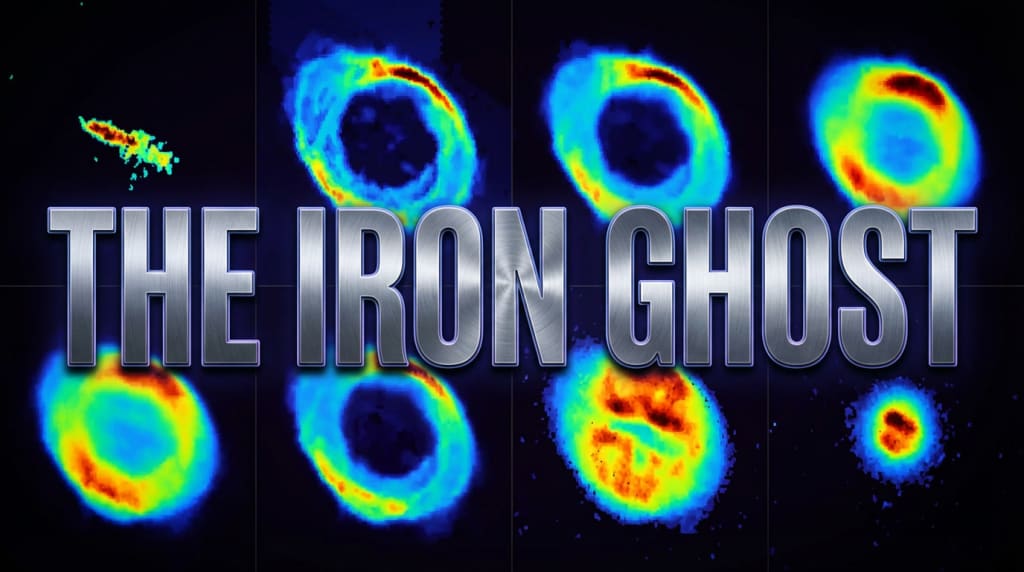
A European team led by astronomers at University College London (UCL) and Cardiff University has just shattered our understanding of this iconic object. Hidden deep inside the nebula, locked within the glowing gas, they have discovered a "mysterious bar-shaped cloud" that shouldn't be there.
The Iron Anomaly
This isn't just a wisp of smoke. The structure is a dense, distinct strip made of ionized iron atoms. It fits perfectly inside the inner layer of the nebula's elliptical shape, like a dark artifact trapped in amber.
The scale of this thing is terrifyingly vast. The iron bar stretches out for a length roughly 500 times the distance of Pluto’s orbit around the Sun. It is a structure of titanic proportions, yet it remained invisible to us until now. Even more disturbing is the density of the material; the team calculates that the mass of iron floating in this bar is comparable to the entire mass of the planet Mars.
The Tool That Found It
How did we miss an object the mass of a planet floating in one of the most studied spots in the sky? The answer lies in a new instrument called WEAVE (WHT Enhanced Area Velocity Explorer), installed on the William Herschel Telescope.
Using a mode called the "Large Integral Field Unit" (LIFU), which utilizes a bundle of hundreds of optical fibers, the team was able to slice the light of the nebula into its constituent wavelengths across its entire face for the first time. Lead author Dr. Roger Wesson described the moment of discovery: when they processed the data, this "previously unknown 'bar' of ionized iron atoms" simply "popped out," sitting right in the middle of the familiar ring.
It was there all along, waiting for us to learn how to see it. But now that we see it, we have to ask the frightening question: Where did it come from?
The Vaporized World
The existence of the bar is a paradox. Dr. Wesson and his team admit that "how the iron bar formed is currently a mystery". In the standard model of stellar death, a star sheds its outer layers in a spherical or elliptical cloud. It does not typically forge a concentrated, Mars-sized bar of heavy metal in its core.
The authors have proposed two scenarios, and one of them paints a violent, tragic picture of the cosmos.
The first theory is that the bar might reveal a new mechanism in how the parent star ejected its nebula. That is the safe, scientific answer.
But the second possibility is far more intriguing: the iron might be the "arc of plasma resulting from the vaporization of a rocky planet".
Think about what that implies. This bar might be the glowing, ionized ghost of a world that was caught in the star's expansion. It suggests that as the star died, it swallowed a planet whole, ripping it apart and vaporizing its rocky body into a stream of heavy iron that is now suspended in the nebula forever. We might be looking at the forensic remains of a destroyed world.
The Missing Evidence
To confirm if this is a planetary graveyard, the team needs more data. Co-author Professor Janet Drew notes that they are currently "missing important information," specifically whether other chemical elements coexist with the iron. If they find the chemical signature of a planetary crust mixed in with that iron, the theory could be confirmed.
The team is already planning follow-up studies using WEAVE at higher spectral resolutions to dissect the bar further. This discovery has opened a new door; Dr. Wesson believes it would be "very surprising if the iron bar in the Ring is unique".
The Universe is Watching
The Ring Nebula was supposed to be a simple story of a dying star. Instead, WEAVE has revealed a complex, hidden structure that challenges our models of stellar evolution. As Professor Scott Trager noted, this discovery in a "night-sky jewel" beloved by sky watchers demonstrates that even the most familiar objects have secrets.
We are left with a haunting image: A ring of beautiful light, and trapped inside it, the iron ghost of something that might once have been a world. The universe is not just silent; it is waiting for us to notice the details.
About the Creator
Wellova
I am [Wellova], a horror writer who finds fear in silence and shadows. My stories reveal unseen presences, whispers in the dark, and secrets buried deep—reminding readers that fear is never far, sometimes just behind a door left unopened.
A Knight of the Seven Kingdoms: The Untold Story Before Game of Thrones
A Knight of the Seven Kingdoms: A Simpler, Deeper Story from the World of Westeros When people think of epic fantasy television, the first name that comes to mind is Game of Thrones—a brutal world of power, betrayal, dragons, and blood-soaked politics. Later, House of the Dragon expanded that universe with even more fire and royal conflict.
By Junaid Shahid a day ago in Fiction
Ludacris and Nelly draw backlash over bookings at MAGA-coded music festival
Ludacris and Nelly headlining a mostly right-wing event is good for them. It’s also great for the genre of hip hop. The two rap veterans have showcased their talents on other stages. Why can’t they perform for mostly MAGA folks and grab that bag?
By Skyler Saunders5 days ago in Beat



Comments
There are no comments for this story
Be the first to respond and start the conversation.