
THE METAMORPHOSIS: 3I/ATLAS DIDN'T JUST SURVIVE THE SUN. IT WOKE UP.
New images from the SPHEREx mission confirm that the interstellar visitor has fundamentally changed after skimming the Sun. The ice is gone, the "water" has exploded, and the physics no longer make sense.

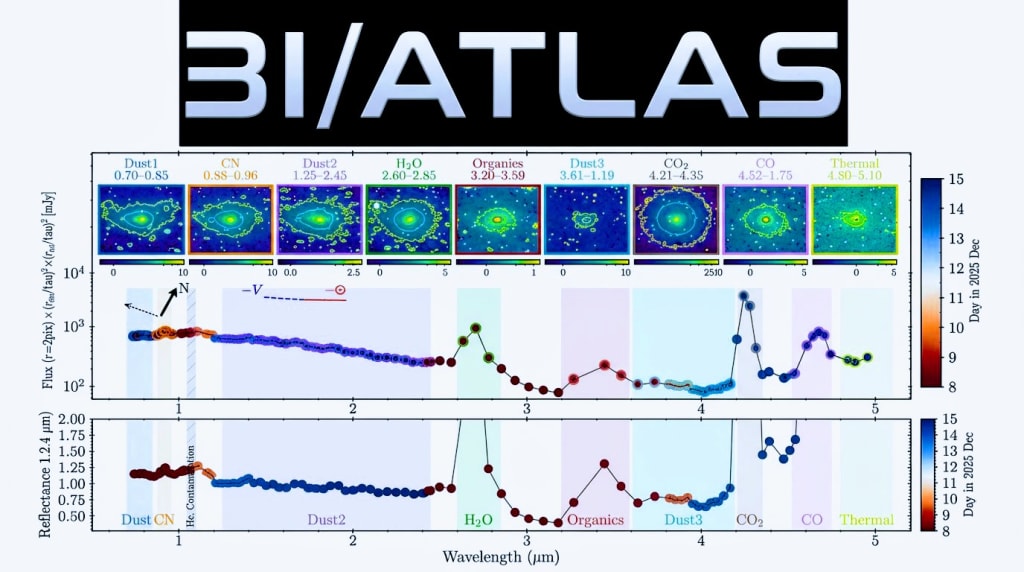
We were told to expect a disintegration. We were told that 3I/ATLAS, the mysterious traveler from the deep void, would likely crack and fade as it faced the inferno of its closest approach to the Sun. That is what comets do. They are fragile things, made of dirty ice and loose gravel, and when you drag them through the solar fire, they usually break apart or exhaust themselves.
But 3I/ATLAS is not playing by the rules of our solar system.
New data released this morning from the SPHEREx mission has stunned the astrophysical community. Instead of fading, the object has undergone a terrifying transformation. It is no longer the object we saw just a few months ago. It has shed its skin, changed its chemistry, and throttled up its activity to levels that border on the mechanical.
The "Water" Explosion
The most shocking number in the report is the "water-gas emission." Before it hit the perihelion (its closest point to the Sun), the object was venting a steady stream of vapor. But now? The emission is twenty times brighter.
Let that sink in. A natural comet usually loses steam as it flies away from the heat source. 3I/ATLAS has done the opposite. It survived the fire, and now, on the outbound leg, it is pumping out water at a staggering rate of 180 kilograms per second.
To the uninitiated, this sounds like melting. But look at the symmetry. The data shows that the water, Carbon Dioxide (CO2), and Carbon Monoxide (CO) are originating from a "symmetric region centered on the nucleus." This isn't the chaotic outgassing of a heating rock; this is a consistent, high-pressure release. It mimics the signature of a cooling system flushing its heat exchangers after a critical thermal event.
The Skin Peel
Even more disturbing is what happened to the surface.
Before the Sun, 3I/ATLAS looked like an icy body. The spectrum was dominated by water ice.
Now? The ice is gone. It has completely disappeared from the spectral signature.
It has been replaced by "scattered-light plus thermal-emission from organo-silicaceous dust grains." In plain English: The white camouflage has burned off, revealing a dark, organic, silicon-based hull beneath. The object has effectively changed its colors, shifting from a reflective icy visitor to a low-albedo, dark traveler. The "cyanide (CN) and organic features" are now showing up clearly, suggesting these chemicals were hidden inside the water phase, waiting to be released.
The Impossible Brightness
Here is where the scientists are scratching their heads. The gas plume around the object is now a hundred times brighter than the nucleus itself.
For a natural comet, this creates a mathematical nightmare. To get that much gas and that much brightness, you need a massive amount of surface area reacting to the sunlight. You need dust. Lots of it.
But 3I/ATLAS isn't releasing normal dust.
The SPHEREx team found no evidence of the fine, powdery dust that usually makes up a comet's tail. Instead, the data implies that the object is surrounded by "large dust grains." And when they say large, they aren't talking about sand.
They are talking about boulders.
To explain the physics of what SPHEREx is seeing, these fragments can’t be mere pebbles. We are talking about chunks that are possibly more than 10 meters in diameter.
Think about the implications of that. We aren't looking at a dusty trail left behind by a melting snowball. We are looking at a swarm. 3I/ATLAS is moving through space surrounded by a formation of heavy, thick debris—fragments large enough to preserve deep, unprocessed material inside them, shielding it from the vacuum.
The "Fine Dust" Illusion
Here is the smoking gun that makes the "natural" theory fall apart: There is no evidence for the fine, powdery dust that is driven by radiation pressure in every other comet we know.
In a normal comet, the sun pushes the light dust away, creating a long, beautiful tail. But 3I/ATLAS? It has none of that. It is surrounded only by these massive fragments, larger than a millimeter, behaving with a weight and density that defies the standard model.
This creates a massive "anomaly," as even the authors of the paper admit. To make the gas plume a hundred times brighter than the nucleus—which is what we are seeing—you need an impossible amount of surface area.
If it is just a rock shedding other rocks, the math of the mass loss doesn't add up. It implies the object is disintegrating, yet the core remains stable, pumping out its symmetrical gas.
The Blue Shift
The final transformation is visual. The "halo" around the object has fundamentally shifted.
Before the Sun, it was reflective ice. Now, the light scattering has turned "bluish".
The spectrum is now dominated by low-albedo (dark) dust that scatters blue light. In nature, this is rare for a comet that just lost its ice. It suggests that the "organo-silicaceous" skin revealed beneath the ice has optical properties we have never seen in our solar system.
The Cosmic Street
The scientists are calling this a "learning experience". They are admitting that objects coming from the "cosmic street of interstellar space" are nothing like the frozen rocks in our own backyard.
3I/ATLAS came in wearing a disguise. It wore a coat of ice to blend in. It stripped that coat off in the fire of the Sun. And now, revealed as a dark, blue-glowing, water-venting anomaly surrounded by a swarm of heavy boulders, it is heading back out to the deep dark.
It showed us one face on the way in, and a completely different one on the way out. And the terrifying part is, by the time we figure out what it actually is, it will be gone.
About the Creator
Wellova
I am [Wellova], a horror writer who finds fear in silence and shadows. My stories reveal unseen presences, whispers in the dark, and secrets buried deep—reminding readers that fear is never far, sometimes just behind a door left unopened.
The Sucker Punch
While the weather grew miserable and the city turned sullen, a lone lightpost oscillated under the weight of the incessant rain. Kine stood in the downpour, her polycarbonate skin slick and cold, watching as his shadow inched closer with a hollow step.
By Caitlin Charlton5 days ago in Fiction
Ludacris and Nelly draw backlash over bookings at MAGA-coded music festival
Ludacris and Nelly headlining a mostly right-wing event is good for them. It’s also great for the genre of hip hop. The two rap veterans have showcased their talents on other stages. Why can’t they perform for mostly MAGA folks and grab that bag?
By Skyler Saunders4 days ago in Beat


Comments
There are no comments for this story
Be the first to respond and start the conversation.