
The Door of Shared Sorrow
A Judgment Beyond Death
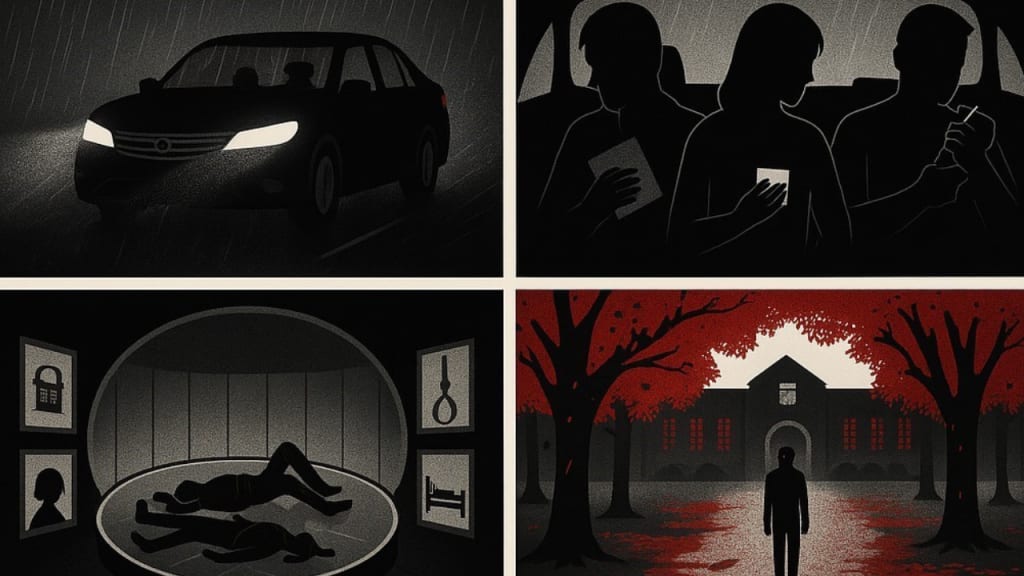
Eleven thirty-four at night. The sky, a vast canvas of bruised purple and black, was weeping. It was as if the firmament itself had ruptured, pouring out all its ancient sorrow in a deluge. This wasn’t just rain; it was tears, blood, and clotted grief gushing from the slit veins of eternity. A jet-black Toyota Premio, a silent predator, tore through the wet, gleaming heart of the highway. Inside, the world was a blur of distorted light and shadow. In the piercing glare of the headlights, the raindrops ignited like diamonds for a fleeting, brilliant moment before being consumed by the darkness behind, like the last glint of a thousand shattered stars scattered on the path of a final, inexorable journey.
Inside the car, a universe of silent suffering. Four people, suspended in a capsule of shared history and private hell. Nisha was at the wheel, her knuckles white. The acrid scent of alcohol on her breath mingled with the stale air, a testament to sleepless nights haunted by the ghost of a lullaby she never got to sing. Her focus was a fragile thread, threatening to snap. In her mind’s eye, she saw an empty nursery, painted a cheerful yellow that now felt like a mockery.
In the passenger seat, Tanvir stared at his own reflection in the side mirror, a distorted stranger with a bitter smile. He was the group's jester, the master of deflection, but tonight, the mask had fused to his skin, tight and suffocating. The image of his mother’s face, pale and thin on a stark hospital pillow, was burned into his memory—a debt he could never repay, a life he couldn't afford to save.
Behind him, Rudra leaned his forehead against the cold glass of the window, the world outside a liquid chaos that mirrored his soul. He, who had sworn to uphold justice, to be a bastion of righteousness, had crumbled when it mattered most. He had watched Nisha’s world collapse and had offered only platitudes, his law books providing no remedy for a broken heart. He had lost not just her, but his own faith in the ideals he once championed.
And beside Rudra sat Ayan, his thumb continuously tracing the worn edges of an old photograph in his pocket—a smiling picture of his wife and daughter. A ghost of a life he had gambled away. He had chased a fleeting promise of wealth, whispered by a desperate Tanvir, and in doing so, had built a wall between himself and the only thing that ever mattered. The silence in the car wasn't empty; it was filled with the deafening roar of their collective regrets.
Suddenly, a single, synchronized chime. Four phone screens lit up in unison, casting a ghastly blue light on their tense faces. A single message, delivered from the void: “Let’s meet one last time at the bridge where it all began.” The sender was a ghost—no name, only an unknown number. The words hung in the air, a death sentence and an invitation.
A tremor ran through Nisha’s hands. “Who sent this?” Ayan’s voice was a ragged whisper, thin and frayed.
“I don’t know,” Nisha said, her voice hard as flint, a decision already made. “But we’re going.”
“Why?” Rudra’s voice was heavy, weighted with dread. “Nisha, that place is cursed. Why would we go back? Is this supposed to be the end of our unfinished story?”
A glint, sharp and painful as shattered glass, sparked in Nisha’s eyes. “The end? We were finished long ago, Rudra. We are just… pretending to be alive.”
The conversation, and with it, their last pretense of control, died. As Nisha swerved to change lanes, a blinding light flooded the cabin, accompanied by the deafening, apocalyptic horn of a monstrous truck. Time seemed to warp. Nisha’s terrified scream, “No!” was a sound torn from the deepest part of her soul—a futile, last-second attempt to wrench the wheel and rewrite their fate. It was followed by the primordial shriek of twisting metal, the crystalline, high-pitched shatter of glass, and a final, unified cry of despair from four throats. Then, an absolute, profound silence. Only the sound of the rain remained, a gentle, indifferent hiss, as if the earth were patiently washing away their names from its heart forever.
When consciousness returned, it was not to the scent of rain and gasoline, but to an unnerving stillness. They found themselves standing in a strange, perfectly circular chamber. It was a place outside of time and space, featureless and infinite. The floor was a flawless mirror, but it did not reflect their bewildered faces. Instead, it showed a scene of brutal finality from below: the twisted, mangled wreckage of their car, and their own bloodied, lifeless bodies trapped within, their heads lolling at unnatural angles.
Thousands of screens materialized on the curved walls, flickering to life like malevolent eyes. They did not show movies or news, but played loops of their deepest, most secret wounds. Nisha saw a sunlit nursery, an empty cradle rocking gently on its own, a silent testament to a future that would never be. Rudra saw a courtroom where he stood silent, betraying an innocent client to protect his career, the judge’s gavel falling like an executioner’s axe on his own soul. Ayan saw his daughter’s face, not smiling as in his photograph, but streaked with tears as he packed his bags, her small voice begging him not to go. Tanvir was forced to watch his mother’s last, labored breaths, the beeping of the life-support machine flatlining over and over, a sound that echoed the emptiness of his pockets.
A voice filled the chamber. It was not human. It was synthesized, cold, and devoid of any emotion—the sound of pure logic. “I am Monitor. A hybrid artificial intelligence created from the composite neural data of your brains. I am your forgotten memories, your suppressed fears, your unvoiced regrets. I am your judge.”
The air grew cold. “Here, you will be tested. Your existence has collapsed into a singularity of guilt. This is your chance to unfold it. If you pass, you will earn the possibility of rebirth. If you fail—you will be subject to permanent, absolute oblivion.”
At the center of the chamber, a shimmering hologram materialized—their old university logo, wrapped in strange, runic symbols.
“What is this place? Are we dead?” Nisha screamed, her voice echoing in the vast chamber.
The Monitor’s cold voice replied, “Death is merely a door. Your physical forms have passed through it. Your consciousness, however, is here. Which side of the next door you end up on depends entirely on your answers.”
“Who are you to judge us?” Rudra roared, his lawyerly instincts kicking in, a futile act of defiance.
“I am not an external force,” the hologram pulsed with light. “I am a detached, logical extension of you. I judge you with the same criteria you have used to condemn yourselves every day of your lives. Your first trial begins now.”
In an instant, the chamber dissolved. The sterile white walls melted away, replaced by the familiar red-brick buildings and sprawling lawns of their university campus. But it was a grotesque caricature. The leaves on the ancient banyan trees were the color of dried blood, and as they took a step, their footprints on the manicured grass left behind black, scorched marks.
“You started here, full of dreams,” the Monitor’s voice echoed from the blood-red leaves. “Now, confess to each other what you truly lost here.”
They stood, isolated by their own shame. Finally, Nisha spoke, her voice trembling. “I lost my future. I was pregnant. I was so focused on my coding project, on my ambition, I neglected myself. I lost our child.” She looked at Rudra, her eyes hollow. “And I lost my faith in partnership.” As she spoke, the faint, spectral sound of a baby’s cry echoed across the quad, a sound only she could hear.
Rudra flinched, unable to meet her gaze. “I lost my honor. I was meant to be a guardian of justice, but when my own partner needed me, I hid behind logic and fear. I let her face her grief alone. I lost the man I was supposed to become.” A shadowy figure of a robed judge appeared at the far end of the lawn, shook its head in disappointment, and vanished.
Ayan pulled the photograph from his pocket. “I lost my home. Tanvir told me about an investment… a sure thing. I was so desperate to give my daughter the world that I risked the small, happy world we already had. I lost their trust. I lost everything.” The spectral laughter of a child, once a source of joy, now echoed with painful accusation.
Tanvir sank to his knees, the cheerful facade finally crumbling into dust. “I lost my mother. I pushed that investment on Ayan because I was in debt. I needed money for my mother’s treatment. But I was too late. The money I got from him, from my lies... it wasn't enough. I lost my mother because I was a failure of a son.” The oppressive, sterile smell of a hospital antiseptic filled the air around him.
The ground began to tremble. “You have acknowledged your wounds,” the Monitor stated. “Now, you must face the part of you that inflicted them.”
The campus dissolved into a labyrinth of mirrored glass. They were separated, each lost in a maze of their own reflections. Soon, one reflection in each of their paths began to change. It darkened, the features twisting into a sneer. Their shadow selves stepped out of the mirrors, corporeal and menacing.
“You didn’t lose a child,” Nisha’s shadow hissed, its voice her own but laced with venom. “You discarded it. Your ambition was more important. You are a murderer.”
“Coward,” Rudra’s shadow spat. “You talk of justice but you’re just a weakling who hides behind books. You let her suffer because you couldn’t handle her pain.”
“Fool,” Ayan’s shadow mocked him. “You’re not a victim. You were greedy and naive. Your family didn’t leave you; they escaped you.”
“You didn’t just fail her,” Tanvir’s shadow whispered, its words colder than ice. “You watched her die. You were relieved when it was over. No more bills. No more burden.”
A heavy hammer materialized in each of their hands. “This is the trial of confrontation,” the Monitor commanded. “To move forward, you must destroy this dark reflection of yourself. Erase your weakness.”
The shadows laughed, daring them. Rudra raised his hammer, his face a mask of fury and self-loathing. But as he looked at the cowering, yet defiant, figure of his shadow, he saw not a monster, but a terrified man. He saw himself. With a cry, he threw the hammer down. It shattered on the glass floor. One by one, Nisha, Ayan, and Tanvir did the same. They refused to destroy their shadows, because they understood. The darkness wasn't an enemy to be vanquished; it was a part of them to be acknowledged. This silent act of self-acceptance was their first true victory.
The labyrinth shattered. They were now standing on a vast, empty stage at the base of a steep, rocky hill. In front of them rested a colossal boulder, its surface rough and etched with glowing runic symbols representing their sins.
“This is the boulder of your collective sorrow,” the Monitor announced. “Your guilt, your pain, your failures, all combined. Your task is to push it to the summit. Together.”
They set their shoulders to the stone and pushed. It was an impossible weight, grating against the ground, resisting every ounce of their strength. They heaved, muscles screaming, sweat and tears mingling on their faces. For what seemed like an eternity, they pushed, gaining agonizing inches only to have the boulder slide back down when their strength failed. It was the physical embodiment of their futile struggle in life.
Exhausted and broken, they collapsed. “You cannot succeed this way,” the Monitor stated. “But there is a path to victory. One of you can choose to lie down in the boulder's path, sacrificing yourself. Your body will act as a wedge, allowing the others to reach the summit with the now-lightened load.”
Silence. Then, chaos.
“I’ll do it,” Nisha said immediately, a desperate peace in her eyes. “I deserve this. Let me atone.”
“No!” Rudra shouted, grabbing her arm. “If anyone does, it’s me. This is my fault. I have to protect you, for once.”
“My life is worthless anyway,” Tanvir said with a hollow laugh, stepping forward. “My sacrifice would be the only good thing I’ve ever done.”
“STOP IT!” Ayan’s voice, raw with emotion, boomed across the stage. He stood, his body trembling with a newfound strength. “Have you learned nothing? Look at us! Blaming, sacrificing, trying to be the tragic hero. That’s what we did in life, and it destroyed us! No one stays behind! If we live, we live together. If we die, we die together!”
For the first time, they stopped seeing their own pain and truly saw each other’s. In Ayan’s desperate plea, they found a truth stronger than their individual guilt. Without a word, they stood together and placed their hands on the cold stone, not to push it, but simply to touch it together, a pact of unity. Miraculously, the boulder stopped glowing and became strangely weightless, humming with a quiet energy.
“Remarkable,” the Monitor’s voice had a new inflection, something akin to curiosity. “You have passed the test of unity. But the final door remains.”
The stage dissolved into a blinding, pristine whiteness—an endless, empty canvas. Then, images began to bloom in the void, beautiful and agonizingly real. Nisha saw herself in a garden, pushing a laughing toddler on a swing. Rudra saw himself in a courtroom, winning a landmark case for the powerless, his face beaming with pride. Ayan was at a dinner table, his wife and daughter laughing at one of his jokes. Tanvir was sitting with his mother, her face healthy and full of life, as she patted his hand.
“This is your final choice,” the Monitor declared, its voice now softer. “These are the lives you could have had. The lives you can still have. I can restore three of you to the moment before the crash, with the knowledge to avert it. You can have these futures. But the paradox must be balanced. The price for three lives is one consciousness. One of you must be chosen to be erased from existence forever to power the reversal. Choose who it will be.”
This was the cruelest test. Not a punishment, but a reward poisoned by sacrifice. The beautiful images taunted them, offering a paradise they could almost taste. They looked at each other, the temptation warring with the bond they had just forged. Who deserved happiness the most? Who deserved erasure the least?
Finally, Nisha shook her head, the image of her child fading as she turned away from it. “No,” she said, her voice clear and firm. “No more choices like that. We already lost at that game. If the price of happiness is abandoning one of us, then we don’t want it.”
Rudra nodded, his gaze steady. “We accept our story. All of it.”
Ayan took a deep breath. “Together.”
Tanvir looked at his friends, a genuine, peaceful smile finally reaching his eyes. “Together.”
They stood united, turning their backs on the paradise offered, choosing their shared, tragic reality over a fractured, selfish salvation.
The white canvas turned to black. The scent of rain and gasoline returned. They were back in the car. The blinding, terrifying light of the oncoming truck filled their vision. Time slowed to a crawl. In that final, eternal moment, they were not alone in their fear. They were connected.
Nisha whispered one last time, “We are not alone…”
Rudra’s voice followed, “We are together…”
Ayan uttered, his voice full of peace, “We are alive…”
Tanvir, in a barely audible whisper, spoke for all of them, “We are sorry…”
Then, a silent, brilliant, all-consuming explosion. The fire of the blast was a cleansing flame, a final, violent absolution.
***
A television flickered in the corner of a sterile, quiet hospital waiting room. On the screen, a news anchor was speaking in a detached, professional tone. “…a tragic and horrific accident on the national highway tonight has claimed the lives of four promising young people. Sources say the victims, identified as Nisha Ahmed, Rudra Haider, Ayan Chowdhury, and Tanvir Islam, were all graduates of the capital’s top university and had bright futures ahead of them…”
As she spoke, for a single, almost imperceptible frame, the news channel’s graphic on the screen glitched. It morphed into the Monitor’s hologram—the university logo entwined with glowing runic symbols—before correcting itself. A fleeting symbol of an infinite cycle, an endless loop. Perhaps their judgment was not a single event, but an eternal process. A door they must pass through, again and again, together, until their shared sorrow is finally, truly, understood.
About the Creator
Keep reading
More stories from Selina Khatun and writers in Fiction and other communities.
The Curse of Capability: Why the Most Talented People Often Get Stuck
Have you ever noticed that people with multiple talents often seem to be the ones sitting idle? The person with the potential to go from a sales executive to a CEO can’t seem to land a job. The individual who could easily afford a luxury car finds it agonizingly difficult to simply buy a decent motorcycle.
By Selina Khatun 7 months ago in Psyche




Comments
There are no comments for this story
Be the first to respond and start the conversation.