
The Cursed Goblet of Ghumra
A Tale of Dust and Thrones, Where Power Drank from Poison

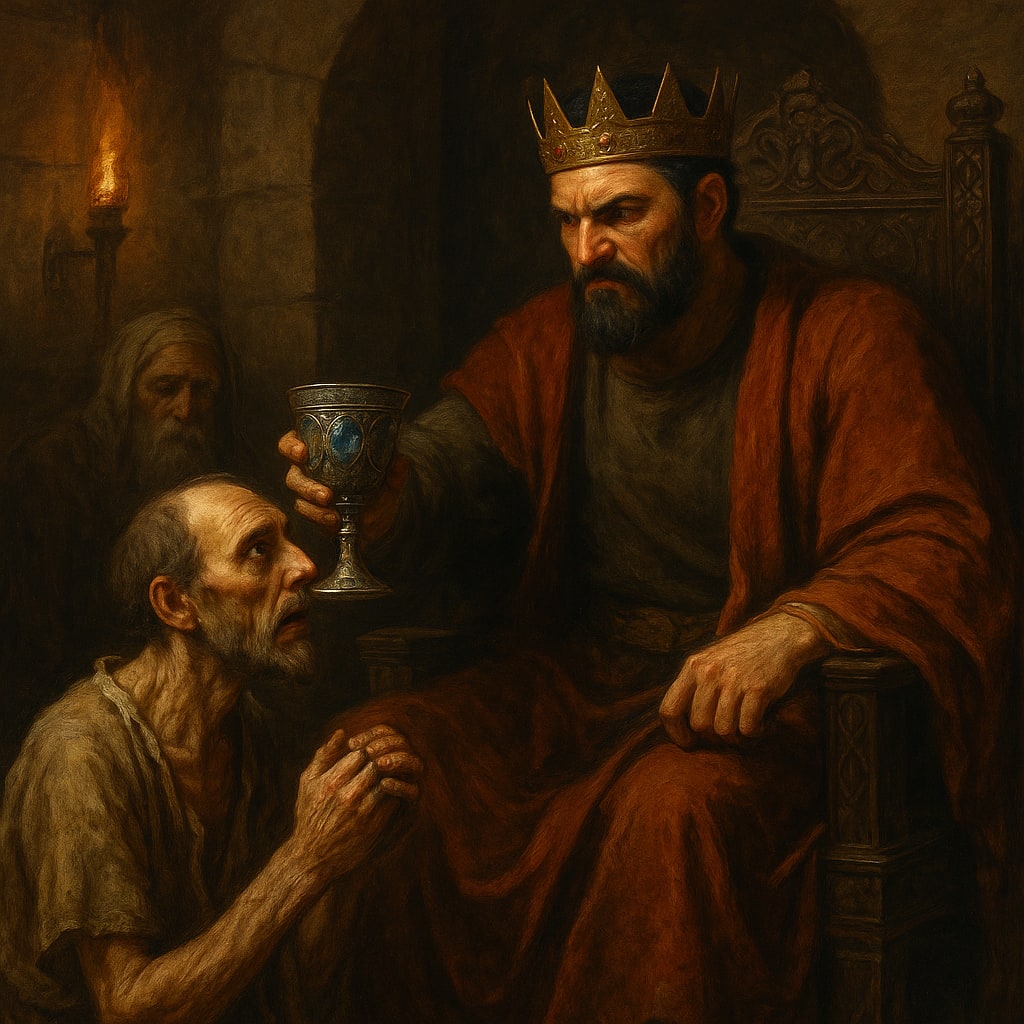
Once, in the sun-baked kingdom of Ghumra, ruled a king whose name was Gharsheed—adorned in jewels, feared by thousands, praised by poets who were whipped if they dared otherwise. The throne was carved of tusks, the court was of gold, and the prisons—of bone. Justice, in his realm, was a servant that limped. Mercy was blind, and wisdom wore shackles.
In the fifth year of Gharsheed’s reign, an earthquake struck a nearby province. A thousand souls perished. When the people came begging for aid, the king waved his hand. Not to send grain, but to shut the city gates—“For plague follows the poor,” he claimed. Thus, famine danced, and rats grew fat on the dead.
Now, Gharsheed owned a slave—Zamin, whose name meant “earth”—an orphan sold by a mother who wept not for sin, but for survival. Zamin was no ordinary servant; he listened like a shadow and remembered like stone remembers the footsteps of kings.
One twilight, Gharsheed summoned his ministers. “A new goblet shall be forged,” he said. “Let it be of sapphire and serpent bone. Let all know I drink the world’s fear as wine.” And so it was made: the Goblet of Ghumra.
It was at the feast of its unveiling—where pheasants roasted in pomegranate and slaves wore leashes of silk—that a strange man arrived. He was cloaked in ash, his beard white as moon salt, his eyes sorrowful as a widow’s womb. “I am a traveller,” he said to the guards. “A seer of things unseen.”
He was brought before the king, who laughed upon seeing his rags. “Speak, sandwalker. But if your tongue offends, I shall have it nailed to your chest.”
The traveller bowed. “O King of Flesh and Fire, I bring a gift. A story.”
The hall dimmed. Even the jesters silenced their cymbals.
“In the age before time,” said the old man, “there was a goblet, cursed by a widow who saw her sons slain by a king’s pride. This goblet, O lion of lions, grants long life—but drains the soul. It feeds the drinker with power, but eats from his peace. It shines brighter with each cruelty he commits, but poisons his blood with sorrow.”
Gharsheed laughed. “And where is this chalice of cowards?”
The old man lifted a cloth. Beneath was a twin of Gharsheed’s goblet. The room gasped.
The king’s face darkened. “You mock me with trickery.”
But the man said calmly, “Drink once, and see the truth.”
Gharsheed, in a mood both vain and vicious, took the goblet and drank.
Nothing happened. At first.
But that night, the king did not sleep. His dreams were filled with faces—burnt children, crying women, prisoners begging for water. And each night thereafter, his dreams grew louder. His food turned to ash. His harem’s perfume smelled of blood. Music sounded like weeping.
He called the best physician. “Cure me, or I’ll use your ribs for lyres!”
The physician, after examination, said: “My king, your body is sound, but your soul is ill.”
“No man can see the soul!” cried Gharsheed.
“Yet every slave can feel its weight,” said a voice behind. It was Zamin.
The king’s rage boiled. “You dare? You, son of a beggar, weigh the soul of kings?”
Zamin bowed low. “A slave weighs nothing, my lord. That is why he learns to measure everything else.”
Gharsheed ordered him whipped. And yet, every stroke that Zamin received echoed in the king’s ears as if it tore his own skin.
The nights turned colder. Gharsheed began seeing the faces of his victims in the mirrors. He smashed them all. He thought it magic, and ordered the old man found and flayed. But the old man had vanished, leaving behind only a parchment:
“He who drinks from cruelty’s cup shall find thirst unending.”
In desperation, the king offered gold to the gods, set pigeons free, and freed some prisoners. Yet the goblet glowed still. The glow grew redder with every unjust act. One day, it burned his hand.
He summoned Zamin, now healed. “What must I do?” the king whispered. “Tell me, wretch. I am ready to fall on my knees.”
Zamin looked into the king’s weary eyes and said, “Build a well where your palace stands. Feed it with your wine. Pour your riches into it. Tear the throne and let it become the footstool of orphans.”
“And then?”
“Then drink from your new cup: remorse.”
So the king obeyed. The palace became a garden. The throne was buried beneath olive trees. The prisons were opened. The goblet—he cast into the sea. And each night, he walked among the beggars and wept with them.
Years passed. Gharsheed became a man whose name faded from banners but remained on lips. He died quietly in a field among the poor, his last breath a prayer for forgiveness.
And what of Zamin? He became the scribe of the people. He wrote of justice, cruelty, and redemption. His words were iron wrapped in velvet.
Moral:
The hands that build tyranny tremble first when the ghosts knock. Power without conscience is a curse dressed in silk. But the heart that chooses repentance over revenge, though slow to rise, shall shine long after thrones crumble.
Let the kings of today sip carefully—for the goblets of pride are still forged, and curses never die.
Dear friends,
If you like the story, kindly support me!
Let me know if you want more stories like this!
About the Creator
Muhammad Abdullah
Crafting stories that ignite minds, stir souls, and challenge the ordinary. From timeless morals to chilling horror—every word has a purpose. Follow for tales that stay with you long after the last line.
Keep reading
More stories from Muhammad Abdullah and writers in Fiction and other communities.
The Perfume of the Slave
Once, in the time when kings ruled with iron fists but claimed to wear velvet gloves, there was a land called Khumyar, veiled in gold but rotting beneath. Its courtyards echoed with poetry while its prisons bled with silence. The king, Jalib the Proud, had a beard as thick as his cruelty and eyes that glistened with suspicion. His court was filled not with wise men but with flatterers dressed as philosophers. The pen was praised, but the sword decided justice.
By Muhammad Abdullah7 months ago in Fiction
The Color Thief
It was a colorless world. The gray skies of winter not the grey days themselves, but this was the place, where everything, even pleasure, had turned black and white and grey. The streets where life was once rich now lay quiet away in monotony. There were now those gardens that bloomed with reds, yellows and purples, but now lay dead, with leaves rotting to dust, and under the earth the flowers could not be differentiated. Laughter also had lost its sound, and in its place was a hollow echo, which felt as though standing right behind your ears.
By Shahd Sameh5 days ago in Fiction




Comments
There are no comments for this story
Be the first to respond and start the conversation.