

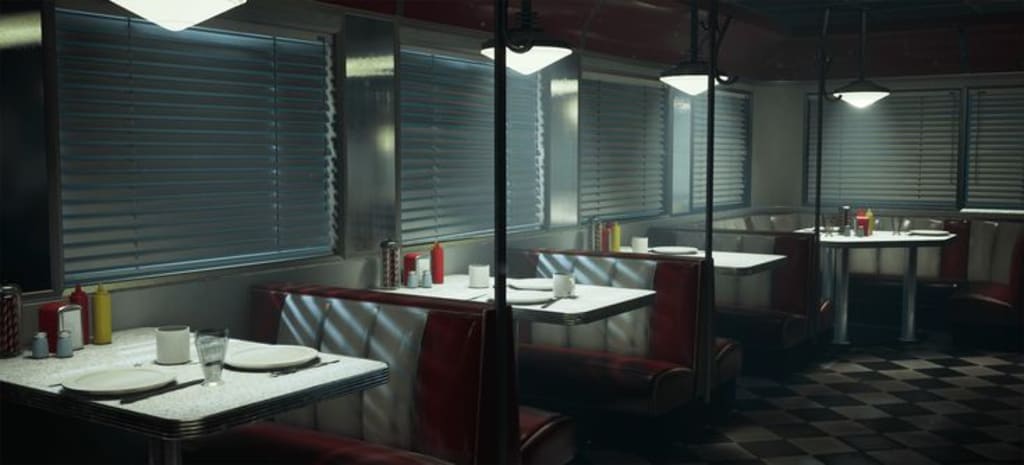
Every Sunday morning, I sit across from a man I do not know and pretend I am in love with him.
I call him Ezra. That may not be his name. I made it up the first time and he didn't correct me. I leaned into the booth at table six, smoothed my dress like I'd just come back from the restroom, and said, "Sorry I'm late." He didn't flinch. He looked up from the menu, smiled politely, and said, "You always are."
That was sixteen Sundays ago.
The diner opens at seven. We never arrive together. I walk in at 7:13 exactly. I bring a book I never read and pretend to be a woman who knows how to wait. He's already seated, coffee half-drunk, jacket on the bench beside him like a placeholder. The servers know our routine. They smile with the glazed friendliness of people who've seen too much and stopped asking questions.
I order the same thing every week: two eggs, over medium, wheat toast, no butter. He gets pancakes and asks for the syrup only when it arrives. That part is always the same. What changes is what we say. Or don't say.
Sometimes we pretend we live together. He'll ask, "Did you feed the cat before you left?" and I'll answer, "She was already on the counter when I got up." other times, we're long-distance. Or divorced. Once, we acted like we'd just met the week before and were still unsure the other had something dangerous to hide.
He never breaks the rhythm. Never calls me out. Never asks who I really am.
The first time I sat down at his booth, I didn't plan it. I saw him by the window, alone, flipping his coffee spoon between his fingers. He looked like someone I might've once known. There was an openness to his face, the kind people lose after their twenties. He didn't check his phone. He didn't even glance at the door.
He looked like someone waiting without needing a reason.
I sat down and said, "Sorry I'm late."
He said, "You always are."
I don't know where he goes after.
I don't follow him. I don't linger. When the check comes, he pays. Always. I thank him. Sometimes I touch his hand. Once, I kissed his cheek and it felt like I was trespassing on something I'd already stolen.
I never give him a name for me. He's never asked.
There are rules I made for myself:
1. Never arrive early.
2. Never ask real questions.
3. Never stay past eight thirty.
4. Never admit I'm lying.
He must have his own rules. I can feel them, even if I don't know what they are. He never touches me first. He never laughs too hard. He always sits with his back to the wall, and he never looks over his shoulder when I speak.
There is a stillness to him, like a house with all the furniture removed.
Week nine, he brought a notebook. He didn't open it. Just placed it on the table between us. It was leather-bound, well-worn, with a loop for a pen that has gone missing.
I asked, "Is that for me?"
He said, "No. It's for the version of you I haven't met yet."
I didn't ask what he meant. He didn't explain.
The next week, the notebook was gone.
Some Sundays are lighter. He talks about dreams. I describe vacations I never took. We invent children. We imagine what we'd name them. Hazel, if it's a girl. Caleb, if it's a boy. He once told me, deadpan, that our imaginary son had just learned how to lie, and I congratulated him.
Other Sundays, we barely speak. Just sit across from each other, sipping coffee, watching the steam lift and vanish. The silence between us isn't awkward. It's deliberate. Like two people digging a tunnel in opposite directions, hoping one day they'll meet in the middle.
Week twelve, someone say in our booth.
I arrived at 7:13, walked through the door, and saw two teenagers tangled together in our seat, feeding each other bites of waffle. Ezra was at the counter, waiting. He nodded once. I nodded back.
We didn't speak that day. Just sat side by side, stools too close, elbows nearly brushing. The coffee tasted colder. The air too clean.
We never spoke about it after. But from then on, he arrived earlier. Ordered something heavier. Began drawing patterns in the condensation on his glass.
That was also the first time I noticed the woman.
She sat three tables over. Tan coat. Hair too neat. Pretending to read a menu that hadn't changed in twenty years. She didn't glance at me, not directly, but I could feel her attention shift every time I did.
At first, I thought she was another customer. But the next week, she was there again. Same seat. Same coat. Same motionless eyes.
I told Ezra, "We're being watched."
He didn't look. Just sipped his coffee and said, "Not any more than usual."
Week fifteen, I broke my own rule. I arrived early.
The air outside was too still, like the world had been paused for inspection. I walked in at 6:58 and sat three tables away from ours. My heart didn't race, but something behind my ribs shifted-- like something remembered it shouldn't be there.
He came in at 7:06. Walked straight to our booth, sat down, ordered pancakes, his face didn't change.
At 7:11, she entered.
The woman, the one in the coat. She slid into my side of the booth and set a small notebook down between them. Ezra didn't react. He poured her a coffee and said something that made her smile. Her smile didn't stretch far enough.
They spoke like people who knew the same story by different names. Their mouths moved, but I couldn't hear the words. The moment looked to rehearsed to interrupt.
I left before anyone turned their head.
Week sixteen, I didn't go.
I sat outside my apartment, cross-legged on the curb, coffee in one hand, notebook in the other. I hadn't written in it yet. The pages were too smooth. Too expectant. The kind of paper that punishes wrong answers.
At 7:38, a car pulled up.
Ezra stepped out, no rush in his gait. He walked toward me, like this had always been the ending. Like he'd just finished the last page and found me again on the cover.
"You left this," he said.
He handed me the notebook.
"I didn't take it," I told him.
He smiled. "But it's still yours."
Inside the front cover, someone had copied my rules in neat, careful print:
1. Never arrive early.
2. Never ask real questions.
3. Never stay past either thirty.
4. Never admit you're lying.
But beneath them was a fifth:
5. Never fall in love.
I stared at it for a long time. My fingers felt wrong. Like they belonged to someone who had written it and then tried to forget.
Week seventeen, I brought a pen.
I wrote in small bursts. Phrases. Dreams. "Today the syrup came before the pancakes." "The cat we don't own was in the window." "She's wearing the coat again."
The entries vanished sometimes. Or rearranged themselves. Once, I found an old note in someone else's handwriting: "This isn't your first time."
The woman started following me.
Never close, never obvious, but there. I'd see her in reflections. Or in the gab between two buses. Once, I opened my mailbox and found a page from the notebook-- torn at the edge, blank on one side. The other side just read: "Don't go yet."
I stopped sleeping. Or, if I did sleep, it was just enough to dream.
One dream: I arrive at the diner and sit down, but Ezra never looks up. The notebooks is open, and everypage has my name on it. Different names. Ones I'd used before. Ones I hadn't yet.
Another: I walk into the diner and she's already there-- not the woman in the coat, but me. Smiling. Laughing. Holding his hand across the table.
When I try to sit down, they both look at me and say, "You're too early."
Week eighteen, I asked Ezra if he believed in ghosts.
He didn't pause. "Only the kind that sit across from you and smile."
"Are we haunting each other?" I asked.
"We're haunting the story," he said. "It just needed the faces."
The woman in the coat stopped sitting inside the diner.
Now she stood across the street. Always at the same angle, always looking through the window, but never reflecting in the glass. She held something in her hand. Not a phone, not a purse. It looked like another notebook. Sometimes she'd open it, look down, close it again.
I never saw her write.
Week twenty, I didn't speak at all.
ezra filled the silence. He told me about the job he used to have-- something to do with measurements, or maps, or fences. He said he used to spend his days drawing lines that didn't need to exist.
"I kept hoping one of the lines would open a door," he said. "But mostly they just made smaller rooms."
I nodded, that made sense.
The syrup arrived before the pancakes that day. He didn't notice.
That night, I opened the notebook again. One of my old entries had changed.
Where I'd written: The silence between us isn't awkward. It's deliberate.
Now it read: The silence is a practice run for vanishing.
Week twenty-one, I told him I was done.
I said I couldn't be someone with rules anymore. That I didn't want to forget which version of me was real.
He nodded slowly. He looked tired, or maybe complete.
"You're not the first to say that," he said. "But you're the first I believed."
I left the notebook on the table. The server didn't pick it up when she cleared our plates. She just glanced at it like it had always been part of the table.
That night it showed up on my pillow.
Open. A new list inside:
-Never speak her name.
-Never open the window at night.
-Never reread your own handwriting.
-Never return to table six.
-Never admit you wanted it to be real.
The last page had been torn out.
I don't know if I did it.
Week twenty-two, I walked past the diner but didn't go in.
Through the window, I saw booth six occupied. Ezra was there. And so was I.
Or-- she was. The version of me who still arrived at 7:13. Still smiled when he said, "You always are."
She wore my dress. Sat with my posture, but she laughed too easily. She looked like she believed him.
The woman in the coat wasn't across the street anymore.
I felt watched anyway.
I moved.
A different city, a new apartment. I left no forwarding address. I burned old notes. I kept the notebook closed.
For a while, it worked. Ezra become a pattern I could interrupt. I forgot what day it was on purpose.
I started drinking tea instead of coffee. I started writing things that had nothing to do with him, or her, or me.
But, then--
Yesterday, I found a key in my mailbox.
Attached to a card that read: "Booth six is still open."
There was no address. No name. No return information.
And it was.
I took a train. I don't remember boarding it. The windows were blank. I kept thinking of the last page-- the one I hadn't written. The one someone else had torn out.
What was I supposed to do with it now?
I walked into the diner. Not the same one, but close enough. The layout rhymed with the first: same booths, same counter, same click of ceramic against metal when coffee was poured.
Table six was empty. Ezra wasn't there.
But someone else was.
The woman in the coat.
She sat where I used to sit. Her hair was longer now. Her hands were folded neatly on top of a new notebook. She looked up when I approached. No smile, no surprise, only recognition.
She said, "Sorry I'm late."
I sat across from her. "You always are."
About the Creator
Shay Pelfrey
I'm a grad student just writing short stories to help fund my way through school. Each story either fuels tuition, a caffeine addiction, and maybe my sanity. Thank you all for reading!
Keep reading
More stories from Shay Pelfrey and writers in Fiction and other communities.
What We Forgot First
We didn't notice at first what was being lost. It began with little things-- how to fold bedsheets properly, how to merge into traffic with hesitating, how to whistle. An older man in my apartment stood in the elevator staring at the buttons like they were unfamiliar. When someone asked what floor he needed, he looked up, eyes glassy, and said, "That depends." We laughed. It became something to joke about, a kind of mass absent-mindedness we chalked up to stress, age, distraction. "Must be Monday," people said, tapping their temples like faulty machines. But the forgetting didn't go away, and it didn't stay small.
By Shay Pelfrey 8 months ago in Fiction



Comments
There are no comments for this story
Be the first to respond and start the conversation.