

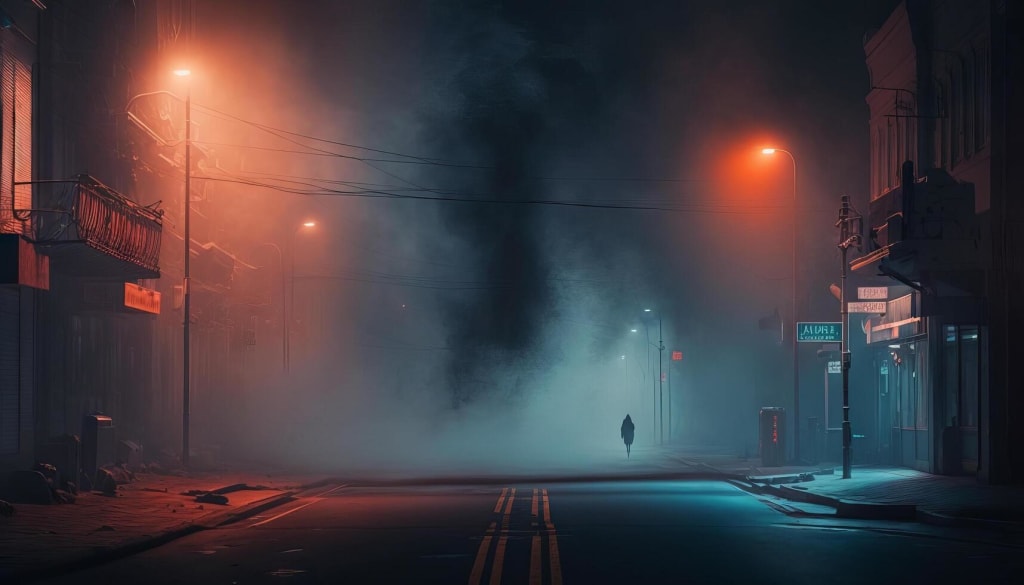
We didn't notice at first what was being lost. It began with little things-- how to fold bedsheets properly, how to merge into traffic with hesitating, how to whistle. An older man in my apartment stood in the elevator staring at the buttons like they were unfamiliar. When someone asked what floor he needed, he looked up, eyes glassy, and said, "That depends." We laughed. It became something to joke about, a kind of mass absent-mindedness we chalked up to stress, age, distraction. "Must be Monday," people said, tapping their temples like faulty machines. But the forgetting didn't go away, and it didn't stay small.
There was no siren, no emergency broadcast. The world didn't end. It just faded. Memory didn't vanish in a single gust but flaked away like old paint. Slowly, constantly. Some things went quietly-- the names of rare birds, the rules for board games, the process for handwriting a check. Others were stranger, less tangible. The concept of flavor for some. The word for longing. One day you knew what an umbrella was. The next, it was just a curved stick and fabric with no context.
My name is Eleanor Parrish. I used to teach English-- grammar, reading, syntax. I remember those words. I remember that they mattered, though not quite why. I still know how to write, how to form sentences, how to hold a pen steady between my fingers. But one afternoon, I stood in front of a class and realized I no longer knew what a student was. I remembered the shape of the word, the rhythm of it--student-- but not its purpose. Not its gravity. The letters became untethered.
Stood-ent.
Sound it.
Stunned end.
I stared at the board I'd just written on and could no longer understand the sentence. The lesson was still in my hand, but it no longer meant anything.
I think that's the part that scared us most. Not just forgetting facts-- but losing the why. We could still say a word, describe as action, but the root was gone. The reason things had once mattered slipped beneath floorboards. I knew how to correct a sentence. I could parse a clause. But I no longer understood who it was for. What it changed.
People began carrying notebooks everywhere, writing down the names of people they lived, the steps to boil rice, the feel of wind across their face. Some taped instructions to their walls like messages to future versions of themselves-- Turn knob left. This opens out. Children turned memory into games: "What's the thing you sit on but not in?" "What color is between red and yellow?" The more we tried to preserve things, the faster they seemed to drift.
I still write every day. It grounds me, though I rarely reread what I've written. The older entries don't feel like mine anymore. I've filled thirteen notebooks by now. Most of the entries are brief: Today I remembered I once played the cello. Today I remembered apples used to taste sharper. Today I remembered someone I loved but then forgot the sound of their name. The next day, I forget again.
The school let me go gently, with the kind of bureaucratic mercy that stings more than cruelty. I remember the principal's voice-- warm, apologetic. "We can't have you in the classroom, Eleanor. You're forgetting things." I'd known it was coming. I'd seen the blank stares of my students-- those strange, wordless shapes I couldn't quite define. I understood the structure of my work but not the heart of it. When they took away my keys, I felt nothing but relief. Like something heavy had been lifted, even as something vital drained away.
Now I live alone in a quiet building. The city hasn't collapsed-- there's no smoke, no screaming. But there's less of everything. Fewer cars, fewer open stores. The shelves at the grocery store are full, but the labels are gone. People hold things up to their noses, trying to identify what they use to love. I once watched a woman stand in front of the tea aisle with tears in her eyes. She held a tin to her chest and whispered, "I used to know what this did to me."
Some people tried to make systems. Classification trees. Urgency lists. One online community began cataloging all remembered knowledge my priority: Keep breathing. Eat. Move towards warmth. Someone else created an audio archive of remembered stories and syllables, a kind of oral time capsule. One man built a virtual cathedral of lost words-- you could wander through it like a museum, hovering over terms that glowed and blinked: lullaby, beehive, hourglass, parade. I remember the day it went offline. I don't remember the words I saw last.
There's a child in the building-- maybe six, maybe older. She lives two floors down and never speaks. I don't know her name. I've never seen her with parents. She draws on the sidewalk in chalk every morning: shapes that look like animals with too many eyes or alphabets I don't recognize. She always waves to me. I wave back.
She left a note under my door last week. It was a drawing of a figure standing under a sky filled with circles. I didn't understand it at first. Then I realized-- it was the moon. She remembered the moon. Or remembered remembering it. That night, I sat on the floor and cried for a long time, notebook open in my lap, pen idle.
Yesterday, I forgot how to tie my shoes. I sat at the edge of my bed, laces in my hands, and wept like a child. I knew there was a loop, a pattern, a pulling-through. But my fingers betrayed me. The memory was hollow. Eventually, I wore sandals.
The child drew something new today. A door with two figures standing beside it, holding something glowing between them. I couldn't tell what it was. Maybe a lantern. Maybe a word. Maybe something sacred. Whatever it was, I knew I had once held it, too.
I imagine there's a threshold. A moment when enough is forgotten that we stop noticing the forgetting. When the ache stops and the drift becomes natural. Like slipping into warm water. The weight of knowing dissolves. What remains is only instinct, breath, the need to be near another body.
But there are still days when the ache is sharp. I miss the shape of things-- of certainty, of language, of ritual. I miss being able to tell someone, You matter, and here's why. I want to remember the word for that.
Tonight, I stood by the window and tried to recall the stars. I couldn't name, but I remembered how they looked in winter: like holes punched through black silk. The child stood on the sidewalk, looking up. She pointed at nothing.
And still, she smiled.
And still, I smiled back.
About the Creator
Shay Pelfrey
I'm a grad student just writing short stories to help fund my way through school. Each story either fuels tuition, a caffeine addiction, and maybe my sanity. Thank you all for reading!
Keep reading
More stories from Shay Pelfrey and writers in Fiction and other communities.
9:52
by Leslie L. Stevens 9:52 PM. Jessica bounced into the kitchen like she owned it. Ponytail swinging, sneakers squeaking, still high off sixty bucks in tips and a full week of crushing it. Her tables were clean. Her section was empty. Her stomach was growling.
By Leslie L. Stevens Writer | Marfa, Texasabout 8 hours ago in Fiction


Comments
There are no comments for this story
Be the first to respond and start the conversation.