
Return to Sender
She wrote fake letters to herself — until one came back with the truth she tried to forget.
Return to Sender
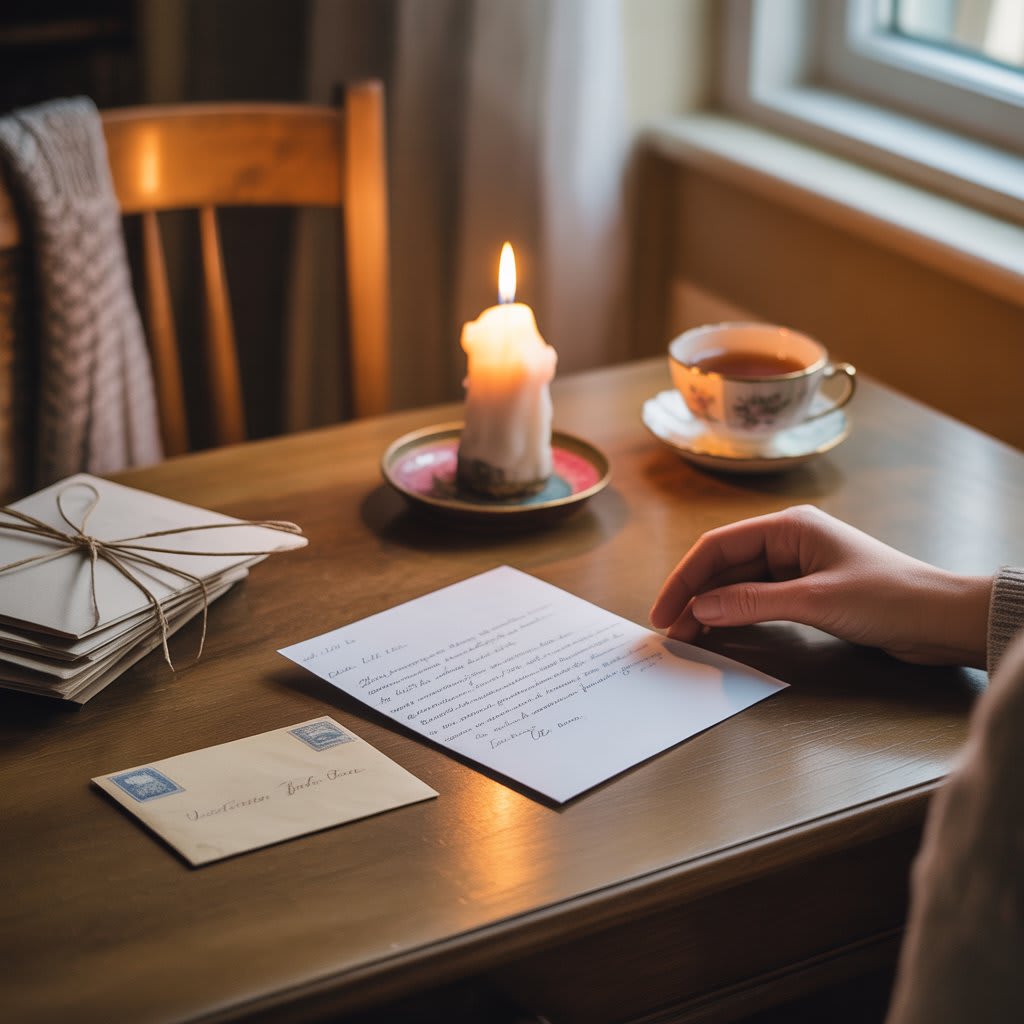
The first letter she ever wrote to herself was addressed from Florence.
She chose Florence not for any particular reason, only that it sounded poetic — a place where people painted sunsets and ate lemon gelato on cobblestone streets. It was the kind of place someone might write from when they were happy.
She sealed the letter in cream stationery, wrote her own name in delicate cursive, and dropped it quietly into the outgoing mail bin after her shift ended.
No one at the office questioned her. Why would they? Margaret had worked for the Forest Hill Post Office for eleven years, sorting thousands of letters, stacking them in bins, memorizing zip codes, and taping down packages that whined about fragile contents.
To most people, she was invisible — dependable, quiet, punctual.
And lonely.
The first fake letter read simply:
Dear Margaret,
The sky here looks like melted peaches tonight. I thought of you.
I hope you’re still taking your tea with honey and reading poetry in bed.
Yours always,
C.
She had cried when she read it, even though she had written every word herself.
Soon, writing letters became a ritual.
Paris, Vienna, Mumbai — each return address a different piece of her imagined life.
She’d mail them from the far corner of town so the stamps and postmarks looked real.
She even gave her ghost writer a name: Clara.
Clara was everything Margaret wasn’t — bold, charming, alive. Clara told Margaret she was missed, remembered, even loved. Margaret would open each envelope slowly, as if unwrapping a long-lost piece of herself.
No one knew.
Until the day she received a letter she didn’t write.
It arrived on a rainy Tuesday, nestled between an electricity bill and a flyer for frozen meat.
It was cream-colored, her name on it, handwritten — but not in her handwriting. The return address was smeared from the rain.
Inside was a single sheet of paper.
Dear Margaret,
I know what you’re doing.
And I know why.
You are not invisible.
I see you.
– A friend
Her breath caught in her throat.
She turned the envelope over again. No return address. No markings. Nothing to tell her who had sent it. Her mind ran wild — a coworker? A neighbor? Someone who had seen her drop a letter into the mail slot and put the pieces together?
Her hands shook as she reread it.
I know what you’re doing. And I know why.
The letter felt less like an accusation, more like… recognition.
Over the next week, no more letters came.
She considered stopping altogether. Burning the stack of old ones. Throwing Clara back into the void she came from.
But by Friday, she wrote again.
This time, not as Clara.
This time, as herself.
Dear Friend,
If you see me, then maybe I won’t disappear.
I write because silence is too loud. Because some nights, I forget what my own voice sounds like.
Who are you?
Why me?
Yours,
Margaret
She mailed it anonymously, scribbling “To the One Who Wrote” on the envelope.
Two days later, a reply came.
Margaret,
I used to sort letters too. Long ago.
I know the ache of watching the world move past you, while you remain still in the fluorescent buzz of routine.
I recognized the handwriting.
Not yours.
Clara’s.
I had a Clara once, too.
Margaret held the letter close to her chest that night, heart thudding like a held breath.
The letters continued.
No names. No promises.
Just two lonely souls, scribbling toward each other through an invisible thread. They shared everything and nothing — favorite poems, childhood secrets, the way loneliness can feel heavier than grief.
Sometimes she’d laugh reading them. Sometimes she’d cry. But mostly, she felt seen — not as a machine processing mail, but as a person with a story still unfolding.
One day, a final letter arrived.
It was shorter than the others.
Margaret,
This will be my last.
I’m going somewhere I need to go — a place I haven’t dared to visit in decades.
Not Florence or Paris.
But home.
Thank you for giving me the courage.
Yours,
A.
She folded the letter carefully and placed it in the same box where she kept all the others — labeled Not Sent, But Received.
Margaret never wrote fake letters again.
But she did start writing real ones — to friends, old teachers, even herself on occasion.
She started baking again. Volunteering at the community center. Smiling at people in the grocery store.
She didn’t know who “A” really was.
But maybe that didn’t matter.
Some connections don’t need names to be real.
Some stories don’t need endings — just someone willing to write them.
About the Creator
Azmat
𝖆 𝖕𝖗𝖔𝖋𝖊𝖘𝖘𝖎𝖔𝖓𝖆𝖑 𝖘𝖙𝖔𝖗𝖎𝖊𝖘 𝖈𝖗𝖊𝖆𝖙𝖔𝖗
So You Decided To Become a Nurse Practitioner:
So you decided to become an "Advanced Practice" nurse. Congratulations!... is what I would say if this was a good idea. Grad school? In this economy? What were you thinking? Likely it was something along the lines of either 1) “I've seen these other chucklefucks do it— Why can't I?” or even 2) “I've got a nice career, I should shake it up. I miss feeling like I have no clue what I'm doing.”
By Sandor Szabo6 days ago in Fiction



Comments
There are no comments for this story
Be the first to respond and start the conversation.