
Plato’s Allegory of the Cave — A Symbolic Story
From Shadows to Sunlight: Understanding Plato’s Vision of Truth"

Once upon a time...
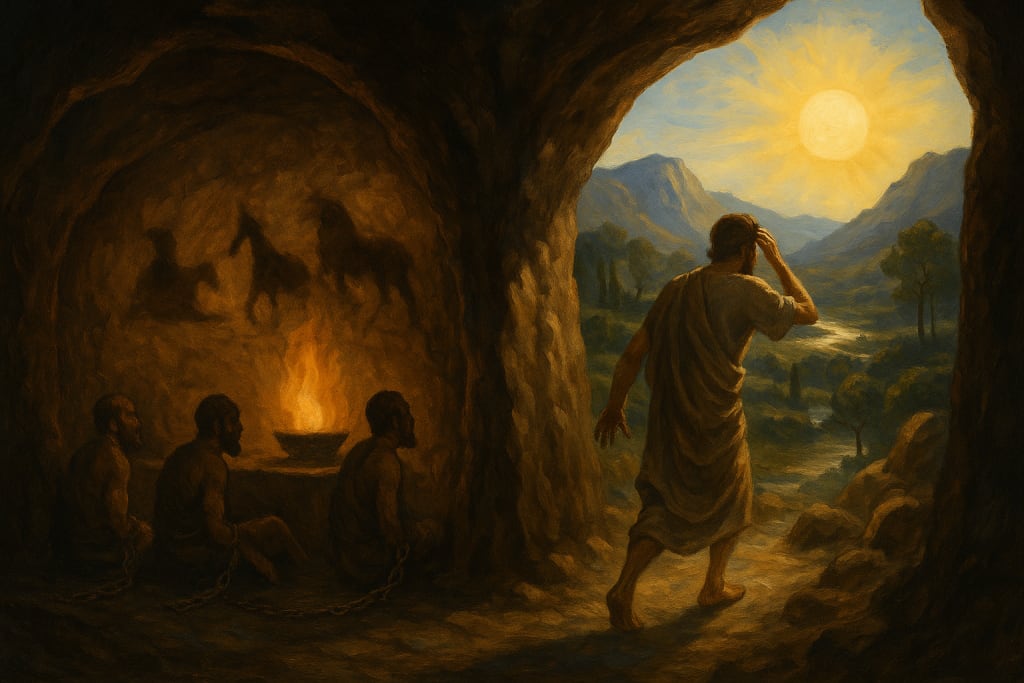
In a dark, narrow, and enclosed cave, some people had been imprisoned since childhood. Their hands, feet, and necks were tightly chained. They could only face and look at the wall in front of them. Their bodies were fixed in such a way that they couldn’t turn around, couldn’t move from their place, and couldn’t even close their eyes. For them, that wall, the shadows on it, and the darkness around were the entire meaning of life.
Behind these prisoners, on a higher platform, a fire was burning. Between the fire and the prisoners was a path, and on that path, people would pass by carrying various objects — statues, shapes of trees, cut-outs of animals, figures of humans, and more. The light of the fire would cast shadows of these objects on the cave wall — the same wall the prisoners were facing.
Since the prisoners could only see what was in front of them, they believed the shadows were real. They would talk about these shadows, give them names, and treat them as truth. If a shadow changed, they were surprised. If a new shadow appeared, they tried to interpret it. Their entire life, knowledge, and reality were based on those shadows.
---
The Release of One Prisoner
One day, one of the prisoners was freed. Slowly, he stood up and turned around for the first time in his life. But what he saw was unbearable.
His eyes couldn’t handle the bright light. He saw the fire, and the people carrying objects. His mind rejected this instantly — “This is all fake! The real world is the one I’ve always seen — the shadows!”
But over time, he began to adjust. He started to understand that the shadows were not the truth. They were just illusions created by objects between the fire and the wall. What he had accepted as reality his whole life — was in fact a deception, a distortion of something else.
---
Stepping Outside the Cave
Then, he moved toward the outside of the cave.
As he stepped out, the sunlight blinded him. He couldn’t see anything clearly. But slowly, his eyes adapted to the brightness. Now, he saw the blue sky, high mountains, flowing rivers, lush green trees, animals, and walking humans.
It was all new and strange for him, but eventually, he understood — this is the real world — vast, bright, and beautiful. Far more truthful and meaningful than the dark cave and its shadows.
He thought: “What use is this truth if I live it alone? I must go back and tell the others. They deserve to know this reality too.”
---
Returning to the Cave
He returned to the cave. Now that he had adapted to the light, the darkness of the cave felt overwhelming again. The other prisoners looked at him strangely. His words, his expressions, his presence — everything felt different to them.
When he told them:
> "What you're seeing — those shadows — they are not real! I have seen the outside world. There's a whole different reality — bigger, brighter, and true!"
The prisoners laughed at him. They mocked him. Some said:
> "What nonsense! We've seen these shadows all our lives. They are real. You’ve clearly gone mad out there!"
Some were even angry. They said:
> "If you try to free us, we will kill you!"
And that’s exactly what happened. The prisoners beat him to death — just because he tried to reveal the truth and pull them out of ignorance.
---
The Meaning of the Allegory
Through this story, Plato tries to explain a deep philosophical truth:
Element Symbolism
The Cave Our ignorance, closed-mindedness, and limited perception
Chains Mental confinement, social pressures, and blind acceptance
Shadows Partial or false knowledge, manipulated truths, illusions
Fire A limited source of light, representing narrow or superficial understanding
The freed prisoner One who gains awareness, questions reality, seeks truth
The outside world True reality, enlightenment, knowledge, and awareness
The Sun The ultimate source of truth, wisdom, and possibly the divine
Returning to the cave The reformer, teacher, or philosopher trying to help others
Being killed The rejection, resistance, or persecution of truth-seekers
---
In Today’s Context
News that is selectively shown, filtered social media, propaganda — are like shadows on the cave wall.
An education system that doesn't allow critical thinking — is like the chains that bind us.
Those who challenge the norm, who ask questions and seek truth — are like the freed prisoner.
---
Conclusion
Plato’s allegory teaches us that the path to truth is difficult. Often, it is painful, uncomfortable, and even dangerous. But despite the challenges, truth gives life real meaning.
> "The price of speaking truth may be your life — but the light of truth is more powerful than all the darkness in the world."
About the Creator
How, Too
Many people wonder how, too. You are not alone, and I am an expert. I will teach you how, too! First, you need to remit a small application fee and fill out an application describing the nature of your financial situation and how often payments will be made, as this will have great bearing on how well I teach you how, too.
By Harper Lewis3 days ago in Fiction
Him
Him. An unsuspecting commuter on an A-train... he sits gazing out the window, immersed in the view, seeing beyond a world of art which whizzes by as the landscape undulates, ebbs and flows. There is a surreal, dreamlike and beautiful view of nature beyond the window, where bamboo stalks grow impossibly tall, reaching towards a sky painted in the swirling, vibrant colors of a Baroque masterpiece. The interior of the train is dimly lit, casting long shadows. The peace it exudes evokes a painterly illustration with dramatic bright and dark lighting filled with rich textures.
By Antoni De'Leon3 days ago in Fiction



Comments
There are no comments for this story
Be the first to respond and start the conversation.