
“Shadows, Gunfire, and Silence” — A True Story from Balochistan
When Childhood Meets Conflict: The Human Cost of a Forgotten War"

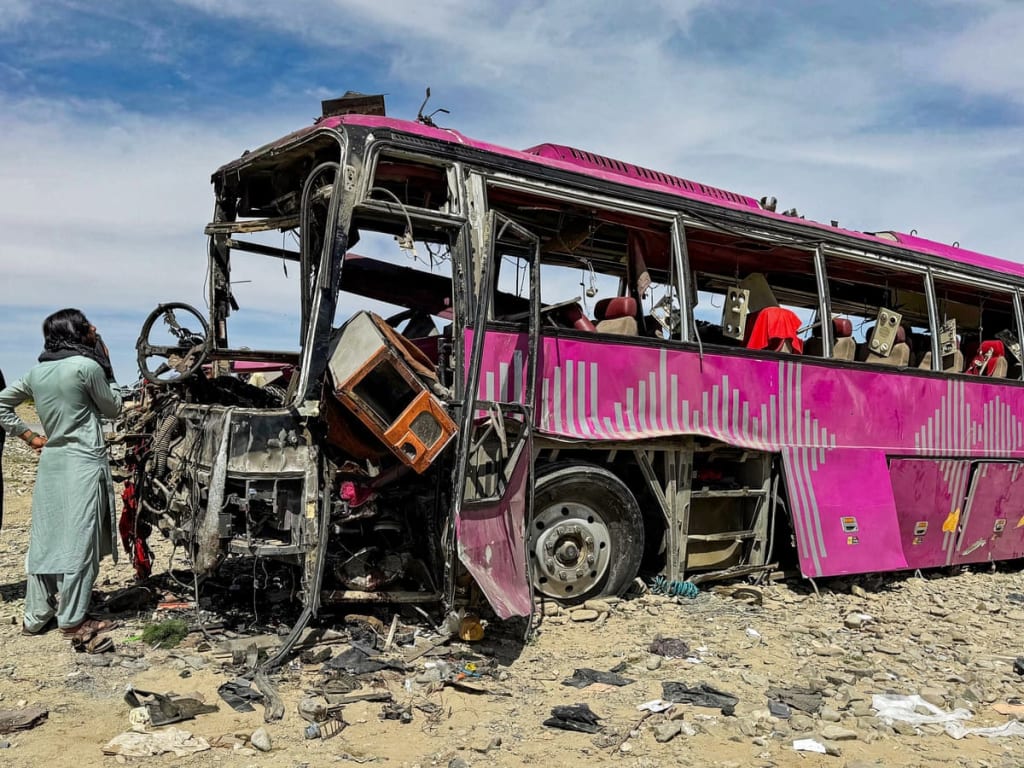
Balochistan — a land of harsh mountains, poetry, and proud traditions — has, for decades, been caught in the crossfire of politics, nationalism, and war. Among the countless stories lost in the dust and smoke, this one belongs to Ayaan, a 12-year-old boy from Khuzdar, and his 8-year-old sister, Meher.
■ The Morning of Fire – Khuzdar, May 21, 2025
It was a clear morning. The sun climbed slowly over the jagged hills of Khuzdar, bathing the town in golden light. Ayaan stood at the gate of his house, holding his little sister’s hand. Both wore crisp school uniforms — Meher’s ponytail bouncing as she skipped.
"I studied so hard for my science test," Ayaan whispered, clutching his notebook.
"I made a butterfly drawing for my teacher," Meher grinned, her voice like music.
Their mother kissed them goodbye and waved as the yellow school bus arrived.
Fifteen minutes later, the calm of the city was shattered by a thunderous explosion.
A suicide bomber riding a motorcycle packed with explosives rammed into the school bus near Zero Point. The blast ripped through metal and flesh, flames engulfing the vehicle in seconds. Shattered glass, screams, and chaos filled the air.
Ten people were killed instantly, including five children.
Fifty-three others were injured, most of them schoolchildren.
Emergency sirens wailed, and bloodied books and shoes lay scattered on the road.
Ayaan was found unconscious under a seat, his leg mangled.
But Meher was gone. Only her schoolbag was found hanging from a burned tree nearby.
---
■ The Hijacked Train – March 11, 2025
Two months earlier, tragedy had struck in another form. The Jaffar Express, running from Quetta to Peshawar, was traveling through the scenic but volatile Bolan Pass when 33 armed militants, linked to the Baloch Liberation Army (BLA), stormed aboard.
They took 380 passengers hostage — men, women, children, even elderly travelers.
One militant shouted:
> “Release our imprisoned brothers, or the train becomes a grave!”
Days passed. The train sat motionless in the wilderness. Food ran out. Heat soared. Hope vanished.
On the third day, the military launched Operation Green Bolan — an intense rescue operation involving helicopters and ground forces.
Gunfire echoed through the mountains. Explosions lit up the sky. When the dust settled, 77 people were dead:
33 militants, 18 soldiers, and 26 innocent civilians — victims of a battle they never asked to be part of.
---
■ The Flame Spreads – Mastung, April 15
In Mastung, a routine police convoy was traveling through a narrow street when a motorcycle packed with a remote-controlled IED exploded beside a police bus.
Three officers died, and more than 20 were injured.
The terrorist group ISIS-Khorasan claimed responsibility, exposing how Balochistan had become a battleground for not just separatist movements, but global terror networks.
---
■ The Storm Called Operation Baam – July 9–11
Just weeks after the Khuzdar blast, an unprecedented wave of coordinated insurgent attacks swept across Panjgur, Kech, Surab, and Kharan.
The Baloch Liberation Front (BLF) launched Operation Baam — a terrifying series of 17 assaults on military checkpoints, telecom towers, and patrols.
Over 50 soldiers were killed in 48 hours.
Balochistan had become a theatre of open rebellion.
---
■ The Boy Who Survived
Back in Khuzdar, Ayaan lay in a hospital bed. His leg was broken in three places. A steel rod had been inserted. Bandages wrapped his head.
He hadn’t spoken since waking up.
Every day, his mother sat by his side, silently praying. His father stood at the window, holding back tears. No one had the heart to tell Ayaan that Meher hadn’t made it.
One evening, Ayaan finally whispered,
> “Mama... when can we go back to school?”
His mother’s heart shattered again. How could she answer? In Balochistan, even schools were no longer safe.
---
■ A Land Bleeding Quietly
Across the province, checkpoints lined roads. Helicopters hovered above villages. The government spoke of foreign conspiracies — blaming India, Iran, the West, even Afghan groups.
But in the silence between bombings, the people of Balochistan whispered the truth:
> “We are not enemies. We are the forgotten.”
Markets remained half-empty. Teachers were afraid to teach. Children carried fear heavier than their backpacks.
Ayaan returned home two months later. He limped, but he walked.
His mother placed Meher’s photograph on his study desk — her smile forever frozen in a moment before fire.
---
Epilogue: The Dream That Lives
On August 14, Pakistan’s Independence Day, a small ceremony was held in Khuzdar. Flags waved. Speeches were made. But Ayaan stood silently, holding a candle.
He wasn’t thinking about politics or borders. He was thinking about Meher. About buses, books, and butterflies.
He was thinking about peace —
a peace that didn’t wear boots or carry guns.
A peace where children lived long enough to grow up.
About the Creator
Miss Persephone's Manual to a Seemingly Ordinary Life
Miss Persephone was found at the dining table, her blue eyes swollen, her tears arriving and retreating like the tides of the ocean. Earlier that day, her family had visited her in the retirement home where she had lived for eight years. It was her eightieth birthday.
By Imola Tóth5 days ago in Fiction
Breakfast
The room was like any I had seen on any episode of Law and Order or other police procedural. They invited me here, said it was voluntary, but I knew it was not. After a while, I lost all track of time. I dozed off and then woke with a start. I’d read somewhere that Thomas Edison slept for an hour or two at a time, around the clock. Not much different from my own bouts insomnia.
By Mindy Reed4 days ago in Fiction


Comments
There are no comments for this story
Be the first to respond and start the conversation.