
Njabiya Bate: The Man with Horns on His Head
"A Tale of Mystery, Wisdom, and the Man Who Wore the Forest’s Secrets on His Head"

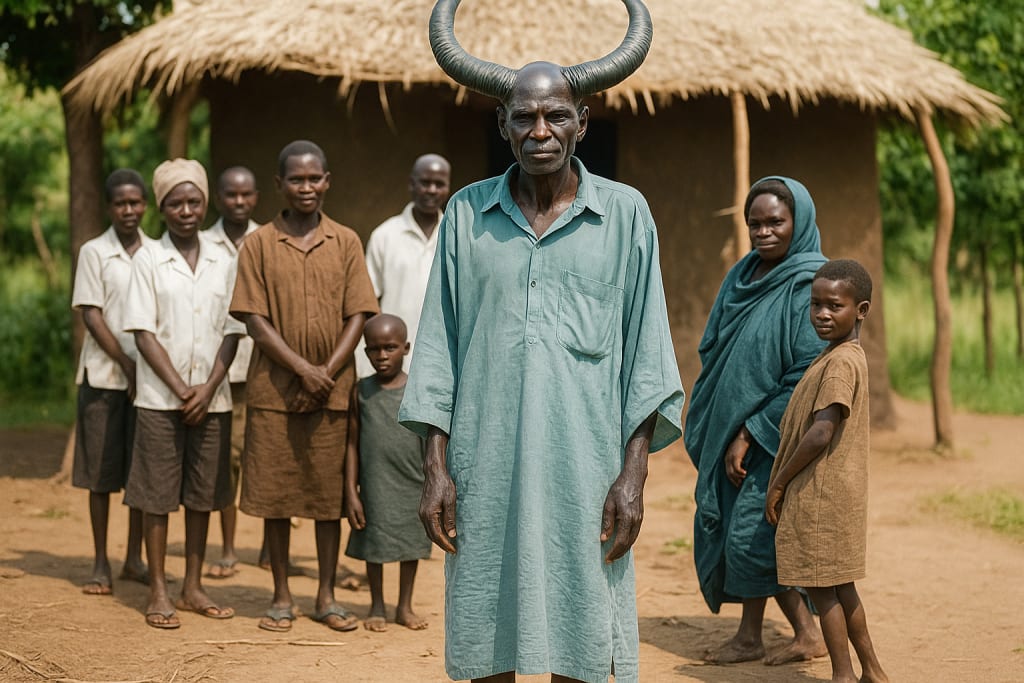
Njabiya Bate: The Man with Horns on His Head
Written by: Kashif Ali
On a sweltering afternoon in the summer of 1934, an English anthropologist and field researcher named Ghost Freeman made his way through the thick forests of Central Africa. His destination was Fiang, a secluded village nestled deep in the Mayo-Kebbi region of Chad. Freeman had traveled thousands of miles, not to study landscapes or wildlife, but to investigate a story so strange, it seemed to belong more to legend than science.
Whispers from hunters, missionaries, and traders had carried the tale: somewhere in the dense wilderness lived a man whose head bore horns—not decorative or symbolic, but actual, natural protrusions growing from his skull.
Most dismissed it as a tribal myth or exaggerated superstition. But something about the tale compelled Freeman to follow its trail. He wasn’t chasing spectacle—he was searching for truth hidden in myth.
When Freeman finally reached Fiang, he encountered a community deeply rooted in tradition, wary of outsiders and protective of their stories. It took weeks of careful observation, respectful conversation, and quiet patience before the locals began to open up. They spoke of a man who lived on the outskirts of their settlement, someone rarely seen and never spoken to directly.
His name was Njabiya Bate.
👤 A Conscious Being from an Isolated World
To the villagers, Njabiya Bate was a paradox—feared and revered in equal measure. Some believed he was a divine curse, others swore he was a spirit guardian of the forest. The reason? From the top of his head rose two solid, bony horns, not unlike those seen in animals. They weren’t surgically implanted or worn as ornaments—they were a part of him.
Children were told not to stare. Adults offered prayers before approaching the areas Njabiya was known to walk. He wasn’t just a man—he had become myth in living form.
But when Freeman finally met him, he found no monster, no madman, no mystic. He found a man of quiet dignity and profound depth.
Njabiya spoke softly, as though each word had weight. He lived alone in a small wooden hut at the edge of the jungle. His days were spent in study—not of books, but of nature. Plants, trees, birds, insects—he knew them all intimately. He had no formal education, yet spoke with the wisdom of a scholar. Freeman would later write that "Njabiya Bate was not merely unusual—he was enlightened."
🌿 Nature’s Doctor
Though isolated, Njabiya wasn’t indifferent to the suffering of others. People in the village, despite their fear, often left offerings or sought healing from him—quietly, from a distance. Njabiya had an almost mystical understanding of herbal medicine. He created salves for burns, infusions for fevers, poultices for infections, and pastes that could numb the pain of snake bites.
To Freeman, this was more than primitive folk medicine—it was refined knowledge, passed down through observation, instinct, and communion with the land.
Njabiya once told him:
"If nature gives wounds, it also gives the cure. You just need ears to listen and eyes that understand."
He didn’t just treat illness; he restored balance—between body, spirit, and the world around.
🔬 Freeman’s Discovery
Fascinated, Ghost Freeman meticulously recorded every detail—Njabiya’s lifestyle, his remedies, and of course, the horns. He took measurements, photographs, and even collected samples of Njabiya’s herbal concoctions. When Freeman returned to England, he published a detailed article in a prominent British scientific journal.
The response was electric.
Could a human truly grow horns? Was this a case of cutaneous horns, a rare keratin growth condition? Or was it a completely unknown genetic mutation? Some believed it was a hoax. Others saw it as a breakthrough in understanding rare human anomalies.
But what lingered with readers—what stayed with Freeman most—was not the biology, but the philosophy.
Here was a man who, though cast out by society, chose compassion. Though feared for his appearance, chose healing over hatred. Njabiya lived not to curse his fate, but to make peace with it.
📖 Conclusion
Njabiya Bate was far more than a medical curiosity. He was a living reminder that wisdom can wear strange faces, and that sometimes, the ones who dwell on the margins of our world see the heart of it most clearly.
We often label the unusual as dangerous, the different as monstrous. But Njabiya taught that what appears unnatural may in fact be closer to truth than we can comprehend.
And perhaps, even now, as the wind weaves through the trees of the Chadian jungle, his voice still echoes:
"I’m not the man with horns—I’m the man with knowledge."
About the Creator
Furqan Elahi
Writer of quiet thoughts in a loud world.
I believe stories can heal, words can build bridges, and silence is sometimes the loudest truth. On Vocal, I write to make sense of the unseen and give voice to the unsaid.
Keep reading
More stories from Furqan Elahi and writers in Fiction and other communities.
The Shadow in the Mirror
The Shadow in the Mirror I first noticed the shadow in the mirror when I was eleven. It was a rainy Tuesday — one of those afternoons where the sky sulks, and the wind whistles secrets between windowsills. I was brushing my teeth when something flickered in the corner of the bathroom mirror. I turned around, fast. Nothing there.
By Furqan Elahi7 months ago in Fiction
Miss Persephone's Manual to a Seemingly Ordinary Life
Miss Persephone was found at the dining table, her blue eyes swollen, her tears arriving and retreating like the tides of the ocean. Earlier that day, her family had visited her in the retirement home where she had lived for eight years. It was her eightieth birthday.
By Imola Tóth3 days ago in Fiction
Silver Screen Magic with Mae West
American actress and singer Mae West became a popular film actress during the Great Depression. She started entertaining in vaudeville, then performed on Broadway, and finally went to Hollywood. She signed up with Paramount Pictures and made her debut in the 1932 film “Night After Night.” She also starred in musicals, comedies, and crime dramas. The American Film Institute named her one of the best classic Hollywood actresses.
By Rasma Raisters5 days ago in Geeks


Comments
There are no comments for this story
Be the first to respond and start the conversation.