

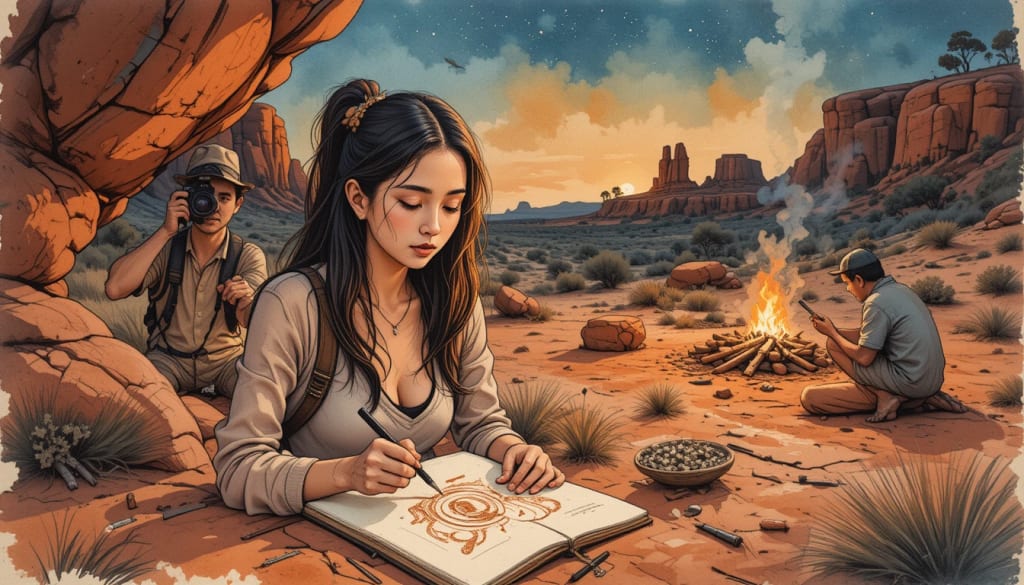
In the sun-scorched outback of Alice Springs, Australia, in the autumn of 2025, the red earth whispered tales of endurance and renewal. For 29-year-old Mira, a disillusioned archaeologist turned tour guide, the desert was both a refuge and a reminder of dreams left buried. Her story, etched in the dust of ancient lands and sparked by an unlikely friendship, unfolded under a sky vast enough to hold new possibilities. This is the tale of Mira’s rediscovery of herself, kindled by the fires of the past and the promise of a new future.
Mira had come to Alice Springs three years ago, fleeing a life in Sydney that had crumbled under the weight of ambition and betrayal. As an archaeologist, she’d once thrived on uncovering Aboriginal rock art and tools, each find a thread to Australia’s deep history. But a fallout with her mentor, who took credit for her research, and a failed engagement left her hollow. She traded her trowel for a tour guide’s hat, leading tourists through Uluru and the MacDonnell Ranges, her knowledge sharp but her passion dulled. The outback, with its stark beauty and ancient pulse, offered a chance to start anew, though Mira wasn’t sure what that meant.
Her days were spent guiding groups through the desert’s ochre landscapes, her voice steady as she spoke of Dreamtime stories and geological wonders. At night, she retreated to a small caravan on the town’s edge, its walls lined with sketches of artifacts she’d once studied. Her only solace was the stars, their clarity a balm for her restless heart. Mira felt stuck, her life a loop of trails and tales, until a new face joined her tour and set her world alight.
Jalen, a 32-year-old Canadian photographer with a weathered camera and a quick grin, arrived in Alice Springs chasing a story for a travel magazine. His assignment was to capture the outback’s soul, but his curiosity went beyond the lens. On Mira’s tour to Standley Chasm, he lingered at the rock faces, asking about petroglyphs and their makers. “You talk like you’re part of this land,” he said, his hazel eyes meeting hers. Mira shrugged, deflecting, but Jalen’s genuine interest stirred a forgotten spark. His questions—about culture, history, her own story—felt like a call to wake up.
Their connection grew over the week. Jalen joined every tour Mira led, his camera clicking as she spoke of the Arrernte people’s lore or the desert’s fossilized past. After hours, they shared beers at a local pub, the air thick with eucalyptus and laughter. Jalen told her of his travels—Patagonia’s glaciers, Morocco’s souks—and his dream to document indigenous stories globally. Mira, hesitant, shared fragments of her past: her love for archaeology, her betrayal, her fear of dreaming again. “The desert’s good at hiding things,” she said, tracing a circle in the dust. Jalen leaned closer. “It’s also good at revealing them.”A chance discovery shifted everything. On a tour to Emily Gap, Mira noticed a faint etching on a rock face, half-hidden by sand—a petroglyph she’d never seen, depicting a kangaroo and stars. Her archaeologist’s instincts flared; it could be significant, possibly undocumented. Jalen, sensing her excitement, offered to help photograph it, his skills perfect for preserving the find. Mira hesitated—reporting it meant re-entering a world that had hurt her—but Jalen’s encouragement, and the memory of her younger self’s passion, pushed her forward. They agreed to investigate quietly, respecting the site’s cultural sensitivity.
Their quest drew them closer to the Arrernte community. Mira sought permission from elder Aunty Noreen, a keeper of local stories, to study the petroglyph. Noreen, with her warm eyes and weathered hands, saw Mira’s respect for the land. “You listen to the country,” she said, granting access but urging care. Noreen’s grandson, Kai, a 19-year-old artist with a knack for carving, joined them, his knowledge of the land grounding their work. Together, they documented the site, Mira’s notes meticulous, Jalen’s photos vivid, and Kai’s insights weaving cultural context.
The process was arduous—scorching days, dusty nights, and the weight of responsibility. Mira grappled with self-doubt, fearing her find wouldn’t matter. Jalen, ever steady, shared his own vulnerability—a failed project that cost him a grant, teaching him to try again. “This is your spark,” he told her, his hand brushing hers as they studied a photo. Kai, too, opened up, revealing his dream to study art but his fear of leaving the community. Their shared vulnerabilities forged a bond, each of them chasing a new horizon.
A storm threatened their work, rain rare but fierce in the outback. The petroglyph risked erosion, forcing Mira to decide: alert authorities now or lose the site. She contacted her old university, risking exposure to her former mentor. The response was swift—an archaeologist, Dr. Ellis, arrived, praising Mira’s find as a rare Arrernte star map, potentially 10,000 years old. To Mira’s surprise, Ellis offered her a role on the research team, acknowledging her past work. The validation, coupled with Noreen’s blessing, felt like a new chapter opening.
The discovery drew attention. Jalen’s photos, published with Mira’s permission, went viral, sparking global interest in Arrernte culture. Kai’s carvings, inspired by the petroglyph, sold at a local gallery, funding his art studies. But success brought tension—Mira’s mentor tried to claim partial credit, stirring old wounds. Jalen and Kai rallied her, and Mira confronted him, her voice firm. “This is mine,” she said, reclaiming her work. The victory was quiet but profound, a spark reignited in the dust.
One evening, under a sky ablaze with stars, Jalen took Mira to the petroglyph site. He’d set up a small fire, its glow dancing on the rock. “You’re not just finding history,” he said, his voice soft. “You’re making it.” Their kiss, warm and unhurried, was a new beginning, a promise to explore whatever lay ahead. Mira felt the desert’s pulse, its vastness no longer daunting but inviting.
In 2026, Mira stood in Alice Springs, now a part-time researcher and guide, her caravan filled with Kai’s carvings and Jalen’s photos. Pūāwai thrived, with Liam now a skilled baker and Moana’s baskets in demand. Jalen, based in Dunedin but traveling often, planned a joint project with Mira—documenting indigenous sites worldwide. Noreen gifted her a woven dilly bag, a symbol of her place in the community. Mira’s life, once buried in doubt, was now a constellation of new sparks, each one a testament to love—for the land, her friends, and the courage to dream again.
About the Creator
Shohel Rana
As a professional article writer for Vocal Media, I craft engaging, high-quality content tailored to diverse audiences. My expertise ensures well-researched, compelling articles that inform, inspire, and captivate readers effectively.
Keep reading
More stories from Shohel Rana and writers in Fiction and other communities.
New Horizons
In the crisp autumn of 2025, the coastal town of Dunedin, New Zealand, shimmered with the promise of new beginnings. For 31-year-old Hana, a former corporate lawyer turned aspiring baker, the salty breeze and rugged cliffs offered a chance to rebuild a life shattered by burnout and betrayal. Her story, woven with the warmth of fresh bread and the courage to redefine herself, unfolded in a bakery where every loaf held a piece of her heart, and every connection promised a new horizon.
By Shohel Rana7 months ago in Fiction
Affection and Healing for Yourself
During the night of the last quarter moon, I gathered my ritual supplies. I carefully handled the chunk of black tourmaline that would protect me from your overall negative and narcissistic energy. I carefully walked the house with my stick of selenite in hand, asking the universe to cleanse our working space.
By Alisha Wilkins ✒️🦋🖋️a day ago in Fiction


Comments
There are no comments for this story
Be the first to respond and start the conversation.