
Mister Scraw
Hot August.
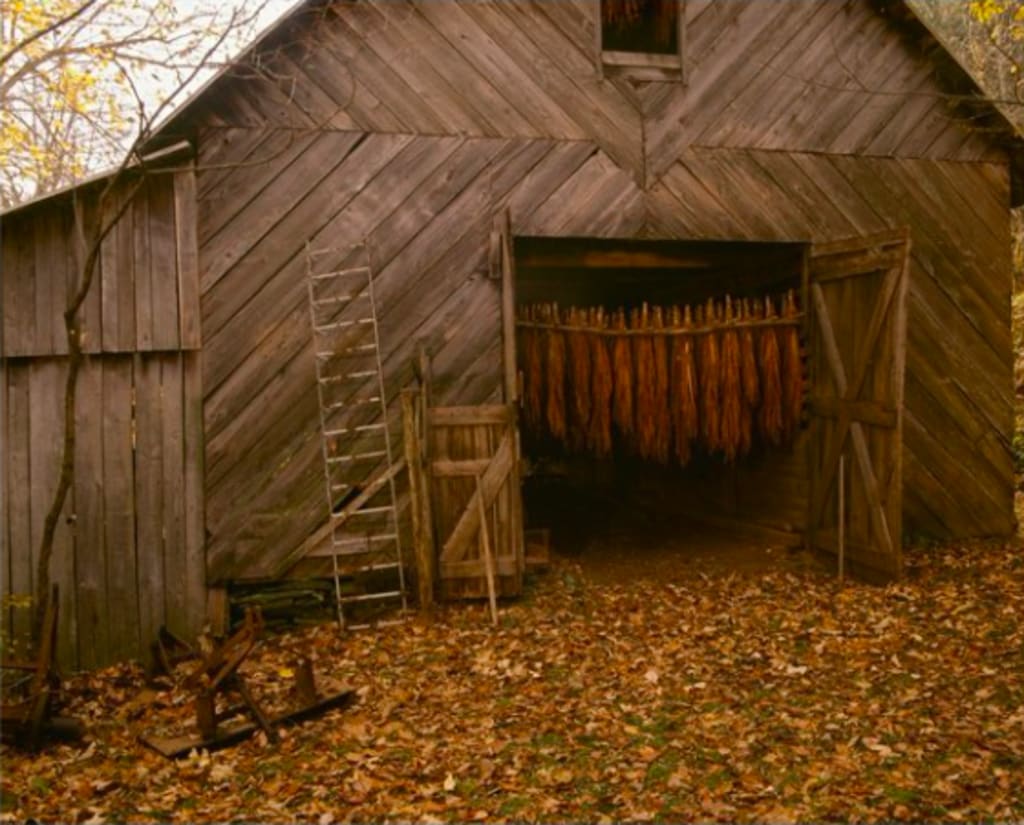
The sun was high and the air sultry. Tobacco already hung lazily in the sheds. Birds flitted from one fence post to the other with more energy than she thought they should have had.
She was only nine, but ever since she was seven she’d been made to go out to harvest just like everybody else. Cut leaf, cut leaf, tie ‘em on the stake. Dig your feet down in the earth where it’s cool.
Three o’clock was dying in the sun and giving way to four when everybody’d stopped and gone to the house for water, but she saw Joe with his cane pole in tow headed for the creek. She was sweating nearly everywhere, and she followed at a distance. Joe could be hot or cold to her, depending on the day of the week. He was twelve.
She woke up a little at the thought of getting a dip in the creek, but even more she hoped that if she followed Joe, she’d find his pack of buddies down there too. That Gabriel Rye was a handsome boy, and she liked to look at him. He was eleven.
Joe was going down into the thick of the boxelders when she broke a stick underfoot. The air must have been so moist that the sound traveled easy, because Joe turned around quick and gave her a stare.
“Go home Sairy, we’s fishin’. We’s fishin’ and you’ll ruin it.”
“It ain’t your creek, Joe. I’m gonna swim down yonder, and I ain’t gonna frighten your fish.”
Joe leered and pulled his broad hat down over his eyes, then stalked off down to the water.
Sairy went off further, climbing down past the ivy where the creek made a bowl. She peeled off her cotton dress and squeezed out of her shoes, and slipped under the clear green water in just her linen shift. She came up refreshed. All of a sudden she could hear voices, and she paddled to the edge of the bowl where a fallen sycamore made a veil between her and the owners of the voices.
Cartwood Owens and Jack Beasley sat in just their shorts digging for worms, and Joe stood tying fishing line with Gabriel Rye. She thought Gabriel a real pretty boy. Prettier than her brother, she could guarantee. They went to throwing out a line into the creek and joking and pushing, and Sairy felt she was missing out. There were no girls her age on the farm or in any of the other families. She did know some older girls, but they spent their time inside schooling their little brothers in letters or sewing quilts. They were no fun, and they certainly weren’t as fun as looking at Gabriel Rye.
She was just finishing this thought when she realized she was standing atop the sycamore, and all eight eyes were on her. All was quiet, and the boys held their poles out dumbly in the split second of wonder at the dripping figure before them who stood in vacant triumph.
Sairy took one look at Gabriel Rye and jumped with all her force into the fishing hole. In her mind’s eye the great fount of her splash had stricken the young mister Rye to his heart, and when she came up she looked for his face. Instead what she saw was Joe’s, and it looked angry.
“What did I tell you, Sairy? You done ruined it, and I told you so, too! Go home!” He took her by the shoulder of her shift and pushed her onto the bank. She turned, hurt by the hardness of it all, and tears came to her eyes.
“You’re a pig, Joe Mender!” she whimpered, stomping back to the creek. “I’m gonna swim.”
“No!” he growled, and kicked creek-sand at her. It splattered her neck and chin. Giving him one last defiant look, she clambered away out of the creek.
Sairy ran from the willows and boxelders with tears in her eyes and grit in her teeth. She couldn’t go back to the house looking like she did, and she turned into the nearest tobacco shed to cry. It seemed to her she heard some mice scamper away as she went in, and it was dark, but she didn’t care. There was sand in her teeth, and worse, she would never know if Gabriel Rye liked her jump.
Her sobs were cut short by a strange sound at the rear of the shed. She held her breath and listened. It was a quiet voice, muffled by the hanging crop. Sairy slowly pushed her way through the still soft leaves until she could hear the voice more clearly.
“Same’s made you as made me?” it asked in quiet disbelief. “I believe you’s wrong on ‘at one. You’s so little, and I’s so big.”
Sairy pushed aside the leaves to see a figure resting against the back of the barn, his silhouette outlined by the sun coming through the spaces in the slats behind him. He was big, and as her eyes adjusted she realized it was the mixed boy who hung around the farm a mile down the road. She had heard he liked to wander about, and nobody really claimed him, except the Warren family offering him food. One time she had heard mama praying for him.
“Hi there” he said with a smile. “Was’ your name?”
Sairy was surprised to be addressed so sudden.
“Sairy Mender” she said slowly.
The boy stood up, and he seemed as tall as a tree, to her, at least. He had on overalls and wore bare feet, but he looked clean and like he wasn’t hungry. He must have been thirteen, or maybe even fourteen. Sairy marveled.
“Well Sairy” he said, poking out a thick hand, “I’m Jonder Haywood.”
“Hi Jonder” she said, taking his hand. He sat down again and motioned for her to sit.
“Where you come from, Sairy?”
“The Mender farm. My mama and papa are Liza Beth and Jacob,” she said quietly, “…Mender. Where do you come from?”
He smiled and raised his eyebrows. “I don’ know. All I know’s folks call me Jonder Haywood. I go ask mister Warren for garden work sometimes, and ‘ey keep me when is’ cold out, but other times I just go ‘round. I don’ know.”
Sairy nodded, staring at his big feet. “Well whatcha doin’ in here?”
“Oh I’z just talkin’ to mister Scraw.” He pointed up into the corner of the barn above where he sat. Sairy looked up, peering into the dim corner until she saw who he spoke of.
“I see. He do any talkin’, you reckon?”
“Oh yes,” said Jonder. “He talks, talks, talks. Just now he was tellin’ me ‘bout how he and I’s brothers of a kind. We was made by ’t same big maker. Now I says I don’ believe that, but now I’s thinkin’ Scraw may be right. See you and me— I’s big, you’s little, and we’s somepin differn’ from each other, like me an’ Scraw, but that don’t mean we wasn’t made by ’t same hand. Your paw makes tobacco an’ beans alike, an’ miss Warren makes berry jam and plum jelly. See, Scraw tol’ me they’s one big hand ‘at makes all things, all kinds a’ different.”
“He said all that?” Sairy wondered.
“Oh yes, mister Scraw says plenty.”
She looked at him for a long time. He was lost, in thought it seemed. But he was smiling, looking all around, and looking up into Mister Scraw’s corner. She sniffed, and he seemed to see her for the first time. He looked her up and down. “My you’s dirty, you’s dirty all over. Whatchu been into?”
She looked down to her shift, which being wet, had made mud of the dust in the shed. Dried sand formed a crust on her neck and chin, and her feet were brown.
“Oh. I’d better be gettin’ on to the house” said Sairy quietly. “They’ll probly get to wonderin’ where I’m at.”
Jonder heaved himself up and took her hand, then led her through the tobacco leaves to the bright open doorway.
“You get on then, an’ I’ll see you next time you want to come see me an’ Mister Scraw. We’s always good for talkin’, and I come roun’ here if’n I want to rest awhile. Mister Scraw’s always ‘round in t’ daytime. If he ain’t, he says it’s for good reason.”
Sairy smiled and squinted in the sun.
“Okay.”
She turned and hurried off toward the house, glancing off toward the creek as she went. For a moment she’d almost forgotten about Gabriel Rye.
—
August wore on, and the Menders finished the harvesting. It was still hot, and Sairy often grew tired while at her letters or mathematics. She’d go out and play with the dogs, but often the dogs were too hot to fetch any stick. One day when Joe slipped off to the creek, she decided she’d traipse across the cut fields and look in the tobacco shed. There in the dusty darkness she found no sign of Jonder, but she looked up into the dim corner where Mister Scraw stayed. She sat in the dust and watched him, waiting to hear his thoughts, but it seemed he had none for her. She knew it was impossible, for that sort of thing only happened in books. She hadn’t read any yet, but Jonder seemed like something out of a book, too.
A few days passed and she tried her luck again, and there was Jonder, sitting against the back of the barn, his silhouette outlined by the sun coming through the spaces in the slats behind him. She was happy to see him, odd though he was. She sat down, and once again he pointed up into that dim corner of Mister Scraw’s, and told her his wise sayings. She mostly listened, and sometimes Jonder would tell things about his own life.
“Mister and missus Warren, they’s real nice, but they’s busy folks. Got a mess of boys and girls, and lots to do on t’ farm. Cain’t talk much wit’ ‘em, no. They’s busy.”
“I don’ know my pa or ma, they like’ta disappeared after I’s born, it seems. But they’s folks who’ll take care of me. Kind folks out there.”
“Not many folks got time t’talk. I wonder about big things, jest big thoughts that come to stay in my head. I listen to Mister Scraw, though, he thinks big thoughts, too. I believe ne’r every word he says, Mister Scraw. Like a trustful friend, and wise. Wise ol’ soul.”
Sairy nodded, and wondered about Jonder.
—
Summer plodded on into the first crisp beginnings of fall, but the middle of the day was still hot. Sairy often crept away to go visit Jonder in the tobacco shed. Sometimes he was there, sometimes away. As strange as the young man was, she always felt it was the most peaceful time she spent. And whether she was right or not, she felt he needed her, and she needed him.
The tobacco was eventually cleared out of the barn, and everything was taken into the town to sell. Tensions were always high whenever Pa took the crop to market, for these days were different than they had been. Sometimes he came back with plenty for the family, but sometimes he came back with less than he left with. It was difficult for everybody, it seemed. Rumor was that the Warrens couldn’t afford to keep up the farm, and they were moving to the town to work at a mill.
One evening Sairy was on her way back from a visit to Jonder, a rare time in which Jonder hadn’t said a thing about Mister Scraw. In fact, they had mostly just talked about fall’s coming, and the things that went with it: pumpkin pies, cider pressing, and corn dolls. Jonder always hung about the Warren farm when fall came around. He loved pumpkin pie.
As Sairy came up to the porch, she paused and hung back near the corner. Joe was sitting on the porch swing, its slow creaking the only sound for miles around, as it suddenly seemed. Tears streamed down his cheeks, and while his brow was furrowed in anger, his mouth quivered in despair. He wrung between his hands his well-worn slingshot, an old shagbark hickory crook with a strip of inner-tubing.
Sairy went to put a bare foot on the lowest stair when she heard sounds from inside. She glanced around the back of the house and saw the buggy. Pa was back from the market. He was normally a quiet man, but the end of harvest seemed to get another spirit into him. Angry shouts came from within, and she knew her ma and pa were at war. She shuddered at the sound of a pot clanged upon the range and withdrew, but she noticed that Joe didn’t move. He stared straight ahead, looking out to the fence posts in the fading evening light. Something lay on the road just beyond the fence, a twisted heap, something pale.
She tiptoed quickly behind the row of forsythia and out to the road, where she approached the thing. Her heart came into her throat. It was a barn owl, shot from its perch and cold on the ground. The feathers were ruffled and loose, and its wise eyes were shut tight. She turned to look at Joe, who looked away.
Tears came to her eyes, for she knew the name of this fallen creature. She knew many of his “sayings”. But she didn’t know what to do about Jonder.
—
For several days Sairy didn’t go back to the shed. She was torn up inside. She couldn’t look at the owl, nor take him up, and she had left him in the road. One day she noticed he was gone, and she imagined the worst. There were plenty of critters around to take opportunity of the fallen philosopher.
Finally that afternoon she slipped away to visit the tobacco shed. As her eyes adjusted, she saw a figure sitting against the back of the barn, his silhouette outlined by the sun coming through the spaces in the slats behind him. She approached slowly.
“Hi Sairy” he said smiling.
“Hi Jonder” she muttered weakly.
He stood up with a humble air as he always did whenever she entered, and took her hand. They sat down, and Sairy looked up into Mister Scraw’s corner.
“I ‘spect you know about Mister Scraw” he said slowly.
She gasped and looked up at him with shame. His eyes looked clearer and more intent than she had ever seen them.
“Don’t be a’feared, I know all ‘bout it. I don’t hold no ill with anybody for it. I went an’ dug him a grave last night.”
They sat in silence for a time, and tears came to Sairy’s eyes.
“No, it’s awright,” said Jonder, gently pressing her hand. “Don’ you cry.”
“But he was your best friend” she sniffed. “He talked to you.”
Jonder nodded. “He was. But I take a comfort great, and I know all’s gonna be awright.”
She looked up questioningly.
“See,” said Jonder with a light in his eyes, “‘fore Mister Scraw went out a-huntin’ the other evenin’, he says ‘Jonder, you know ‘at while t’ earth goes spinnin’ this way we cain’t always be together. Some day you’s gonna have to leave, or I’s gonna have to leave, an’ ‘at’s just the way things work right now. One day we gon’ get to always be wit’ friends, one day when all gets made right. But ’til then, I tell you t’ truth, that same big hand ‘at made you is gonna give you t’ friend you need, even if I ain’t here’. And ‘at’s what he said, ‘at Mister Scraw. So I believe ‘im, and I feel nuttin’ but peace cause ‘zactly what he said would happen, happen’d.”
He smiled big, and a shaft of dusty light fell on his brown face.
“Cause t’ big hand ‘at brought me Mister Scraw brought me Sairy Mender, and when she’s got to go, by gum the same big hand will provide.”
About the Creator
Keep reading
More stories from writers in Fiction and other communities.




Comments
There are no comments for this story
Be the first to respond and start the conversation.