
Major Mohammad Zaki: Valor Beyond Borders
The untold journey of a soldier torn between loyalty to the empire and love for his motherland during India’s struggle for freedom.

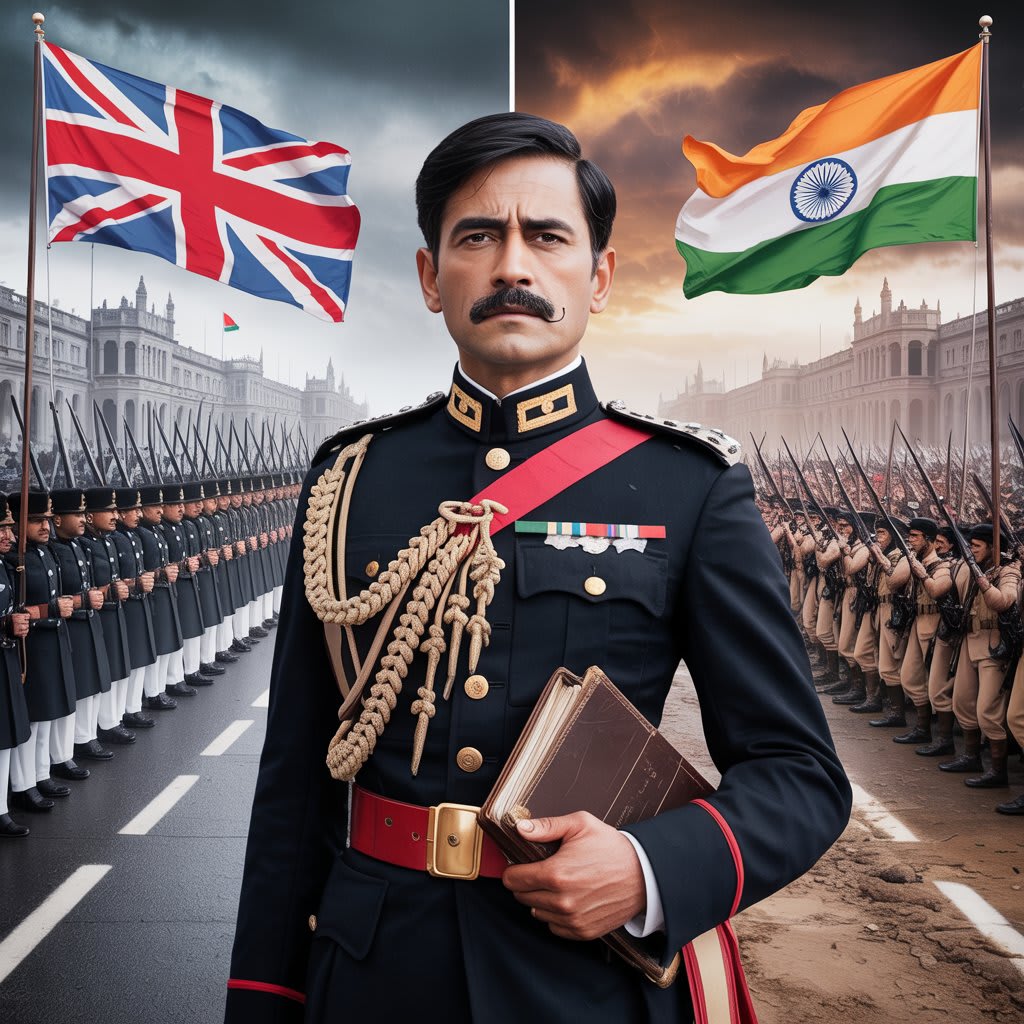
The winter of 1941 blanketed the hills of Rawalpindi in silence. The barracks were quiet, but within them stood a man whose mind was far from calm — Major Mohammad Zaki, a proud officer of the British Indian Army, a decorated soldier, and a man at war with his own conscience.
Born in 1903 in a modest Muslim household in Aligarh, Zaki was raised with strong values of discipline, loyalty, and education. His father, a schoolteacher, often recited from the Quran and Shakespeare in the same breath, nurturing in Zaki a deep sense of balance between faith and reason. Young Zaki was captivated by stories of Tipu Sultan and Sir Syed Ahmad Khan — men who defined courage and intellect in turbulent times.
At age 20, Zaki joined the British Indian Army, one of the few Muslim men from northern India to rise quickly through the ranks. He showed exceptional promise in the Northwest Frontier campaigns and later in North Africa during World War II. The British admired his precision and loyalty; his peers respected his tactical brilliance and calm demeanor.
But the deeper Zaki climbed into the military echelons of the British Empire, the more uneasy he felt. He had seen villages in Punjab razed under suspicion of rebellion, Indian soldiers treated as expendable, and fellow officers dismissed when they questioned orders. His position gave him access to both privilege and peril, and with each passing year, the contradictions gnawed at him.
It was in 1942, after returning to India for a short leave, that Zaki's life took a decisive turn.
The Quit India Movement had erupted. Streets across the country were aflame with protest. Young men and women were chanting slogans, tearing down colonial symbols, and daring the empire to shoot. Zaki visited his childhood friend, now a professor at Aligarh Muslim University, who had joined the underground resistance. There, he saw the unfiltered faces of revolution — bruised but burning with passion.
“What is a soldier’s honor, Zaki,” his friend asked him, “if the nation he defends is not his own?”
Zaki had no answer. But the question followed him like a shadow.
Returning to his post in Assam, where he was stationed to suppress rebel movements along the eastern frontier, Zaki found himself increasingly hesitant. He gave lighter sentences to captured freedom fighters. He leaked warnings to villages marked for raids. And in quiet moments, he wrote in his diary — “I was trained to defend an empire, but I was born to serve a nation.”
In 1943, an order came that would test his soul.
A unit of suspected Indian National Army (INA) sympathizers was to be executed without trial near Chittagong. Zaki was assigned to oversee it. That night, he walked into the prisoners’ tent, looked into the eyes of the bound men — some not older than twenty — and saw courage, not treason. He defied the order.
At dawn, he staged an “escape” — secretly letting the prisoners flee into the forests, reporting that a skirmish broke out and the men overpowered the guards. He knew this lie would not hold. He packed his uniform, burned his diary, and disappeared into the night.
For months, Zaki lived as a fugitive, moving across villages, occasionally sheltering with INA units, sometimes with local resistance networks. He changed names, grew a beard, and wrote letters to his mother — never sent — describing the ache of exile and the freedom of conscience.
After Independence in 1947, Zaki re-emerged. But he did not seek fame or recognition. He refused a government post, turned down honors, and retreated to a quiet life in Lucknow, teaching history at a school for underprivileged children.
He often told his students, “A soldier’s greatest weapon is not his rifle — it is the ability to choose justice over orders.”
Major Mohammad Zaki passed away in 1965, quietly, without parades or obituaries. His grave, tucked beside a mosque near the Gomti River, bears a simple inscription:
"He served with honor, but lived with courage."
Today, Major Zaki remains a forgotten name in the annals of India’s freedom struggle. But in his silence, in his defiance, and in his love for a land not yet born, he embodied a truth deeper than uniforms and flags — that patriotism is not in obedience, but in sacrifice.
About the Creator
Muhammad Sohail
Stories have the power to change lives. I aim to transport you to new worlds, ignite your imagination, and leave you thinking long after the final chapter. If you're ready for unforgettable journeys and characters who feel real.
Keep reading
More stories from Muhammad Sohail and writers in Fiction and other communities.
The Devil's Cut
“Comrade, finally you’re awake.” The voice was smooth, sensual. A flickering incandescent bar was all that lit the white, sterile room. All Vladimir remembered was everything going black. He tried to move his arms and found them strapped to the gurney.
By Matthew J. Fromm5 days ago in Fiction


Comments
There are no comments for this story
Be the first to respond and start the conversation.