
Lioness of Awadh: The Forgotten Flame of Rebellion
The untold story of Begum Hazrat Mahal — the fierce queen who dared to challenge the British Empire during India’s First War of Independence.

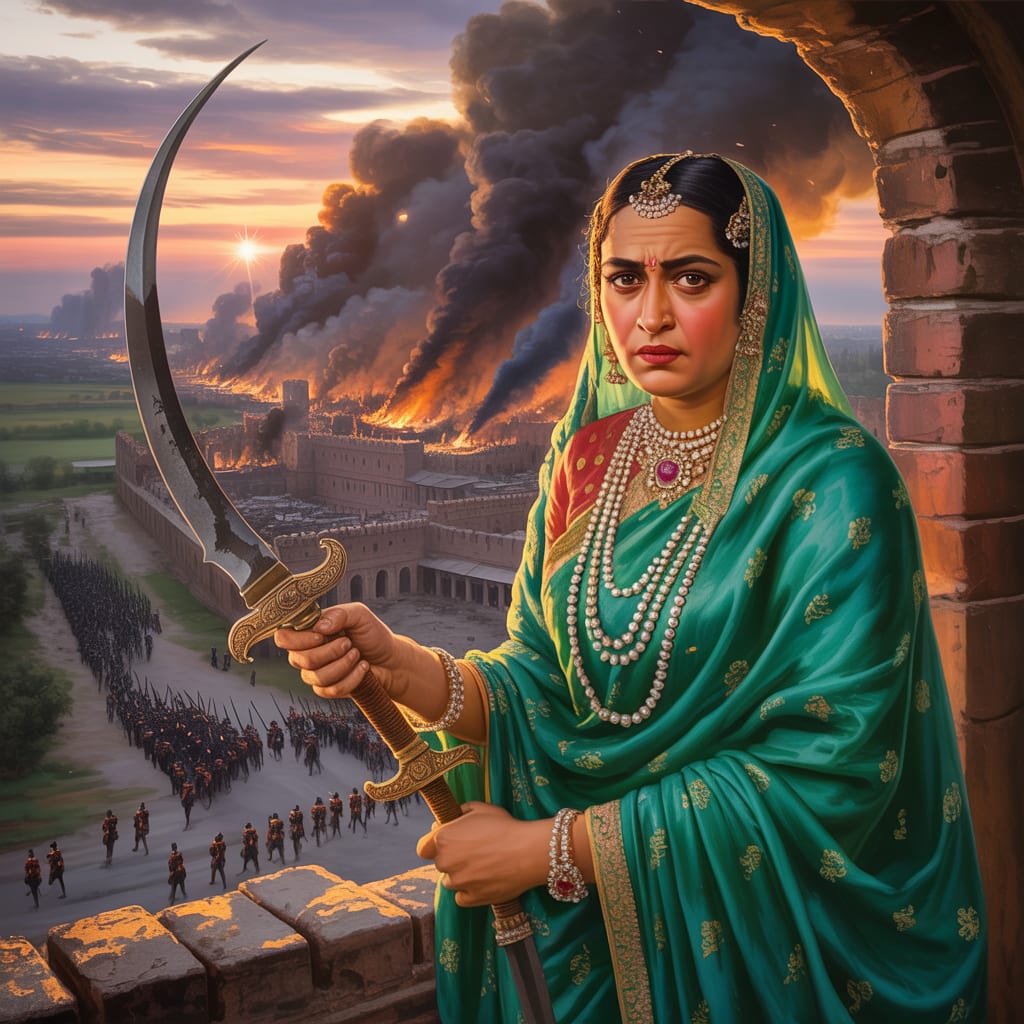
In the turbulent summer of 1857, when flames of revolt began to engulf India, a solitary figure stood as a beacon of courage in the heart of Awadh — a woman, a mother, a queen — Begum Hazrat Mahal.
Born as Muhammadi Khanum in Faizabad, her early life was far from royal. She was a courtesan in the royal court of Awadh before fate elevated her to the position of a Begum after marrying Nawab Wajid Ali Shah. As the tides of history would have it, her resilience and intelligence would soon prove that her soul was forged not just for palace politics but for the battlefield itself.
The annexation of Awadh in 1856 by the British East India Company was a calculated move under Lord Dalhousie's infamous Doctrine of Lapse. Nawab Wajid Ali Shah was exiled to Calcutta, and Hazrat Mahal was left in Lucknow with her young son, Birjis Qadr. The annexation was not just political theft — it was a direct assault on the identity, culture, and sovereignty of the Awadhi people.
While many nobles either submitted or fled, Hazrat Mahal stood tall. She took control of the resistance in Lucknow, declared her son as the rightful heir, and assumed the regency. In a world dominated by men and imperial forces, her defiance was nothing short of revolutionary.
Lucknow became a center of rebellion during the 1857 Uprising, also known as the First War of Indian Independence. Hazrat Mahal formed alliances with sepoy mutineers, local chieftains, and disgruntled nobles. Under her leadership, a people's army surged forth, retaking the city from the British. For months, the Union Jack was replaced by the green flag of Awadh fluttering proudly over the city’s skyline.
Her court, though hastily organized, became a symbol of indigenous governance. Hazrat Mahal ruled not with fear but with justice and a fierce sense of loyalty to her land. She ensured the protection of civilians, maintained law and order, and resisted British propaganda portraying her as an unruly usurper.
Her speeches, full of fiery conviction, inspired not just soldiers but also ordinary citizens. She spoke of honor, of independence, of the right of her son — and of every Indian — to live free from foreign domination. The city of Lucknow rang with chants of resistance, and Hazrat Mahal was hailed as a true Sherni — the lioness of Awadh.
However, valor alone could not withstand the might of the British war machine forever. In early 1858, the British forces under Sir Colin Campbell returned with vengeance. Cannons roared, and the skies darkened with smoke as they began a brutal campaign to retake the city. The Siege of Lucknow became one of the bloodiest chapters in the uprising.
Hazrat Mahal fought valiantly, often appearing on the battlefield to boost morale. Clad in armor, wielding a sword, she became a legend in her own lifetime. But even legends are not immune to betrayal and the tide of war. After prolonged resistance, Lucknow fell. Yet, Hazrat Mahal refused to surrender.
With her loyal followers and her son, she retreated northward, seeking asylum in the Nepali Terai. Even in exile, her spirit remained unbroken. She refused all British offers of pardon that came with the condition of accepting their rule. She chose a life of hardship over a compromise that would stain her honor.
Begum Hazrat Mahal spent her remaining years in Nepal, isolated and away from the land she had fought to protect. She died in 1879, far from Lucknow, and was buried in an unmarked grave in Kathmandu — a silent resting place for one of India’s bravest daughters.
Today, history remembers many kings and generals, but the name of Begum Hazrat Mahal often lies in the shadows. Yet her legacy lives on — in the narrow lanes of Lucknow, in the whispers of rebellion, and in the hearts of every woman who refuses to bow.
She was not merely a queen. She was the soul of Awadh, the fire of resistance, and the lioness who dared to roar against an empire.
About the Creator
Muhammad Sohail
Stories have the power to change lives. I aim to transport you to new worlds, ignite your imagination, and leave you thinking long after the final chapter. If you're ready for unforgettable journeys and characters who feel real.
Keep reading
More stories from Muhammad Sohail and writers in Fiction and other communities.
The Pot Boiling Over
Once, there was a pot of about 340 million drops and droplets. Most of them would like to think they lived together peacefully for decades, but that wasn’t true. Different regions struggled, sometimes fought, with each other. And the mainstreams still often pursued and attacked the minorities. Law enforcers sometimes pushed minority drops out of the pot, never to be seen again.
By Gabriel Shames7 days ago in Fiction
Ludacris and Nelly draw backlash over bookings at MAGA-coded music festival
Ludacris and Nelly headlining a mostly right-wing event is good for them. It’s also great for the genre of hip hop. The two rap veterans have showcased their talents on other stages. Why can’t they perform for mostly MAGA folks and grab that bag?
By Skyler Saunders4 days ago in Beat



Comments
There are no comments for this story
Be the first to respond and start the conversation.