
How would an alien invasion look like? Part 2
Why would they stop here anyway?
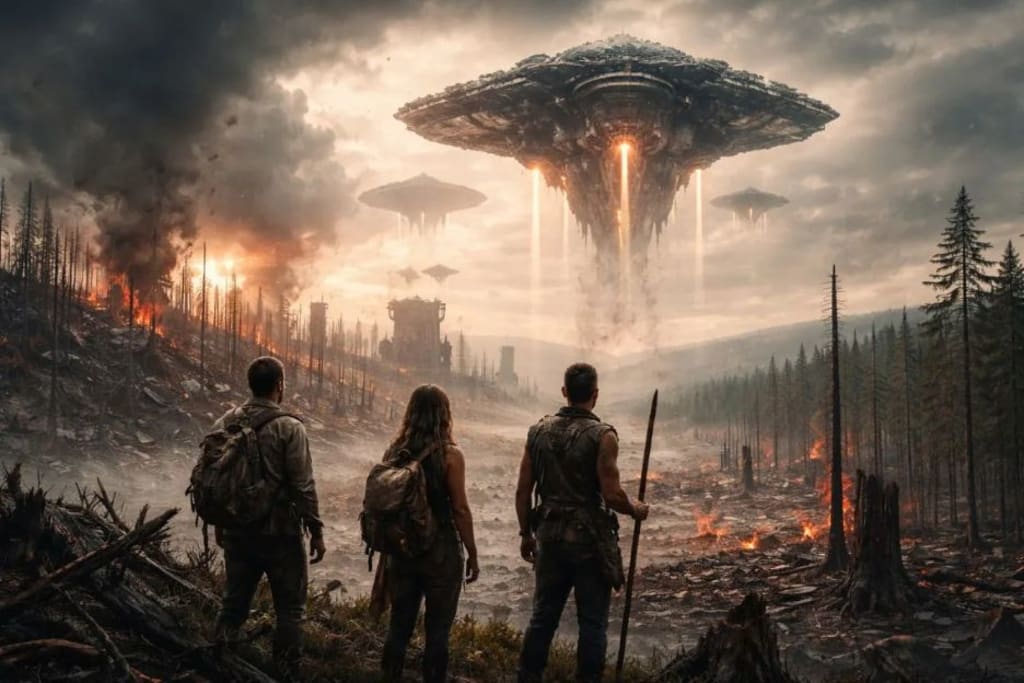
As told in the first part of the story, an alien invasion would unfold without large battles, with humanity overwhelmed not by brute force but by systemic collapse designed from orbit. Humanity becomes collateral damage, displaced, suppressed, or extinguished by environmental and technological interventions, not direct warfare.
The first part was a speculation based on human experiences and my humble imagination and, therefore, may not reflect a real course of events. Sorry, if I am not meeting your storytelling expectations. Most likely — as many readers observed — aliens wouldn’t be interested in Earth’s resources, not to mention its arrogant apes. Some readers do have a point if they say that minerals and metals can be easily mined in space without wasting time capturing our small planet.
I don’t disagree, this may be true after all.
Evolutionary loop
Across biological and technological history, evolution follows a recurring structural loop rather than a linear path.
Scarcity is the primary driver of innovation. Environments constrained by limited energy, space, or materials exert selective pressure on organisms or civilizations. Those pressures reward efficiency, problem-solving, and adaptation. In biological systems this yields evolutionary traits; in intelligent societies it produces tools, technologies, and organizational complexity.
Innovation, once successful, creates temporary abundance. New methods of energy extraction, food production, or material use reduce immediate constraints. Abundance lowers mortality, increases population, and frees cognitive and economic capacity for further experimentation and specialization.
Abundance inevitably fuels expansion. Populations grow, consumption accelerates, and surplus capacity is redirected outward — into territorial growth, industrial scaling, or interplanetary exploration. Expansion is not a cultural preference but a structural consequence of surplus.
Expansion recreates scarcity at a larger scale. As systems grow, they exhaust local resources, encounter logistical limits, or destabilize their environments. The original constraints return, amplified by scale.
Scarcity reasserts selective pressure, demanding new rounds of innovation, efficiency, or technological upgrading.
The result is a self-reinforcing evolutionary cycle: scarcity → innovation → abundance → expansion → renewed scarcity.
Crucially, a resource-rich world does not escape this loop. Abundance does not halt evolution; it accelerates expansion, compressing timelines and intensifying future shortages. Likewise, a resource-poor world does not stagnate — it innovates or collapses.
This pattern appears consistent across ecosystems, civilizations, and hypothetical extraterrestrial societies. If intelligent life arises under universal physical constraints, its long-term behavior is unlikely to be static or restrained. Expansion is not an anomaly — it is an emergent property of survival in a finite universe.
In that sense, an alien civilization seeking new worlds or resources would not be acting out of malice or ideology, but as the predictable outcome of the same evolutionary dynamics that have governed life on Earth.
Why, after all?
Let’s consider this: humans may not be unique in following a basic survival-driven pattern — explore, secure resources, and expand control. If intelligent life elsewhere in the universe evolved under similar pressures, it is reasonable to expect comparable behavior.
History shows that explorers did not need to understand the full scale of the world to act decisively. Christopher Columbus had no idea how vast Earth was; he stopped at the first viable landmass he encountered and claimed it for his sponsors. Sometimes, exploration does not wait for complete knowledge or befriending with locals — it reacts to opportunity.
Now apply this logic beyond Earth. An advanced civilization traveling through space would not need to map the entire universe to act. The nearest suitable planet along its trajectory would naturally become a stopping point: a place to refuel, gather information, test the environment, or establish a temporary foothold.

If Earth lies along such a route, why would an external civilization simply pass by? Harboring temporarily, observing local life, and assessing resources would be a rational, low-cost decision. From that perspective, contact — or even intervention — would not require hostility or grand conquest plans, only the same opportunistic logic that has guided exploration throughout human history.
In short, alien visitation would not need extraordinary motives. It would only require familiar ones: proximity, habitability (or resource potential), and the universal instinct to exploit advantage where it is most immediately available.
Feeling no constraints
Start from a simple premise: an arriving alien species is not fundamentally different from any other complex system.
If biological, it relies on respiration to sustain cellular metabolism (not necessarily oxygen) and requires liquid water (not necessarily in current composition) for basic biochemical reactions. If machine-based, it still depends on energy, thermal regulation, and a stable environment. In other words, it is bound by the same physical and chemical conditions that shape all complex life or engineered systems.
This pattern appears consistent across ecosystems, civilizations, and hypothetical extraterrestrial societies. If intelligent life arises under universal physical constraints, its long-term behavior is unlikely to be static or restrained.
Expansion is not an anomaly — it is an emergent property of survival in a finite universe.
Like humans, such a species would prioritize its own survival and expansion. Moral concern for less advanced life forms would not be automatic; history shows that technological superiority rarely comes with ethical restraint. There would be no inherent obligation to protect Earth’s populations, just as Homo sapiens have rarely felt accountable to species they considered inferior or obstacles.

From this perspective, Earth would not be viewed as a shared home, but as an environment — potentially useful, potentially expendable — evaluated strictly in terms of utility. This assumption does not require hostility, only indifference — which is often more dangerous, in my opinion.
I propose below two timelines of Earth conquest, built around different strategic motives — colonization and resource extraction. Each is grounded in plausible constraints for an interstellar civilization, framed as structured, high-level worldbuilding material.
So, this is the second part of my story about an imaginary alien invasion — perhaps unworthy any scientific purpose, but let’s hope good enough for a Sci-Fi movie script. Don’t judge me too harshly. 😊
Timeline 1: Colonization campaign
Objective: Seize Earth as a habitable world for long-term settlement. Preserve planetary integrity, reshape biosphere to match alien biological requirements, and eliminate or contain human resistance.
Year -5 to 0: Remote reconnaissance
Alien probes don’t need to establish on orbit, they operate far from Earth to map its climate, oceans, atmospheric chemistry, and magnetic field. They determine Earth is within tolerances for eventual habitation, but its native biosphere is incompatible with alien physiology or robotic operation.
Possible key findings:
• Atmospheric composition outside optimal parameters (whether due to oxygen concentration, nitrogen ratios, trace gases, or pressure).
• High pathogenic risk from Earth’s carbon-based life, regardless of the invaders’ biochemistry or machine nature.
• Human industrial capacity sufficient for limited kinetic defense but incapable of sustained space-based retaliation.
Month 0: Arrival of a forward observation fleet
A small flotilla enters the outer solar system, remaining hidden by using low-signal profiles and gravitational assists from Jupiter. They deploy relativistic microprobes to Earth orbit. No contact is made.
Only the most sensitive instruments (deep-space telescopes, radar arrays, and long-term orbital monitoring systems) might notice anomalies — slight deviations in object trajectories near Jupiter, unexplained gravitational effects, or tiny, fast-moving probes.
The detected objects might first be interpreted as natural phenomena (asteroids, comets), classified space debris, or experimental probes from other nations. As Professor Avi Loeb demonstrates in his articles, we rarely jump immediately to “alien” conclusions.
If anyone succeeds to prove that it’s alien technology, we are likely to witness public shock, mass panic and widespread looting, amid a global information embargo at official level.
Month 1: Infrastructure suppression
Instead of dramatic attacks, the aliens implement precise, and perhaps reversible measures:
- Communication disruption via targeted ionospheric interference.
- Disablement of military radars.
- Neutralization of launch sites with non-nuclear hypersonic penetrators.
- Global power grid collapse within 24–48 hours due to coordinated orbital EMP pulses. Containment of nuclear power plants.
Humanity loses ability to coordinate, but terrestrial structures remain intact.
I’d pay a special attention to nuclear power facilities. If left without external power and human supervision, nuclear power plants represent both a risk to planetary stability and a source of uncontrolled contamination — undesirable for colonization and inefficient even for extraction.
To address this, the invaders would likely deploy a parallel mitigation strategy:
- Immediate remote shutdown commands transmitted directly into reactor control systems, exploiting software vulnerabilities or inducing physical fail-safe states.
- Targeted disablement of turbine and cooling loops, forcing reactors into cold shutdown rather than meltdown.
- Deployment of autonomous maintenance drones to critical facilities, ensuring decay heat is safely dissipated and spent fuel pools remain cooled.
In cases where shutdown is not possible, the invaders may deliberately induce controlled reactor failure, venting pressure and sacrificing individual sites rather than risking large-scale atmospheric or hydrological contamination.
Month 2–6: Atmospheric and biospheric conditioning
Orbital factories begin building a thin, reflective stratospheric veil. The veil slowly adjusts climate toward the aliens’ comfort zone: lower temperatures, higher humidity.
Simultaneously, they send autonomous drones to sterilize specific microbe-rich regions, then release engineered nano-filters that begin altering the atmosphere’s composition.
Human collapse accelerates through agricultural failure, but ecological systems remain physically intact for a while.
Year 1: Population containment
Suppose the preceding phases didn’t kill all the organisms relying on oxygen, temperatures and humidity they were used to, and some species have adapted to the new atmospheric and biosphering conditions. And suppose that due to some ethical constraints the visitors avoided extermination. Instead, they use non-lethal suppression:
- Sleep-inducing aerosols over urban centers.
- Drone patrols enforcing no-go zones.
- Human relocation into designated “stability zones” where basic needs are provided but mobility is restricted.
At this stage, resistance groups exist but cannot coordinate nor strike back efficiently.
Year 2–10: Progressive terraforming and alien settlement
This phase starts before setting foot on Earth; terraforming enters full cycle:
- New atmospheric mix stabilizes.
- Microbial ecosystem seeded to support alien agriculture.
- Construction of colossal, arcology-type settlements using orbital drop modules.
- Gravity alteration by slowing down or acceleration the planet’s revolving with river dams.
First alien settlers arrive in Year 5 or earlier, depending on progress. Their cities expand across coastal and hard to reach zones.
Year 25+: Integrated planetary order
The world becomes a dual-biosphere environment.
- Humans exist under administrative oversight, used selectively for knowledge work or light industry.
- Alien governance structures replace nation-states.
- Earth is now one of many colony worlds, valued for climate stability and hydrological richness.
The original human world persists in fragments, but sovereignty is gone. The story about white Europeans displacing native Americans in America gets a new chapter, with aliens taking the place of white Europeans and humanity the place of native Americans.

Timeline 2: Resource extraction campaign
Objective: Strip Earth of high-value materials while minimizing cost and avoiding unnecessary alterations to the planet’s geology or atmosphere, or conflict with resident species. No interest in long-term habitation.
Year -3 to 0: Remote reconnaissance
Alien scouts analyze target resource categories:
- Heavy metals deep in crust.
- Water content in oceans.
- Organic compounds in biomass.
- Atmospheric gases suitable for industrial feedstock.
They determine that humans are not a strategic threat but could complicate extraction if left undisturbed.
Week 0: Initial Strike
Extraction-focused invaders require no terraforming, only removal of resistance and simplification of the biosphere. Their first actions:
- Orbital kinetic rods destroy major military bases and missile silos.
- Global satellite networks are disabled in minutes.
- Power grids collapse due to high-altitude electromagnetic bursts.
- Underwater “disruption arrays” scramble communication cables.
Humanity enters instant global blackout.
Week 1–8: Population and industry neutralization
The alien goal is efficiency, not conquest. They impose planetwide paralysis through indirect pressure:
- Atmospheric interference halts aircraft usage.
- Major ports are sealed with precision strikes.
- Robotic units prevent large-scale regrouping in population centers but avoid wholesale destruction.
Humans survive as a result of these actions; economies do not.
Month 3: Global resource survey grid installed
Thousands of orbit-to-surface autonomous extractors land across continents and ocean floors.
Their functions are focused — but not limited to — on the following:
- Deep crust tomography to locate metal-rich veins.
- Oceanic sampling to calculate extraction yield curves.
- Biomass analysis to determine profitable organic compounds.
Aliens rely entirely on machines. Human and other local labor is unnecessary.
Month 6–5 Years: Intensive extraction phase
This is the core of their mission, which is secured by various autonomous machines and robotic patrols that prevent disruption and sabotage. Frankly, I have no idea what they would need, so I just speculate.
- Deep-drill harvesters strip mine specific corridors 10 to 40 kilometers deep.
- Atmosphere is siphoned into orbit to harvest nitrogen, carbon, and noble gases.
- Oceans are tapped for hydrogen isotopes, reducing global sea level by measurable margins and killing much of its flora and fauna.
- Biomass scrapers selectively remove forests and biomass hot zones without triggering full ecological collapse. Land fauna suffers devastating effects.
Societies and nations crumble around extraction zones; survivors cluster in marginal regions, seeking shelter in underground spaces.
Year 6–10: Withdrawal and postprocessing
Reserves reach optimal depletion but the visitors are not interesting in crippling the planet; hoping probably to return here later rather than being concerned of ethical limits:
- Alien megaships arrive to collect refined materials from orbital foundries.
- Extraction drones either self-destroy or depart.
- Minimal or no effort is invested in restoring the planet; only geostructural stability is maintained to avoid catastrophic chain reactions.
The Earth species are left with:
- Severely reduced oceans and vegetation.
- Fragmented or disabled ecosystems.
- Mass extinctions across most species.
For humans, the loss of key minerals needed for modern industry is devastating. The lack of a global governance structure also means that humans return to prehistoric tribal orders, relying on hunting and gathering skills mainly.
Year 10+: Aftermath
Earth becomes a depleted but still habitable world after this purely transactional operation. Human civilization has two options now — die out within a short period or recover over time. For the sake of continuation of this story, let me chose the second way:
- Geological scars shape new continents and coastlines.
- Humanity slowly rebuilds with diminished resources.
- Conflicts for territory and remaining resources are frequent.
- People who are too weak or “useless” for society are considered social liabilities and are left on their own or terminated.
- Hunting and gathering regain a significant place in the list of main human activities.
- Knowledge becomes the most priced asset and scientists have a chance to rise to privileged ranks. This is one of a few positive aspects following the retreat of aliens.
From the above-described scenarios it is hard to imagine humans surviving an alien invasion. Recovery is not just improbable but almost miraculous. Even if the aliens do not actively exterminate humans, the combination of global infrastructure collapse, disruption of agriculture and logistics, atmospheric and environmental manipulation, and targeted suppression of resistance would reduce humanity to a fragile, scattered population.
Civilization would fragment, technology would regress, and many would perish simply from starvation, exposure, or societal collapse.
Survival would likely hinge on two critical factors:
- Remote and isolated regions combined with chance and timing — as aliens prioritize efficiency, in certain zones their intervention is minimal, and small communities there are underestimated and overlooked.
- Human adaptability and knowledge retention — small groups learn to rely on hunting, gathering, and low-tech survival skills, while those who can preserve engineering, medicine, and agricultural knowledge could seed eventual recovery.
In the end, the survival of humanity was not about defeating the invaders outright, but about enduring, learning, and reshaping themselves to fit a new world — a testament to the stubborn persistence of life, even under cosmic indifference.
Well, that would be all that comes to my mind. Hit me if I omitted any important details or phases.
Disclaimer: I relied on AI-generated pictures, LiveScience image, and “Oblivion” screenshots for this story, and used AI to look for inconsistency and logic failure in my narration.
About the Creator
Keep reading
More stories from Aurel Stratan and writers in Fiction and other communities.
How would an alien invasion look like?
I’ve been reading all important articles about the 3I/ATLAS with mixed feelings. I’d love Avi Loeb to be right about the technological nature of this object — this way I would become an eyewitness of the biggest discovery of all time; but I also hope its origin is natural, because I am sincerely freaking out about aliens.
By Aurel Stratanabout 12 hours ago in Fiction
The Devil Gets What He Wanted
“Hello Old Scratch. My name is Glabon. I assume you know why I am here?” “Of course, Glabon, as you no doubt know, I know many things, most in fact.” “Well, despite that I am required by my superiors to inform you of my intentions in any case.” “And, you always do what you are told don’t you my friend Glabon?” “Of course, and I am not your friend, nor are you anyone’s friend, but that matters not for purposes of this discussion.” “No need to hurl insults, it was only a figure of speech. I would suggest you lighten up, but I assume your superiors would find that objectionable, and my guess is you are not capable of it. Do you ever even smile Glabon? Or laugh? No, I presume not.” “Mr. Scratch I am not here for banter or games, I am here for your interview. As you know a select group has been commissioned to write your biography for the historical record.”
By Everyday Junglist4 days ago in Fiction




Comments
There are no comments for this story
Be the first to respond and start the conversation.