
Home Amongst The Marigolds
There was no longer day nor night in Martha’s world, nor winter nor summer, nor rain nor sun. There was only the unending uncertainty.

“He’s never coming home, Martha.”
Martha pulled her tiny shoulder out from under the stifling weight of her father’s massive hand, the heat from his sweaty palm fueling her internalized rage.
“You don’t know that.”
“Honey, we’ve been through this a thousand times. The police have no leads. No one’s seen him in years, and he hasn’t tried to contact you. He’s gone. He’s deceased. He doesn’t exist. I don’t know how many more ways I can say it. It’s time to move on. You can’t spend the rest of your life staring out that window waiting for him to come home.”
“He could still be out there, somewhere.”
Martha’s father hung his head and sighed, his hot breath hitting the back of Martha’s neck as he tightly gripped the back of her chair.
“Look, you’re still young, and I bet if you took care of yourself you could find another man willing to marry you.”
Martha said nothing.
“You look thinner and thinner every time I see you. You should eat something. Men like gals with a little meat on their bones.”
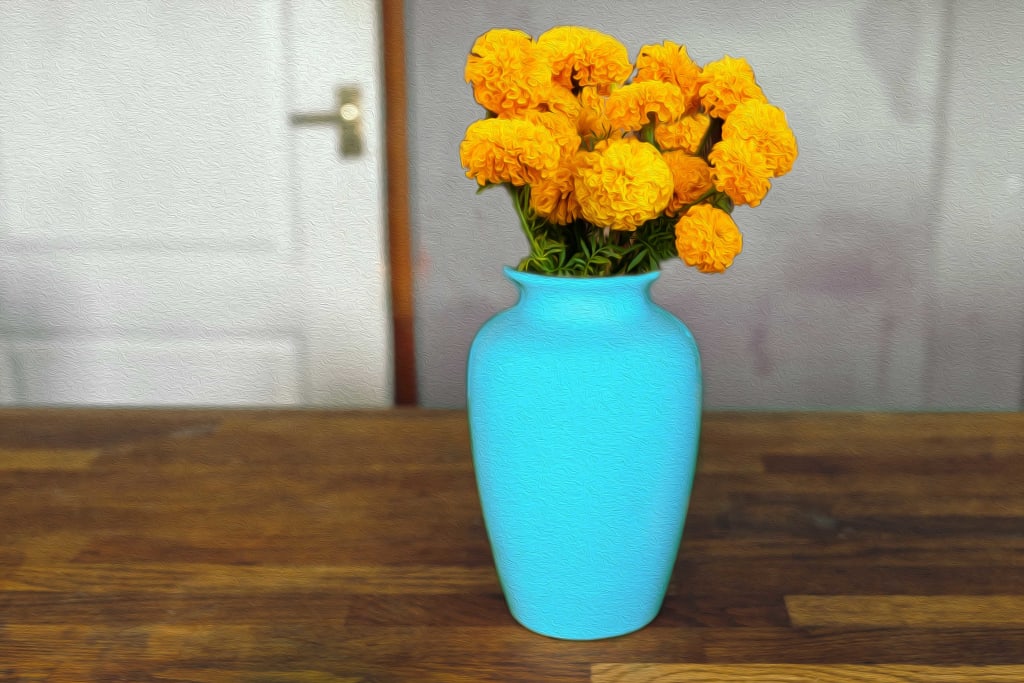
Martha grabbed the porcelain vase off the windowsill and threw it against the wall, her weak body collapsing onto the floor.
“If you’re going to behave like a little brat then I guess I’ll be leaving. Maybe you’re not ready to be a wife again after all. Maybe you never were.”
Tears of hate welled up in her eyes as she turned her head back toward the open window, refusing to look at her father. He grabbed his hat and coat off the mantle and made his way to the door.
“Oh, and clean that mess up,” he scolded as he slammed the door shut.
Martha sat frozen for a few minutes before she sluggishly lowered her gaze to the ground. Blue shards of porcelain lay scattered across the floor. The water had already soaked into the wood. A beam of light from the window illuminated the handful of freshly picked flowers that had come to rest at the foot of the wall. Marigolds from the garden. She picked one up, examining its every petal, remembering.
Martha had married Fred in 1945, exactly one week after he returned from fighting in the war. Having never been partial to roses or peonies, she walked down the aisle with a bouquet of marigolds, vibrant and warm, like she was with Fred.
It was 1950 now. Fred had been missing for three years. Martha never left the house. Her friends used to call, pleading for her to let them take her out for some fresh air, but Martha would always decline, saying, “What if he comes back and I’m not here to welcome him? I can’t have him coming home to an empty house. He’ll think I’ve forgotten him.” Eventually, her friends stopped calling. The only person who ever checked in on Martha was her father, whose visits she could just as easily do without. He was nothing to her. The world and everyone in it were dead to her, except for Fred.
“This one’ll do, I think.” That’s what Fred had said nearly half a dozen times during their search for their first house.
“Fred, you need to take this more seriously,” Martha had urged.
“But don’t you think we could be happy in any of these? We don’t need anything fancy.”
“Darling, you know I would have married you years ago if I could have, but the war took you from me before I had the chance to. Now you’re finally here, and we have a lifetime to make up for the years we lost. I’m never going to let you go again. You and I will grow old together, possibly in whichever house we buy today. It has to be perfect.”
Despite her plea, Fred maintained his cavalier attitude during the rest of the viewings, until finally, they came to the last house. It was just up the road from town, and as they made their way down the long dirt driveway they could see that it was a small, relatively isolated log cabin-style home with several acres of open fields and a beautifully maintained garden out front, with beds of marigolds so radiant that it was blinding.
“Martha, look at this place!” Fred had shouted, taking her hands in his.“It’s got a brand new roof, space enough to raise a few kids, even a workshop out back!”
“And did you notice the flowers out front?” she asked.
“What?”
“The marigolds in the garden. Like the flowers in my bouquet?”
“Oh, right, right, right. Yes, the marigolds, of course.”
She knew he hadn’t really noticed them. To her, the marigolds had been a sign. She could see herself making a life here, raising children, sharing the passing years with her darling Fred beside her, with her beautiful garden serving as a constant reminder of the vow she made to stand by him forever. To Fred, they were mere flowers, the kind of thing only a woman would notice. Fred was a practical man. His only goal was to provide for his wife’s immediate needs and go from there. Fred didn’t think in terms of “forever.”
In this house they spent the first two years of their marriage, until, one day, Fred walked out the door and never came back. It was a struggle now for Martha to recall her memories of the weeks following his disappearance. She could vaguely recall speaking with Fred’s friends, asking if any of them knew where he had gone. The police had come to the house but she couldn’t remember who called them. She remembered telling them that they hadn’t fought in weeks, and that he hadn’t mentioned any plans to leave. He left no note, made no goodbyes, and took nothing with him, besides his hat.
The police spent two months exhausting any leads as to the whereabouts of Fred, but were unable to find any trace of him, eventually ruling his disappearance a suicide. Martha had never accepted it.
“I know he’s alive. I can feel it,” she had told her best friend the last time they spoke, nearly a year ago now.
“Martha, you have to realize there’s virtually no chance that Fred could still be alive after all this time. Someone would have seen him. It’s time for you to come to terms with what everyone already knows. People in town are starting to talk, Martha. They say you’re not right, you know, in the head.”
“I don’t care what they say. They don’t know anything. They have no evidence that he’s dead. They didn’t even know him. No one knew Fred but me, not truly. If he were dead, I would feel it.”
“Honey, Fred is dead, and you’re not much better off. You’ve given up on your life, and you choose to spend all your days with no company but the ghosts of the past. Call me if you ever decide to return to your life amongst the living.”
There was no longer day nor night in Martha’s world, nor winter nor summer, nor rain nor sun. There was only the unending uncertainty. Where was he? Why did he leave? What did she do wrong? When did he stop loving her? Why didn’t she see this coming? Why hadn’t she been enough?
For three years she’d sat in the windowsill, her gaze fixated on the horizon beyond her long driveway, always believing in her heart that Fred would return any day now. Her only respite from her self-imposed cage was her daily trip to the garden, to tend to the flowerbeds.
“I can’t let the flowers die”, she’d think to herself. “I must keep them alive for Fred.”
The day the sheriff came was a Wednesday, not that Martha was aware.
“Open up, Martha. I have to speak with you.” he shouted as he banged on the door.
“Sherriff Lowrey,” she said as she hesitantly opened the door. “Have you found him?”
“You might want to take a seat.”
“Please, Sherriff, please tell me you’ve found my Fred!”
“Martha, sit down.” She did. “I’ll just get to the facts. We arrested a man who goes by the name Joe Black. He’s a war veteran who escaped from an asylum a little over three years ago. Upon his arrest he begged me not to send him back to the hospital. He said to me, ‘I’ll tell you anything you want to know.’ I dismissed this as some kind of burst of insanity, until he told me ‘I’ll show you where the bodies are.’ Obviously, we take these kinds of claims very seriously. So, I asked him to do just that, and to my complete shock, he did in fact lead us to 3 shallow graves, just outside of town. We’ve exhumed the remains, and we’ve determined that they belong to a woman in her early 20s, a small child, and, finally, a man in his early 30s.”
He placed his hand on Martha’s knee.
“Martha, we believe these remains to be Fred.”
The next day, the story hit the papers. They claimed the woman and child were Fred’s secret family, for whom he’d left Martha. Still, Martha refused to believe it. Fred wasn’t capable of that. Martha’s father came to see her, but she didn’t answer the door. She couldn’t bear to hear him say, “We all tried to tell you. You didn’t believe us. We were right all along.”
“It’s not him,” Martha would say to herself over and over. “It can’t be Fred.”
...
“Excuse me, Mr. Black?”
This was madness, and Martha knew it. What was she thinking, taking a trip by herself to an asylum to confront the man who had killed three people? Still, the police had not been able to ascertain the identities of the victims, and Martha needed answers.
“Mr. Black?”
The man continued to blankly stare out the window.
“Mr. Black, my name is Martha. My husband went missing three years ago, and, well, I need to know if he was the man you killed.”
Joe briefly surveyed Martha with his pale blue eyes, before returning his gaze to the window.
“I didn’t tell the police nothin’. They didn’t keep their end of the bargain. Sent me back here. So why would I tell you?”
“Everyone thinks the man you killed was my husband, but I don’t believe them, I won’t believe them unless you tell me in no uncertain terms that he was the man in that grave.”
He looked Martha in the eyes and held her gaze for an uncomfortably long time.
“He was a sailor. During the war, I mean. I knew him.”
“A sailor? What did he look like?”
“He was on my ship. We served together. He left me for dead.”
“What was the name of the ship?”
“He and I were fated to meet again, and he got what was coming to him.”
“Please, what color were his eyes? His hair?”
“I didn’t want to hurt the wife and child but I couldn’t have them running along to the police, now could I?”
“What was his name?”
“That bastard left me there, bleedin’ out. He expected me to die. That’s just as bad as murder.”
“His name. Please.”
“Pardon?”
“His name! What was the sailor’s name?”
“Hmm… I can’t recall.”
“Don’t lie to me! Please! I have to know his name!”
She grabbed him by the collar and began to violently shake him.
“I have to know if it was Fred! Please! Tell me his name!”
“Nurse! Nurse!” He cried.
The nurse came running out of her office and forced herself between Martha and Joe.
“Miss, you have to leave. You’re disturbing my patients.”
Martha fell to her knees, weeping, grabbing the bottom of the nurse’s skirt, pleading with her to be given just one more minute with Joe. The nurse loaded Joe into a wheelchair before wheeling him out of the room, leaving Martha to her hysterics. The room fell silent as all of the men listened to Martha’s desperate cries for help, none of them knowing what to do, until one of them cautiously approached her.
“It’s going to be okay, Miss. Here, let me help you up.”
She felt two strong arms around her waist, hoisting her to her feet as she continued to thrash her body about. The owner of the voice held her tight, allowing her to sob into his chest as her body went limp.
“Here, let me walk you to the door,” he insisted. He began walking, his arm around her shoulder, as her unwilling feet dragged across the linoleum floor.
“Please,” Martha choked through her sobs, “Please don’t make me leave. I need to speak with him. I need to know if he killed my husband.”
“Miss, I’m not the one forcing you to leave. That’s the nurse’s call. I’m just trying to help you out. Maybe you ought to compose yourself and come back another day. Maybe you can speak to him again.”
Yes. She could come back. Try again. Find a way to pry the information out of Joe.
“You might be right,” she sighed as she slowly regained her breath, wiping the tears from her eyes. “I’ll come back another day.” As she reached for the doorknob she turned back to the man. “Thank you. I’m sorry for-"
Her eyes met his for the first time.
“Fred?”
She was met only with a confused stare.
“Fred? Oh, Fred! It’s you!” Martha threw herself at the man’s chest once more, crying “I’ve found you, Fred! You’re here!”
“I’m sorry Miss, I’m real sorry, but I’m afraid I don’t know you. My name is John. John Doe.”
“Oh Fred, how can you say you don’t know me? It’s me, Fred! It’s Martha! Your wife! Please know me!”
He pushed her away, his hands holding his head in confusion as he stumbled to a nearby chair.
“I’m sorry, Miss, but I don’t know you, honest. I think I did have a wife, but I don’t remember anyone named Martha. All I remember is Marigold.”
“What did you just say?”
“I can’t remember much. The nurse says they found me wandering through the woods and brought me here. I don’t know where I come from. All I can remember is my home with Marigold.”
“Is- is Marigold a person?”
“I’m not sure. It’s the only word that comes to mind when I try to remember the past. I remember a woman, warm and vibrant like marigolds. I remember the yellows, the oranges, the reds. I remember the way I felt there. Like I belonged, and was loved. That must have been home. If only I could remember how to get there. How to get that feeling back.”
Martha knew, without a hint of doubt, that she had found Fred.
“I know that place you're describing,” she said. “I can take you there. We can go today. We can go right now.”
“We can?”
“Oh, Fred,” she whispered as she caressed his cheek with the back of her hand. “It’s time to come home.”
About the Creator
Nena Sterner
Photographer, writer, ameteur historian.
Keep reading
More stories from writers in Fiction and other communities.
So You Decided To Become a Nurse Practitioner:
So you decided to become an "Advanced Practice" nurse. Congratulations!... is what I would say if this was a good idea. Grad school? In this economy? What were you thinking? Likely it was something along the lines of either 1) “I've seen these other chucklefucks do it— Why can't I?” or even 2) “I've got a nice career, I should shake it up. I miss feeling like I have no clue what I'm doing.”
By Sandor Szabo4 days ago in Fiction
The Confrontation, Saturday, September 24th, 2011
“Toby’s dad is ‘it’,” called one of the neighborhood boys at the park. Anton was enjoying his weekly Saturday game of tag with Toby and the neighborhood kids at the local park. The park’s large, grassy area was rarely mowed and riddled with weeds. Random garbage and the occasional pile of dog feces dotted the landscape. In the center of the park was a circular area of old, red mulch with a rust, brown jungle gym in its center. On the side adjacent from each other were two equally deteriorated, brown swing sets. The children used one of the swing sets, while the other set only had one swing left. That individual swing was used by the local drug dealer as a one stop shop for a variety of illegal drugs. He monopolized that spot for a majority of each day.
By Anton Mathias Heft 2 days ago in Fiction




Comments
There are no comments for this story
Be the first to respond and start the conversation.