
Girl on Fire
Where one life ends, another begins.
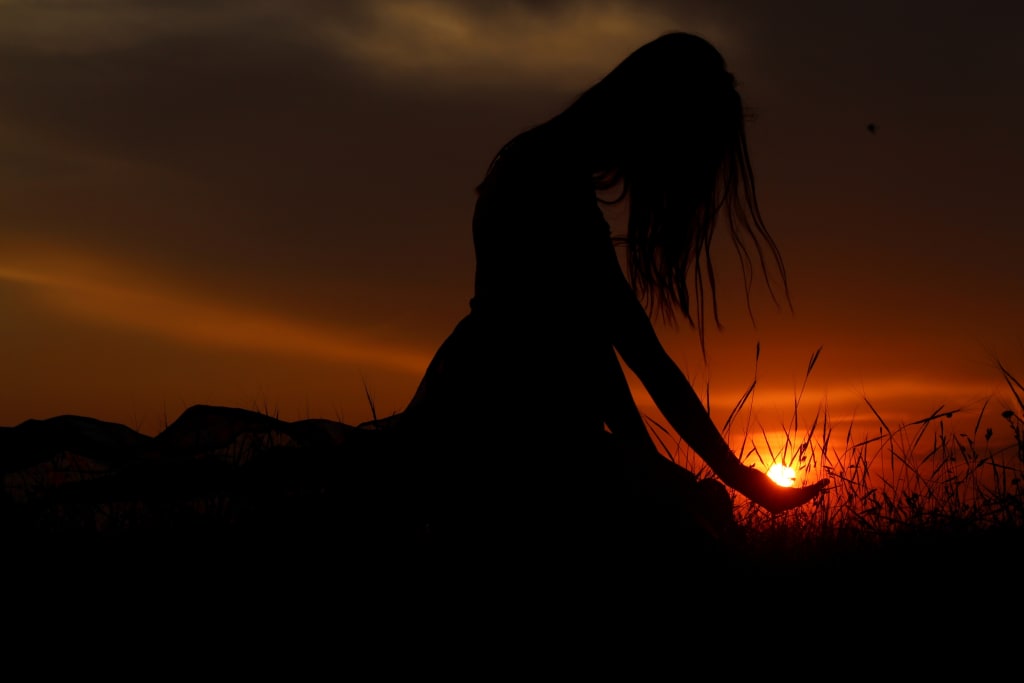
This is the third day the sun has burned in bold scarlet as it rose behind our pear tree. I take it as a sign my world is ending. If Mother were alive, she would have given some cheeky explanation to ease my fears. It is Sir Helios on his chariot, setting the sky ablaze with his personality.
But I am nearly a woman, and answers such as these no longer suffice. Over the last few years, our crops have been lost to drought and flood, groundwater supplies have become limited, and our income has dwindled. I cannot sacrifice an ivory bull to appease Neptune for the heavy rains or curse Jupiter for striking our cattle barn with his rigid spears of light—the gods are not to blame for our undoing.
The pear tree, within sight, is delicate and pale in the distance. It stands as though naked, surrounded by flat fields glowing green in twilight hues. Summer has waxed to autumn, and the branches bear fruit, already fat and ripe. Unlike the last two mornings, I wear Mother’s nightgown and pull it up over my hip bones as I crouch, awaiting movement. It has been a challenge, keeping the silk threads from touching droplets of dew woven among the grass blades.
Satisfied that I am alone, I press forward. My heart insists on beating loudly at my eardrums, coaxing out noises I do not hear. Then, I see myself, an echo ahead in time, tiptoeing translucent in the field. Father hollers out from the bushes, promising an endless string of punishments worse than the Fury who comes for me at night.
This wild imagination requires attention, so my mother often lay with me long after the others went to sleep. In a tone almost a whisper, she devised careful narratives from the illustrations she fashioned in the star-splattered sky. I watched as her fingertip animated bears, a dragon, an eagle, an archer, and more. Not even Gaia could erase her stories from the clearest of nights. I recall tickling the freckles on my siblings’ backs in selfish attempts to claim them, but I knew I was not (and would never be) a goddess hiding among mortals and the trivialities of farm life.
Although faded now, several stars remain in the aura-filled sky as the sun and moon cross celestial paths. One of them belongs to the tantalizing harp that Hermes gave Orpheus to woo his love with. I pretend that Mother walks behind me as Eurydice had when Orpheus tried to rescue her from Hades in the underworld. It isn’t difficult; the air turns colder in the open, and quick hot breaths feed the morning fog that slithers about my ankles. It was only when Orpheus turned around that Hades yanked her back under, so I focus my eyes on the pear tree. I try my best not to listen for her footsteps. For his.
But oh, if I were to ever see her again, I would swallow my joy and sling hurtful words her way. She was our rock, my source of comfort in isolation, the one with all the answers. I would have wasted little time in asking, was it something we did that made you go?
When asked why Father was the only one to venture off the property, she had told us we were nearing the end of the Iron Age. It would not be long before Zeus brought a flood that would nearly wipe out humankind, and we needed to spend our end-of-days together.
Nearly? I had asked curiously. I wanted to know what our chances of survival were.
Few will be spared, was her reply.
As far as I know, this was the only thing she had ever been wrong about. Zeus created us, the Iron Race, and we would nearly bring the world to an end all on our own. The god-of-all-gods would only return to finish us off for good.
I hear a twig crack underfoot, a sound from this world and not the next. With the strength and grace of the goddess of war, I continue without glancing back, as afore practiced. I make my hips sway ever-so-slightly, graze the grasses with my fingers, let the silk drink the dew. I embody the name I was given.
Athena.
When Mother named me after this great goddess, she was merely hopeful. In my tiny face was compassion, she had said. I would grow into my strength. But I wonder now if I had disappointed her. If only she had allowed herself the opportunity to observe my courage.
In the days that led up to her death, I noticed a change, however subtle. Come night, she was quiet. Tired. She no longer told me the oral histories of her immortal companions. The state of the world, her world, became unknown, and I briefly wondered which stars told the story of her life. Was she somewhere up there among them? Was I?
Once, when I relieved myself late one night, I looked up at the attic window and noticed the warm glow of a kerosene lamp in the attic window. I stood outside for some time as the crickets, fireflies, and toads played their nightly symphony. Eventually, in a little burst of breath, the lamp blew out, and I spied my mother expertly dodging creaky floorboards in our darkened house. Her white nightgown gleamed in silver as the cool moonlight trailed in through the windows. Although the need to know was strong, I did not venture up to see.
I would never tell.
A few days ago, I finally found the courage to climb those dusty stairs. On a small trunk with her belongings was a note that said, quite simply, “Athena.” A dusty corner in the attic had been left for me. There were pages scribed in identical lettering, bound by leather, the universe transcribed by the gods—or so I first thought. As I read, more questions arose. More answers: unknown. There was no one to satiate this thirst for knowledge now, and my imagination, I feared, had gone too far.
Then, I recalled the eccentric things my mother had done over the years. Getting lost running in the woods for days before my father found her and brought her back to us. Jumping into a thawing pond with waters chilled like ice. Accidentally slicing her wrists while conducting her daily chores.
I did not see my mother’s pain until it had already drained the light from her body. I did not know pain until she left me behind. Mother was a woman unable to bear the burdens of life like Atlas, and if I had known, I would have tried to carry her myself.
I wish to speak with Zeus directly: why was my mother not spared? I want to ask my translucent self from the past: why did you not stop Mother when you saw her run off like that to the pear tree?
Unfortunately, I have only myself to rely on now. I reach the tree and sigh, looking out at the rising sun that has warmed to blood orange. I have anticipated this moment for every second leading up to it: I will feast on a pear and then let the carcass drop, as mother had in the end. The sweet juice explodes from the grooves of soft flesh as my teeth pierce it, and I close my eyes, allowing it to drip.
The time has come.
With a deep breath, I turn, a radiant goddess haloed by fiery sun rays beneath our pear tree. Father watches me float beneath the branches, long white silk hiding my toes. He buckles, face contorts, and tears escape his eyes in a manner I have never before seen. When his skin becomes so flushed it appears to melt in the wake of my light, he retreats. Back the way he came, and in reverse, looking until he cannot anymore. We had only ever had this one thing in common, loving Mother more than anything else in the entirety of the universe.
My world is not ending, I realize. It is just beginning. Mother’s ghost will keep him going another year so we can continue to grow and gain strength. One need not be immortal to be brave, and one day, I will take my brothers and sisters on a chariot of my own and ride the sunset into the flaming horizon. I will meet the men called Hesiod and Homer who invented the gods to give us hope. Then, I will write my own stories and bind the pages with stars to set the words alight.
It is what Mother would have wanted.
About the Creator
Jessica Hanisch
Writer, reader and 24-hour dreamer, chasing down moments to live in whole-heartedly alongside fiction.
Keep reading
More stories from Jessica Hanisch and writers in Fiction and other communities.
The Unexpected Visitor
You can’t look at the dead and see only a cadaver, Wren explained during dinner. As she spoke, Mick scrambled to make sense of her. This soft and dainty soul once screamed in a heavy metal band and surfed in mosh pits above sweaty living bodies. And while grossly opinionated about nearly everything, she returns from her passionate tangents just in time to giggle at herself for having gone on them. And then, of course, there is the unapologetic way swear words clip at the soft lull in her voice, a siren’s song to his ears.
By Jessica Hanisch4 years ago in Fiction
So You Decided To Become a Nurse Practitioner:
So you decided to become an "Advanced Practice" nurse. Congratulations!... is what I would say if this was a good idea. Grad school? In this economy? What were you thinking? Likely it was something along the lines of either 1) “I've seen these other chucklefucks do it— Why can't I?” or even 2) “I've got a nice career, I should shake it up. I miss feeling like I have no clue what I'm doing.”
By Sandor Szabo3 days ago in Fiction


Comments
There are no comments for this story
Be the first to respond and start the conversation.