
Exploring reality of time travel
Science fact vs Science Fiction

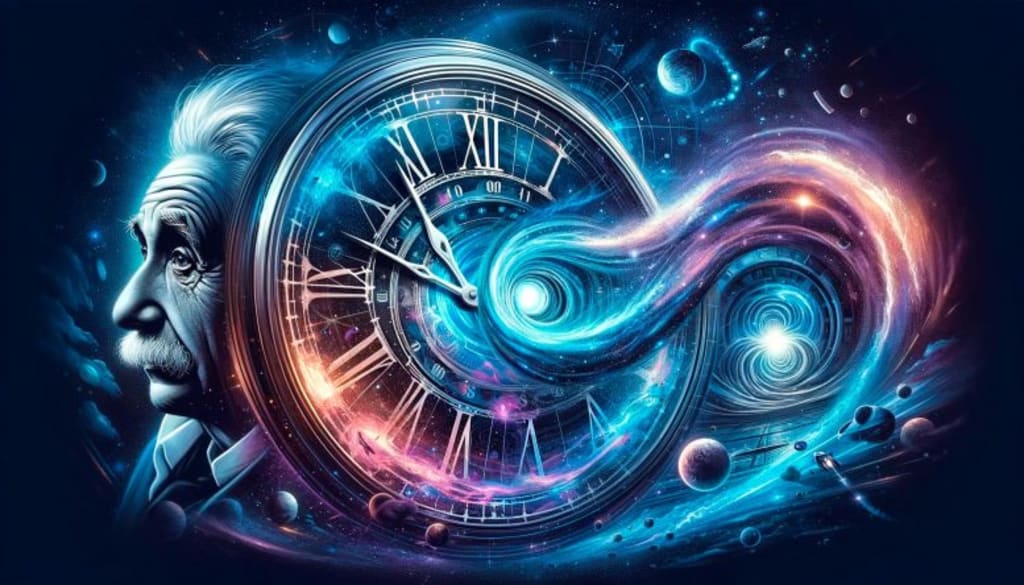
IS TIME TRAVEL POSSIBLE
Have you ever dreamt of traveling through time? I'm sure we all have. Maybe you want to go back to the past to see how things were, or even change something. Or would you prefer to go into the future to see how things turn out? Time travel is a mainstay of science fiction, with books and movies imagining the benefits and risks of such an ability. But is time travel actually possible? And if so, what do we need to be able to do it?
To understand how we might go about traveling through time, we must first understand what time is. Classical physics saw the concept of time as something that exists for everyone, everywhere in the universe. It's independent of anyone who perceives it and progresses at the same pace for everyone. This means that a cause is always followed by an effect, never the other way around—something that the structure of the universe relies upon. The problem with this understanding of time, though, is that it doesn't hold true in all circumstances. That is why Einstein's theory of relativity is seen as one of the most important scientific breakthroughs ever because it explains the changing nature of time. The theory of relativity sees time as one element of four-dimensional space-time and can be influenced by other factors. For example, objects moving at high speed experience time slower than those moving with less velocity, and there's a similar effect for objects held within gravitational fields. On a human level, this means that an astronaut orbiting the Earth will age slower than those of us who remain on the planet. But there are far more unexpected consequences of this.
Take black holes, for example. They exert the greatest gravitational pull of any known object in the universe. They are so strong that light itself cannot escape, and they also cause time to slow down to an extreme level. If you were to, say, fall into a black hole while looking out into the rest of the universe, you would, in theory, witness hundreds of millions of years' worth of events before ultimately succumbing to your inevitable fate—or getting trapped behind some bookshelves. If it were even possible to escape a black hole, so much time would have passed on the outside that life would be completely unrecognizable.
Another quirk of time occurs with the speed of light. As you get faster and faster, time slows down for you, and this continues until you reach the theoretical maximum speed that anything can reach—the speed of light. At this speed, time has slowed to such an extent that things seemingly happen instantaneously. Imagine, for example, a photon of light emitted by a star on the other side of the universe. It will take, even at its incredible speed, many millions of years to reach us on Earth and be seen by our eyes as a twinkle in the sky. For the photon, though, the journey is instantaneous; it is created and then reaches us in the same instant. When traveling at the speed of light, time is neutral; it travels neither forward nor backward. So if the faster you go, the slower time appears for you compared to everything else, this is a potential route to traveling forward in time. You could speed away from Earth and return, and many years would pass without you getting much older.
The really difficult part, of course, is going backward in time. If at the speed of light time is stagnant, then does that mean if you were to travel faster than the speed of light, time would work in reverse? Many researchers think so, and there is a theory that a subatomic particle known as a tachyon does exactly this. These particles are theoretical and have never actually been observed, partly because if the theory is true, you would never be able to see them coming toward you, as this event would be occurring in the future. The ideas of cause and effect would work in reverse for tachyons, but there are those who believe that harnessing them could be the best route to learning how to travel through time.
Another theory is that of wormholes. These act as tunnels through the fabric of space-time and could create a path between any two places at any given time. The theory of relativity actually allows for wormholes to exist, but the energy levels required to create one would be astronomical and could result in the formation of a black hole. Stephen Hawking believed that the radiation feedback—which works in a similar way to the feedback of sound—would make wormholes inherently unstable and unable to last long enough to be used as a time machine. Other researchers have suggested a number of ways in which space-time could be harnessed to allow time travel. Perhaps lasers could be used to create extreme levels of gravity, quantum physics may allow for the formation of a so-called quantum tunnel between universes, and perhaps string theory might lead to revelations about how cosmic strings and black holes could intertwine to warp space-time enough to travel back through time.
In conclusion, the notion of time travel has long been of interest to researchers and all of us at some point or another. For a long time, it seemed completely impossible, but with advances in our understanding of the universe in the last century, it's no longer seen as completely impossible. It's still an ability that lies well beyond our current capabilities, but the laws of physics do allow for it to happen. It could very well, in the future, become more of a fact than fiction.
Thank you for reading
---
About the Creator
Richchik Bardhan
A MBBS student,Love to read and write about science facts and sometimes sci-fic too because Some sci-fic can later be proven into facts someday.....
Keep reading
More stories from Richchik Bardhan and writers in Fiction and other communities.
LIFE ON MARS
In life, it's not just a person, place, or thing; it's an occurrence where a bunch of events, all happening in a sequence, cause and effect, lead to results. Life, whether we want to admit it or not, is elusive. No matter how hard we try to pin it down, it escapes us in so many ways. Yet, as human beings, we still try to study it, hoping that if we capture different aspects of it, we will finally understand what life is and, by doing so, what life really means. This has been humanity's pursuit for as long as we have been conscious of ourselves as truly sentient beings.
By Richchik Bardhanabout a year ago in Fiction
So You Decided To Become a Nurse Practitioner:
So you decided to become an "Advanced Practice" nurse. Congratulations!... is what I would say if this was a good idea. Grad school? In this economy? What were you thinking? Likely it was something along the lines of either 1) “I've seen these other chucklefucks do it— Why can't I?” or even 2) “I've got a nice career, I should shake it up. I miss feeling like I have no clue what I'm doing.”
By Sandor Szabo4 days ago in Fiction



Comments (2)
Amazing write up
Well detailed analysis and thanks for sharing