


I was spending the night at Annie’s house. She lived in a big Victorian on the edge of town. It had a veranda and a lawn in front with a barn in the back. I lived with my mom and brother in a triple-decker by the school. There was no lawn and it was always noisy and cramped.
Annie and I watched a monster movie on the late show and then, after the tv station signed off for the night, we huddled around her transistor radio, listening for our favorite song. Annie drowsed off quickly. I had trouble falling asleep because I am alert to every sound or movement, especially in an unfamiliar bedroom. The house was old and it creaked as it settled. The wind made tree fingers tap at the window. There were owls and fishercats, hooting and howling, too.
At 2 a.m. I was awakened by a flickering light and the moans of a lonely cow. The barn light was on, but it didn’t look like anyone was out there. I didn’t think Annie had a cow. I went back to sleep.
“The lights came on in the barn about two o’clock in the morning,” I said to Annie over a bowl of cereal. “It woke me up.”
“It happens a lot. The lights come on in the middle of the night, but they go off in the morning. We haven’t been able to find the switch that makes it do that.”
“Yeah, probably a ghost,” I joked.
Annie choked. “There is no such thing as ghosts. I don’t believe in them.”
I had to get back home so I could meet up with my grandmother. I joined her and her friends at the church hall to play Bingo once a month. They met up for Bingo as long as I can remember. I liked to hear them pray for winning numbers, cuss when they lost and gloat when they won. They cackled when they laughed, loudly and often.
The church hall was already smoky when we arrived. We sat in the front where we could see the Bingo board and hear the numbers. The ladies arranged their six cards each and their markers and their lucky Bingo talismans in front of them. My grandmother announced to her friends, “Nancy stayed over at the Parker girl’s house last night.”
“The Parkers? The new doctor? Who bought the old Atkins place?” asked Vera.
“Yes, the Victorian on the hill, where Dr. Atkins was murdered.” my grandmother replied.
“Wait! What? A murder?”
I was really interested to hear more but the other ladies scowled and shook their heads at the subject. They didn’t need to say anything to remind everyone there that the subject was taboo.
I lived in a town where nothing ever happened. The same families lived there for generations. The town’s history was the intertwining of the families’ histories. The descendants of the bankers still owned the bank, the undertaker was from a family of undertakers. The teachers and the preachers were about the only community members who ever moved in or out. Everyone knew everything about everyone else and gossip was a sport. That the Bingo ladies wouldn’t talk about a murder that happened in our town was very strange.
So strange I have thought about it for the fifty years since I spent the night at Annie’s. I have wondered about the mysterious light in the barn and the murder that occurred there. There are facts and explanations, but even now the truth of what happened in the barn that spring night in 1918 is unknown.
The grand jury could find no one at fault for the doctor’s death, yet many were suspected. Was it the banker who had a bruise on his face the next day? Was it the sickly wife who was jealous of the attention her husband received from his flirtations with the ladies of the town? Was it the tenant with the suspiciously German-sounding name? Was it the summer visitors associated with a spy ring?
I read the transcripts of the grand jury testimony, preserved by the historical society. I looked up newspaper coverage from the time. The story made national headlines. Investigators came from Washington, D.C. I asked the old-timers around town.
People in town still won’t talk about the case, all these years later. At the time of Dr. Atkins’s murder the town was being challenged as new immigrants settled in the area to farm and work and tourists were coming to enjoy the fresh air away from the city. This was good for business, but these people were all outsiders. With a war in Europe looming on the horizon, one could not be too careful. The Atkins case pitted the town against each other as accusations, speculation and rumors flew. The rift has never healed and those who know or remember aren’t talking about it.
Surely someone must know what happened, unless they are dead now, too. Someone must know who came to the barn in the middle of the night and murdered Dr. Atkins.
Dr. Atkins was a semi-retired doctor who came to our town on vacation. He and his wife Mary were charmed with the town and they bought the Victorian as a small working farm. Besides being murdered in our town, Dr. Atkins was known for his car and for his cows.
Dr. Atkins owned one of the first cars in town. It was a Peerless Touring car that wasn’t much good for driving on rutted, rocky roads, but could get the doctor to a patient or to the hospital much more quickly than the wagon. Being the only car in town, it was featured in every parade. The car was a curiosity to everyone and a sign of status and wealth to those who cared about such things, like the banker, Mr. Boyd.
Dr. Atkins pictured himself as a country gentleman, and he insisted upon doing much of the work around the farm himself. He would occasionally hire a hand to help with haying or shearing, allowing them to live in a small cottage outbuilding at the back of the property. Dr. Atkins insisted upon tending the cows himself. He raised prize Jersey cows which he boasted gave the best milk. He made sure the new mothers he treated had plenty of milk, while he had fresh cream for his coffee and for the strawberries he harvested in the late spring.
Dr. Atkins was the happiest in the barn. It was his respite from the stress of caring for his wife of 38 years, as her health and her mental condition deteriorated. He kept the Peerless under a tarp in one part of the barn. Sometimes he would just stare at it in amazement for the good fortunes of his life. He especially like the barn in the middle of the night. He was sure Mary was settled and asleep and he could have time to think. He would turn on the light at around 2 a.m. and turn it off on his way back into the house at sunrise.
The murder occurred in the barn. The cows’ breath came out in puff clouds of steam against the cold air. Dr. Atkins was rendered unconscious, bound hands and feet with ropes from the cattle stall. Dr. Atkins’s body was dragged across the straw on the barn floor, across the yard and dumped in the well.
Mrs. Atkins woke up and saw the light on in the barn. She waited for her husband to come in from tending the cows. When he hadn’t come by morning, she sent for the police. She was the main suspect in the early days of the investigation. She couldn’t have done it, not by herself anyway. She was too weak. She barely had the strength to come to the door. She died in a mental hospital before the year was out.
The next suspect was the tenant who had been helping Dr Atkins put up a fence. There had been some conflict with him which had led Dr. Atkins to evict him. The conflict involved the rumors of German spies who were in town. They were sending messages to U-Boats offshore by flashing codes with mirrors from a trail nearby. The doctor thought his tenant was a spy and had gone so far as to send a confidante to the city to get a federal investigator in on the matter. Dr. Atkins died before the investigator arrived, adding t0 the speculations about his murder.
Some speculated that the car was the motive for Dr. Atkins’s murder. Some suggested that it was Mr Boyd, the banker who was jealous of the Peerless.
Several books have been written about this case and last I heard there was talk of a made for TV movie based on the story. The books rehash all of the theories already set out and the screenplay was an adaptation of one of the books. While the theories were sensational, I suspect that the real truth was something much more simple. The sketchiest evidence I have is what my grandmother told me. It is what makes the most sense to me.
My grandmother was adopted by the Rich family when she was days old. Mr. Rich was a businessman and selectman. They were approached by a priest from a nearby town to see if they could provide a loving home for the baby since her unwed mother could not. They were happy to adopt as their only other child was about to leave for college. Mrs. Rich had always wanted a girl and was fretting over how empty the house would be without her son, Trevor.
Trevor was a great big brother. In spite of the eighteen year age difference, he took great interest in helping tend to the baby and as she grew, he played with her, took her on trips and doted on her. As wonderful as he was, he drank a lot and was often in fights. When my grandmother was older and living on her own, rather than go home, he would show up at her apartment so she could tend to his wounds and he could sober up.
Great-uncle Trevor passed away in the 1980s. My grandmother was there with him, holding his hand, until his last breath. She says that’s when he told her what happened. He was urgent, like telling her was the last thing on his list before he could let go.
He said he was sorry. He said it was an accident and he never meant to hurt anyone, especially her. She didn’t understand what he meant.
He said it was springtime and her mother was the prettiest girl. She was new in town, the preacher’s daughter. They had been drinking with a bunch of his friends. They started talking about cars. He decided to show her the Peerless.
He knew the doctor kept it in the barn. They tiptoed across the back part of the property to the back of the barn. They opened the big door, stifling giggles as the door creaked. He lifted back the tarp and invited her mother into the leather-upholstered seat. They smoked cigarettes and then he kissed her. They drifted off in each other arms. They awoke to lights and yelling.
Dr. Atkins was mad. He was swinging a rake. Trevor grabbed a board. He swung at the doctor. The second lick hit and the doctor went down. There was blood. In a panic, they tied him up and dragged him to the well house. They promised that they would never breathe a word of what happened that night and they would never see each other again.
“I’m your father. I love you. I’m sorry. It was an accident. Don’t tell.”
About the Creator
Faye Hanson
I am a teacher and professional storyteller, living between two worlds- in more than one way.
Keep reading
More stories from Faye Hanson and writers in Fiction and other communities.
Eve
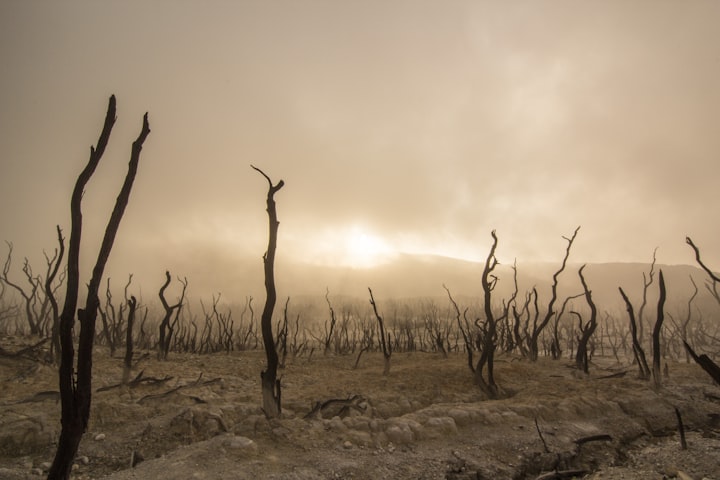
The Erasure came when every plant was erased from the surface of the Earth. With no plants to hold the topsoil, the ground turned to dust. The rains were infrequent. The sun was relentless and the wind was fierce. When it did rain, the precipitation was full of the poisons that had accumulated in the atmosphere, made more toxic by the radiation from the sun. The rains came in torrents that made the flat places into a muddy churning and the places below the surface that had sheltered ancestors in the beginning were filled with poisoned water. What people remained took to higher ground.
By Faye Hanson5 years ago in Fiction


Comments
There are no comments for this story
Be the first to respond and start the conversation.