
Dante's Oblio
Book IV of Dante's Divine Comedy
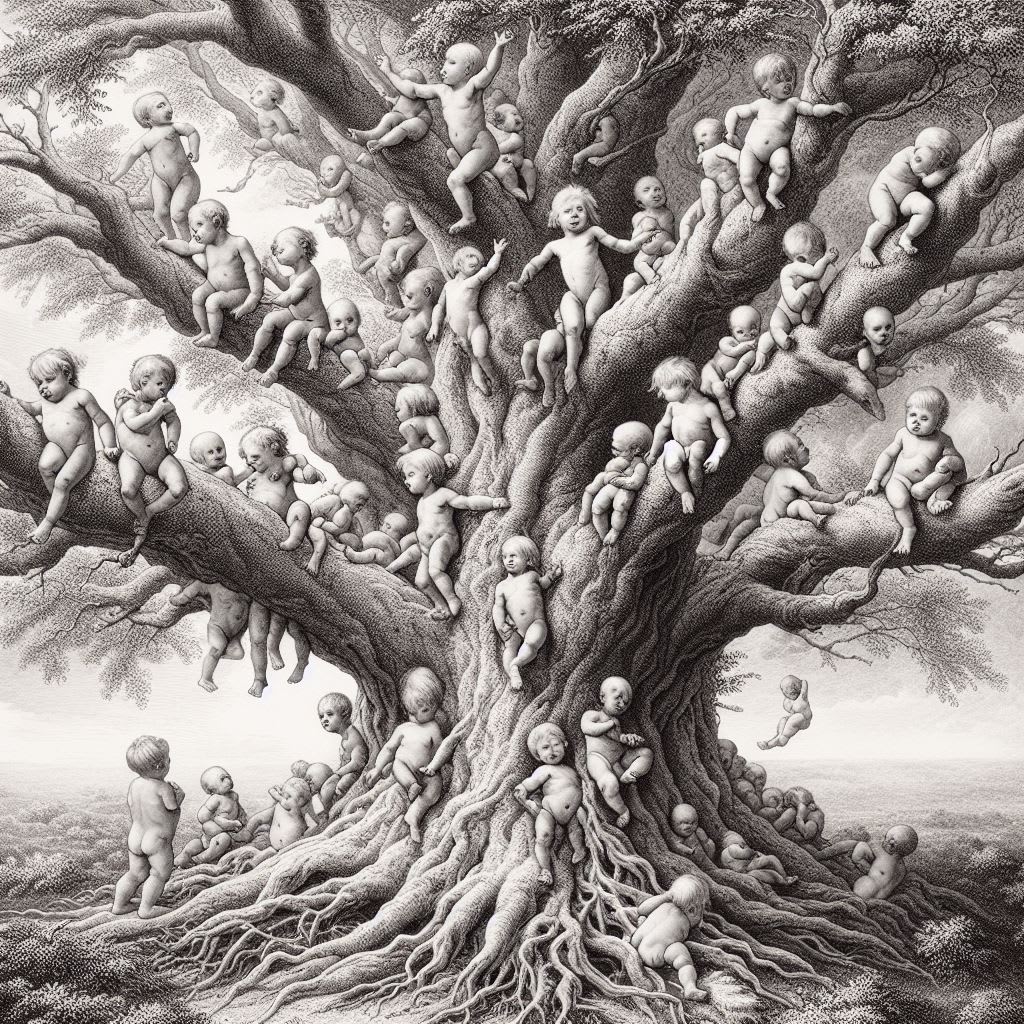
Oblivion is an eternal state of lack of awareness thought by some to occur after death. This idea contradicts beliefs that there is an afterlife, such as a Heaven or Hell, after death. Limbo, in Catholic theology, was believed to be neither, for those souls who died without Baptism. Although not condemned to punishment, they were, by dogma, deprived of admittance into eternal happiness with God (in Paradise). If this were really the Church's position, there would remain one of the black eyes on Catholicism, necessary to be overturned by a theology centered on an all-loving and just God.
I, myself, was raised Catholic. But as one grows older and matures, so should one's theology mature — from what we as children are told in grade school and from which, unfortunately, many never "graduate." (Once, a Nun actually kicked my Guardian Angel out of the classroom because I was misbehaving. You can only imagine!)
With that in mind, I flash my creative license to hereby announce to the world that a newly discovered fourth and final book extends the trilogy to a tetralogy, as Dante’s forays into a fourth realm, a gossamer world of almost-souls — Limbo or, alternatively Oblio, or Oblivio.
Herein continues the "Pilgrim's" itinerary, where his Paradiso left off. His guide, Beatrice, says goodbye to him as he crosses the threshold into Oblivion, and where she introduces to him his new guide. And also where I gingerly, but hopefully, place a raw steak on an ecclesiastical black eye.
***
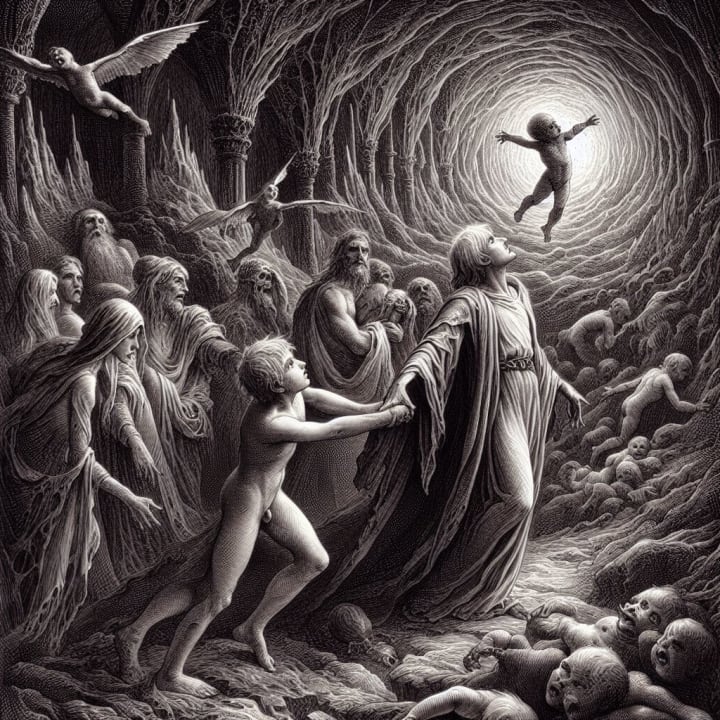
Translation by Gerardo DiLeonardo
BOOK IV, CANTO I
Beatrice and I passed through the threshold.
We withdrew from the bright Empyrean
To a fourth realm where the Trinity ends.
.
Whereupon we happened onto a bush
That burned, but within she reached and retrieved
From its smoldering branches an infant.
.
Whom she offered me and directed me
“I cannot go with you any farther.
“But take this infant,” she said and then left.
.
I called to her, uneasy without her,
Back to that threshold before it had sealed:
“Is it yours?” I asked, and she heard me thus.
.
“It is everyone’s,” she answered to me.
"Born of the sun, but grown here in this shade,
"Blind but seeing its place; deaf but not deaf."
.
I held out my arms to receive it so,
A life begun, a soul in suspension,
A child like none other, a special child.
.
Cherubic yet a fully formed infant
Who replaced Beatrice as rightful guide
And meant to take me through this eclipsed realm.
.
Bestowed gifts of speech; he wore around him
Pristine leaves around his pelvic girdle,
By which he/she remained not boy or girl.
.
“I will lead you,” he/she said, “for your tour,”
Which startled me upon first hearing it.
Yet it sounded so naturally true.
.
“And what is the place, child?” I asked, amazed.
“I’ve been to the Empyrean, indeed
So my apotheosis is complete.”
.
“No. You must see here, as well—dwell with us.”
He held out his plump forearms to presage
And sweeped the vista to the horizon.
.
“This,” he answered, “is our lot’s shadowed world."
(For which “he” is to mean he/she, him/her,
His/hers, to encompass androgyny.)
.
“Behold! The shadow world of Oblio—
“Oblivion, but to us, permanent.
“It is, but is not, was, but was not, still.
.
“This inconclusive land be Limbo?”
I asked, but I knew too well the answer.
“Yes, the Limbo—Oblivion, no more.
.
“Where we, the Unaware, the Unbaptized,
“The Incomplete. The not-damned, the not-saved,
“The also-are, and-were, also will be.”
.
“This Oblio? You are not baptized, child?”
“No,” he answered, this homuncular child.
“Is it,” asked I, “your absolute placement?”
.
“My final placement, is it?” he rejoined.
“Would not, I know, not till finality?
“For now that remains unbeknownst, secret.”
.
“I am unborn yet again—unaware,
“All forgotten, with the woe-begotten,
“The misconceptions, and the ill-conceived.
.
“We are amiss, dismissed, in the abyss
“We have been taken, yet well-forsaken,
“The wretched, the weathered, and untethered.
.
“I beg you: take me to finality
“Take us all, we are helpless and inert
“How we suffer, for oblivion hurts!”
***
BOOK IV, CANTO II
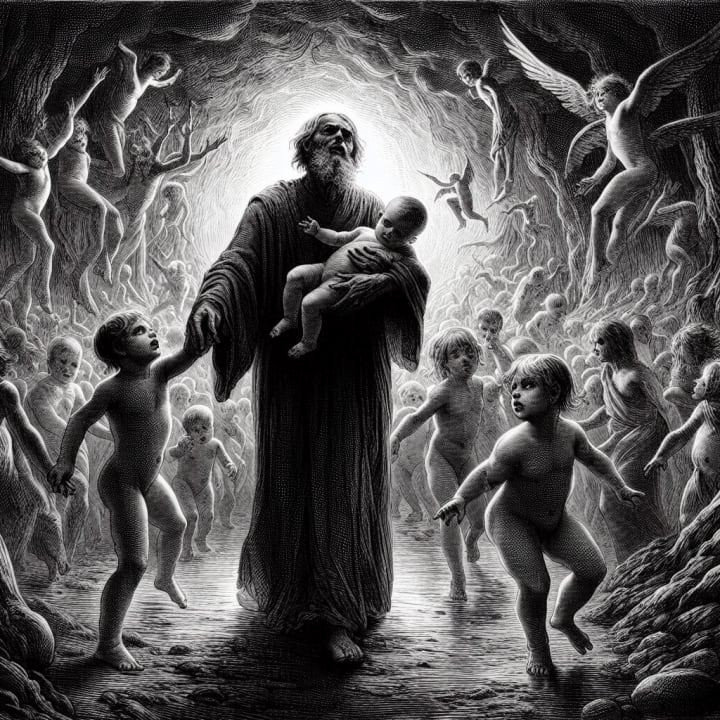
He held out his cold, diminutive hand
And grasped my first finger, in sweet embrace.
He could walk, yet no more formed than newborn.
.
He could speak, he could smile, and he could laugh.
He laughed. He laughed. And he laughed yet again.
But I saw nothing amusing or queer.
.
“Why do you laugh? What do you laugh about?”
“About this place,” he said. “You stand out here
“As a beacon, omnidirectional.
.
“Oh! you illuminate the restless shades
“Who undulate beyond that false brightness
“On the irregular terrain we walk.”
.
“And why is that funny, child?” I ask.
“Is this amusement, this dark tragedy?”
“Because — the joke is on us,” he replied.
.
“And it is funny. My tears are laughter
“And I do not even know how funny
“Which is yet a joke upon a joke.”
.
He paused his footing. “Why do you not laugh?”
“Because of the sadness," I answered him.
“The sorrow, the waste that perseveres here.
.
“Without hope, without purpose, without worth.”
"Is," he asked, "weeping not Satan's laughter?
“If not, show me different, traveler!" he said sternly.
.
“I am the stranger here,” I replied back.
“You are my guide. But I am whole. I’m saved.
“I can see both sides, can see with both eyes.
.
“I have sinned Originally, early.
“Ate from the Tree of Knowledge, Good, Evil.
“Leading me to this place’s grim meaning.
.
“Thus I can use my wholeness of knowledge —
“To help you. But, alas, I cannot forge
"A path to Redemption, to Admittence.
.
"That is a path hewn and gorged through bedrock."
Then the child began to weep. "More laughter?"
“Help,” he explained. “A deciet, the one word —
.
“An idea. A promise, that makes me cry.
“For there is no help here in this void!”
And as if on cue, on this eerie stage,
.
It happened that a large stone rolled away
With a finality of sound, crushing,
As all things sounded here in the deadness.
***
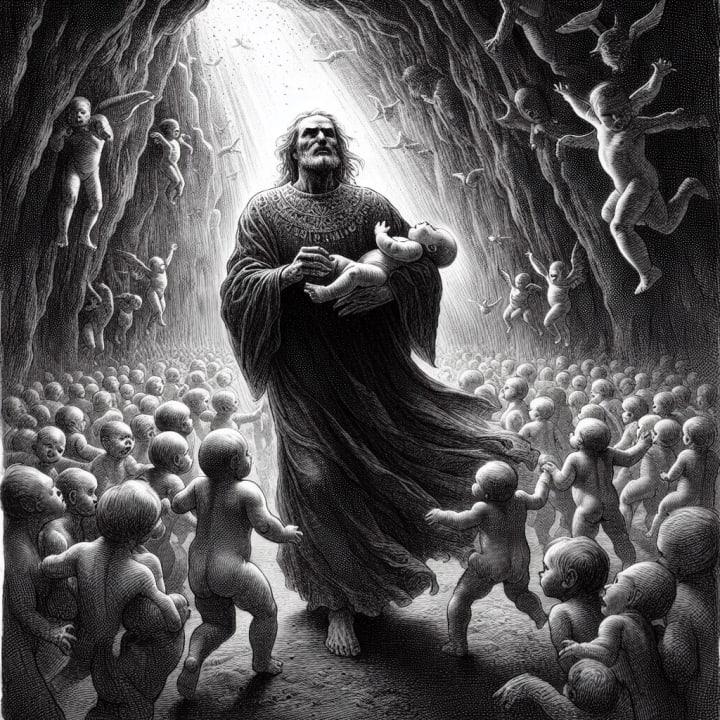
BOOK IV, CANTO III
Entrance, unblocked, beyond which we saw light
And a tall man, silhouetted through it.
“Come hither, Dante,” he instructed me.
.
“And bring the babe, for I have wondrous news!”
“Who are you?” I asked him, the babe’s jaw slack.
His eyes squinted, unaccostomed to light.
.
“Joseph Aloisius Ratzinger,
“The sixteenth Benedict in succession.
"And I come to you on my own accord."
.
The light brightened, and other souls followed.
For beyond the open threshold was one word:
Help. The one word. An idea, a promise.
.
And Benedict walked us all through that gate.
Beyond lay the Empyrean, t’was true.
Blinding in its honesty and joy.
.
And my tears fell as newborn cries for us
And for all those finally collected.
To fill the holes in the Empyrean —
.
Righting the wrongs of condemning those souls
The misconceptions and the ill-conceived
Redeemed from the wrath of superstition.
.
I addressed the late Pope as I passed through:
"What have you wrought? What Testament is this?"
"A Newer One without magic or tricks,
.
"Where the fallible can no longer cite
"Fallibility — for the miracles,
"And blind beliefs, and fearful coercion."
.
"High praise to you, sir," I said as I passed.
"A crown of achievement, encyclical."
"One of thorns," he spoke, "with much more to do."
****
AUTHOR'S NOTE: This submission has a companion poem, called "Limbo," at https://shopping-feedback.today/poets/limbo-6r2sg06zp%3C/a%3E.%3C/p%3E%3Cfigure class="css-drbim6-Image">
About the Creator
Gerard DiLeo
Retired, not tired. Hippocampus, behave!
Make me rich! https://www.amazon.com/Gerard-DiLeo/e/B00JE6LL2W/
My substrack at https://substack.com/@drdileo
Keep reading
More stories from Gerard DiLeo and writers in Fiction and other communities.



Comments (1)
Absolutely stunning and moving