
CONFUCIUS AND SOCRATES: THE DAWN OF A NEW WORLD
Chapter 4 - The Circle

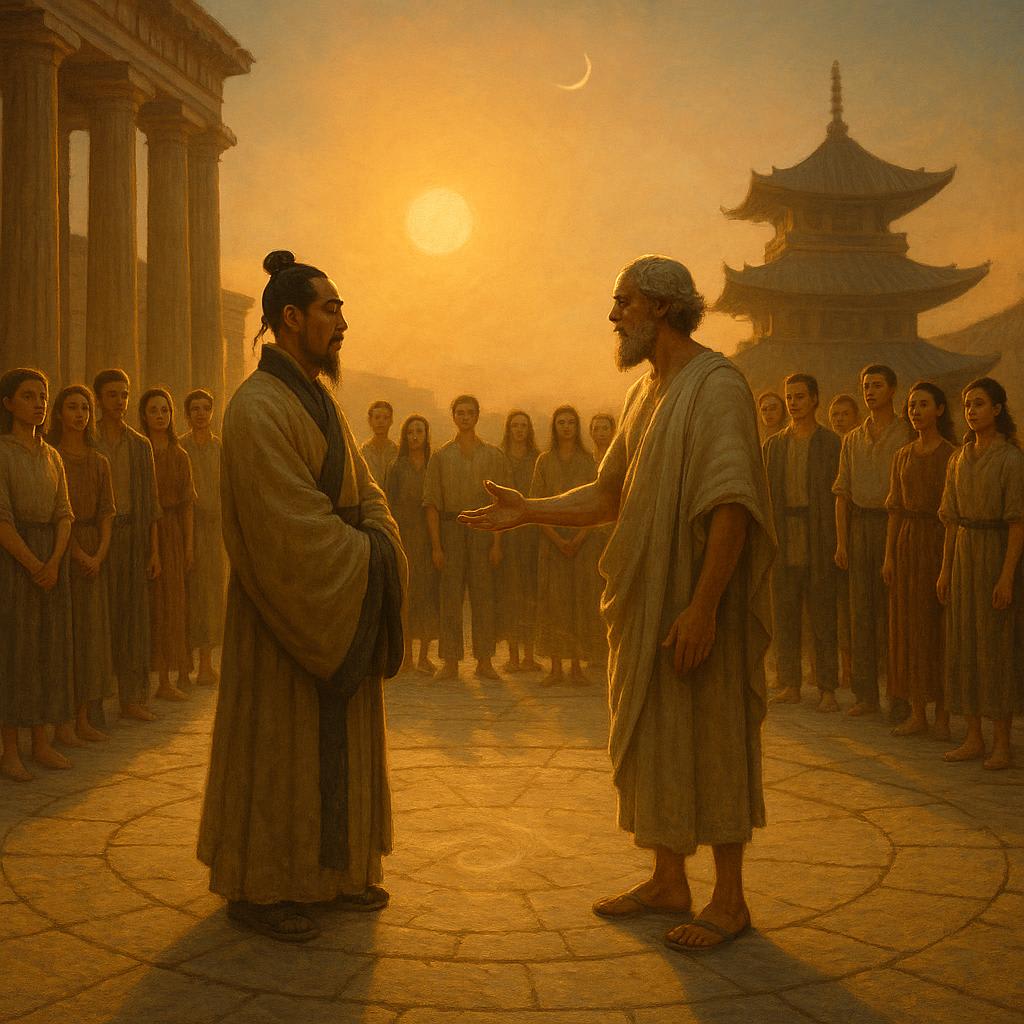
The sun, hanging above the square, cast long shadows around the circle formed by the disciples.
Confucius and Socrates stood facing one another, a few paces apart.
Behind each stood about twenty young men and women, seated in silence, eyes wide open, breath held.
The wind occasionally stirred the dust, tracing fleeting spirals between the ancient paving stones.
The Doric columns and the pagodas with their curved roofs seemed to watch the scene too, in mute solemnity.
Confucius spoke first.
His voice was clear, slow, as steady as a hand on one’s shoulder:
— Right living begins with knowing one’s place.
Just as Heaven is above and Earth below, so too must man honor his parents, respect his rulers, and guide his children.
Order is the condition for harmony.
Without rites, without respect for the elders, man becomes a wolf to man.
Socrates listened, arms crossed, his head tilted slightly like a clever dog observing a new game.
He waited for silence to settle, then responded, his voice hoarse but vibrating with gentle irony:
— But how can one truly know their place, O Master of the East?
Shouldn’t men themselves question what they are taught, instead of blindly repeating the gestures of their fathers?
For he who obeys without reflection is no sage — he is a machine.
A faint murmur swept through the disciples.
Confucius gave a thin smile.
He saw the pitfall, but he had not walked his whole life just to avoid the stones in the path.
He replied:
— To reflect without a model is to wander without a star.
The respect for rites is not blind submission: it is a living memory, a light passed down through the ages.
The sage does not obey; he understands the meaning of what he honors.
Socrates blinked, amused.
He stepped forward, arms open:
— So be it!
But what if the model is corrupt?
If the elders themselves erred, teaching vanity under the name of virtue, fear beneath the mask of piety?
Should we not then break the old vase to shape a new one?
A shiver ran through the assembly.
The duel was rising—not in hostility, but in pure intensity.
Confucius looked at Socrates for a long moment.
Then he bowed slightly, like a go player saluting a bold move.
He responded:
— The old vase may indeed be cracked, yes.
But the clay from which it was made is eternal.
It is not a matter of destroying all, but of restoring the essence—of purifying, not erasing.
Socrates let out a brief, warm laugh.
— Then we are brothers, you and I, far more than we thought.
For I too seek the essence behind dead forms.
But to reach it, I question relentlessly, I unravel every last thread of falsehood.
The circle now vibrated with a gentle, almost luminous tension.
The disciples drank in every word.
Some, come from the East, nodded at Confucius’ words.
Others, enamored with the fire of doubt, smiled at Socrates’.
But none turned away.
All understood that this was not about choosing sides, but witnessing the birth of a new way of thinking — a fusion, like two rivers embracing under the moon.
Confucius, in a softer voice, continued:
— You seek truth through questioning.
I seek it through the rectitude of the heart.
Perhaps our paths are not opposed, but parallel, stretched toward the same star.
Socrates nodded.
His gaze, sparkling with mischief and tenderness, settled on Confucius:
— Perhaps, Master.
Or perhaps we are circling the same mystery—you in the dance of ritual, I in the spiral of doubt.
But in both cases, what matters is not grasping the star, but walking toward it.
A great silence followed those words.
The wind calmed.
The light grew softer still, as if the heavens themselves were blessing this fragile moment.
Then, slowly, Confucius extended his hand to Socrates.
Not as a master, not as a judge — but as a fellow seeker.
Socrates, without hesitation, took the calloused, firm, living hand.
The circle of disciples, as if moved by an ancient force, then rose, forming a human crown around the two sages.
On that day, in that timeless hour, a secret pact was sealed: a new Code, woven from dialogue and respect, from question and ritual, from reason and heart.
A code no book would ever fully write, but which would sprout, long after them, in the minds to come.
Thus began the slow building of a possible world, where one would learn to doubt without destroying, to respect without submitting, to seek without ceasing to love.
About the Creator
Alain SUPPINI
I’m Alain — a French critical care anesthesiologist who writes to keep memory alive. Between past and present, medicine and words, I search for what endures.
Keep reading
More stories from Alain SUPPINI and writers in Fiction and other communities.
Mastering French Without Losing Your Sanity: A Realistic Guide for Beginners
Learning French can feel like solving a Rubik’s Cube blindfolded. The tricky pronunciation, the never-ending grammar rules, and the surprising exceptions make it seem impossible. But don’t worry—equipping yourself with key expressions and effective strategies can turn frustration into fluency. Let’s simplify French and make learning enjoyable.
By Alain SUPPINIExclusive • 11 months ago
So You Decided To Become a Nurse Practitioner:
So you decided to become an "Advanced Practice" nurse. Congratulations!... is what I would say if this was a good idea. Grad school? In this economy? What were you thinking? Likely it was something along the lines of either 1) “I've seen these other chucklefucks do it— Why can't I?” or even 2) “I've got a nice career, I should shake it up. I miss feeling like I have no clue what I'm doing.”
By Sandor Szabo3 days ago in Fiction
The Ritual
Every night at nine, Mara set the second place. She did it even when she ate standing at the counter, even when the sink was full and the radio was still murmuring to itself. She took the blue plate from the cupboard—the one with the chipped rim—and set it across from her. She folded the napkin into a neat rectangle. She put the fork on the left, the knife on the right, blade facing in, as if someone had taught her manners she was determined not to forget.
By Nina Pierce6 days ago in Fiction



Comments
There are no comments for this story
Be the first to respond and start the conversation.