
CONFUCIUS AND SOCRATES: THE DAWN OF A NEW WORLD
Chapter 5 - The First Manuscript

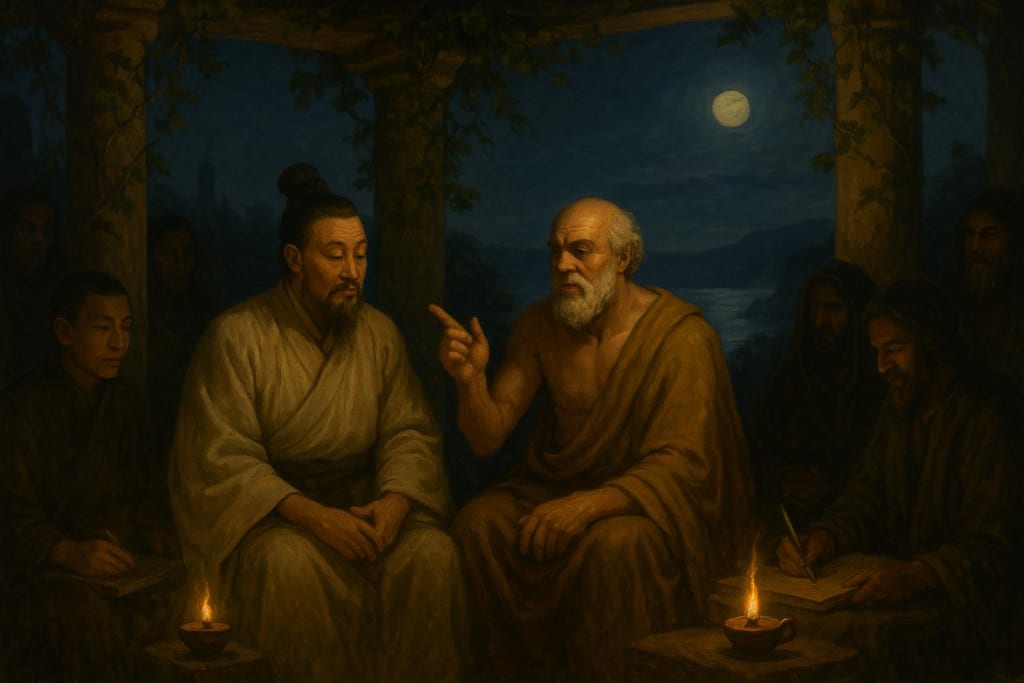
Night had fallen over the nameless city.
Beneath a pergola of stone entwined with ivy, in the flickering light of a few oil lamps, Confucius and Socrates sat side by side.
Their disciples, silent, surrounded the scene like benevolent shadows.
Some held wooden tablets, others blank silk scrolls, ready to inscribe the words about to be born.
A light breeze drifted through, carrying the mingled scents of Greek olive trees and Chinese plum blossoms.
In the distance, the sea whispered against the cliffs.
Socrates broke the silence, smiling with playful provocation:
— Let’s begin, O Master of Rites.
You who love order, give us the first stone of this new edifice.
Confucius closed his eyes for a moment.
Then he spoke, his voice slow and grave:
— The first foundation is inner uprightness.
Before acting, a man must be true within himself.
Without truth of heart, all law is hollow, every custom a mask.
Socrates nodded, thoughtful.
He added, his tone sharp:
— But how can we know the truth of the heart unless we question it?
Let the second foundation be vigilant doubt:
to question one's own thoughts as well as those of the masters — not to destroy, but to purify.
One disciple feverishly wrote:
Inner uprightness. Vigilant doubt.
Confucius continued, now smiling in turn:
— Then comes active benevolence.
To know the truth but not act for others is sterile knowledge.
The sage must be a father to the people, a brother to his companions, a son to wisdom.
Socrates replied without pause:
— And let that benevolence be tempered by lucidity.
To love without blindness.
To help without enslaving.
Good misunderstood can become poison.
Thus, all through the night, the two sages wove together, word by word, the first threads of their code.
Each principle was born of a duel, a creative tension:
Confucius would declare, Socrates would question.
Socrates would propose, Confucius would adjust — sometimes yielding, sometimes resisting.
Little by little, a subtle balance emerged, like a strange dance between the rigor of the East and the boldness of the West.
Here are some of the first articles they carved in silence:
- Be true in your heart before seeking to lead others.
- Question relentlessly, but respect what survives the flame of doubt.
- Love without possessing, teach without dominating.
- Seek harmony, but not at the cost of justice.
- Know that no one is the absolute master: each is a student of truth.
At dawn, the lamps had gone out on their own, leaving only a pale light bathing the pergola.
Confucius and Socrates remained seated for a moment, silent, their eyes lost in the rising mist.
They knew that what they had begun would never be finished.
That this code would not be a law carved in stone, but a fragile music, to be reinvented again and again.
They also knew that long after they were gone, a few stubborn souls — a few unruly dreamers — might one day rediscover these words, and try, in their turn, to make of them a living fire.
And in that place forgotten by the world, two old masters — strangers in tongue, brothers in spirit — sealed without ceremony what would become
the First Manuscript of Right Living.
About the Creator
Alain SUPPINI
I’m Alain — a French critical care anesthesiologist who writes to keep memory alive. Between past and present, medicine and words, I search for what endures.
Keep reading
More stories from Alain SUPPINI and writers in Fiction and other communities.
Mastering French Without Losing Your Sanity: A Realistic Guide for Beginners
Learning French can feel like solving a Rubik’s Cube blindfolded. The tricky pronunciation, the never-ending grammar rules, and the surprising exceptions make it seem impossible. But don’t worry—equipping yourself with key expressions and effective strategies can turn frustration into fluency. Let’s simplify French and make learning enjoyable.
By Alain SUPPINIExclusive • 11 months ago
Miss Persephone's Manual to a Seemingly Ordinary Life
Miss Persephone was found at the dining table, her blue eyes swollen, her tears arriving and retreating like the tides of the ocean. Earlier that day, her family had visited her in the retirement home where she had lived for eight years. It was her eightieth birthday.
By Imola Tóth4 days ago in Fiction
Suprematism. Abstract art based on feelings.
Suprematism is an early 20th-century art movement focused on the fundamentals of geometry (circles, squares, rectangles), painted in a limited range of colors. The term suprematism refers to an abstract art style based upon "the supremacy of pure artistic feeling" rather than on the figurative depiction of real-life subjects.
By Antoni De'Leon5 days ago in Fiction



Comments
There are no comments for this story
Be the first to respond and start the conversation.