
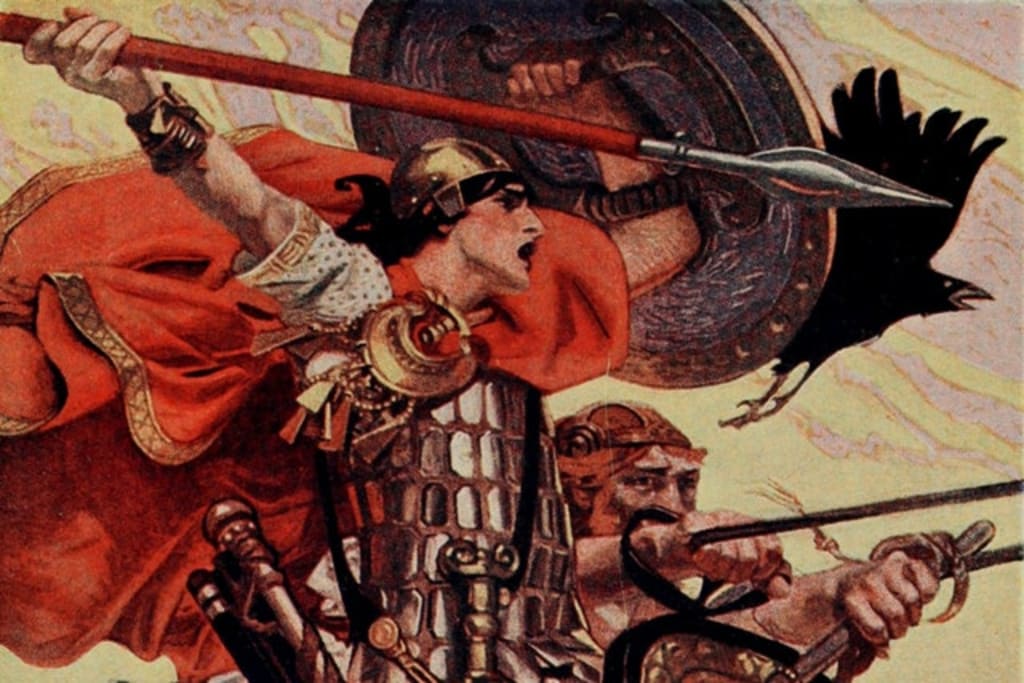
In the old times, one day, the mightly warrior Fionn mac Cumhall and his band of warriors, the Fianna, were hunting deer on the shores of Loch Léin in Kerry when towards them across the waters they saw a vision: a lovely young woman with flowing golden hair, dressed in robes as blue as the summer sky, riding towards them on a white horse. Though she rose over the waters, neither her rich garments nor her horse's hooves were wet when she reached land. The men bade her greeting, and Fionn asked her "What is your name, and what land have you come from?"
"I am Niamh Cinn-Óir (of the Golden Hair)," she said, in a voice like the ringing of many silver bells. "My father is the king of Tír na n-Óg. I have heard tell of a warrior named Oisín, and have come to find him, and take him back with me to Tír na n-Óg."
Oisín, son of Fionn, was a great warrior and a poet, and he had already fallen in love with the beautiful Niamh. "Tell me," he said, "what sort of a land is Tír na n-Óg?"
"It is the land of youth," replied Niamh. "A happy place, with no pain or sorrow. Any wish you make comes to pass, and nobody grows old. Come with me, and you shall see that all this is true."
Oisín bade farewell to his father and friends, and mounted the white horse behind her, promising to return soon. They galloped away over the water, moving as swiftly and silently as a shadow. The Fianna wept to see him go, but Fionn bade them have courage, reminding them of Oisín’s promise to return soon.
When they arrived in Tír na n-Óg, the king and queen gave them great welcome, and held a feast in Oisín’s honour. Oisín was delighted to see that all Niamh had said was true; he passed his time hunting and feasting, and telling great tales of the Fianna and of Ireland. Before long, he and Niamh were married, and their union was blessed with three children.
But after a time, Oisín longed to see home once more, and to visit those whom he loved. Niamh begged him not to go, but after a time she relented and said "Take my white horse. He will carry you safely to Ireland and home again. But whatever happens, you must not dismount, and you must not touch the soil of Ireland. If you do, you will never return to me, or to Tír na n-Óg."
Oisín promised, and set off on his journey. But when he arrived in Ireland, it seemed to him a strange place — there was no trace of his father, nor of the Fianna. He did not recognize the trees, and the people he saw seemed small and weak to him.
As he passed through Gleann na Smól, he saw some men struggling to move a large stone. They were terrified of the giant upon the white horse, but Oisín greeted them kindly, and leaned down from the saddle to seize the stone with one hand and hurl it away. With that one movement, the girth snapped, and Oisín was flung to the ground.
As quick as thought, the white horse disappeared, and the men saw before them an old, old man, with hair as white as clouds and a beard that fell to his knees. They brought him to a holy man who lived nearby and was newly come to Ireland.
"Where is my father, and the Fianna?" Oisín asked. When he was told that they were long, dead, he was heartbroken; though he thought he had spent but a few years in Tír na n-Óg, in reality, he had been gone for three hundred years, and all his friends were long since gone.
For the short time left to him to live, Oisín spoke of the many deeds of Fionn mac Cumhall and the Fianna, and their adventures together. He spoke of the High Kings of Ireland, and the warriors who had ruled the land so long ago. He spoke of his time in Tír na n-Óg, his wife and children, whom he would never see again. Though he died not long after returning home, his stories will live on forever.
Even as a child, I always cried at the ending of this story; thinking about Oisín returning to his longed-for country to find all his family gone was sad enough to make me melancholy for the rest of the night. And all the same, I begged my mother to read us this story over and over again.
I was born the eldest child of first-generation Irish immigrants; my parents only allowed us to watch movies once a week and no television, and my mama taught us all to read almost before we could walk. As a result, we grew up steeped in stories, both real and imaginary. Some of Mama’s favourite stories to tell us, even today, are those of our ancestors and their history. Determined we should know our history, know where we come from, she taught us Irish history as daily anecdotes, until we knew it by heart. We learned disgust for Cromwell before we knew the name “Hitler”; we learned to mourn the Great Hunger over a hundred years later; we learned to remember, always, the struggle that was fought for our freedom from England.
But first and foremost, we learned our stories.
I was three and five respectively when my two younger sisters were born, just old enough to vaguely remember what it was like to be an only child and lonely. As we were growing up, our mother worked full-time, but the bedtime ritual every night was sacrosanct. Every night, we’d climb into her lap in the rocking-chair in the nursery, a tangle of limbs and baby powder and stuffed elephants (our middle sister when through quite a phase), and Mama would read us a story.
I say a story, but the reality was that we begged every night for one more, and one more, and one more, until she finally called a halt to the proceedings and bundled us laughing off to bed. It was always the most magical time of the day, the comfort of being cuddled up together, warm and sleepy, watching spellbound as she turned the pages and let us follow along as we read. I lose count of how many stories from how many books we heard over the years, but the best nights by far were those when Mama pulled out a particular storybook -- Irish Legends for Children. It’s a thin volume, with brightly-coloured pages; to this day, it sits on the bottom shelf of my bookcase. There are only six stories inside, all Irish myths condensed down into child-friendly forms, taking out the majority of the violence and graphic descriptions so as not to give us all nightmares. By the time I was six, I had memorised all of them, and all three of us -- including my baby sister, who at the time was speaking in babbles -- had very strong opinions about which were the best and why.
We all had a soft spot for the story Setanta, the story of the young boy who killed the ferocious hound of Chulainn, and so earned his name Cú Chulainn, the Hound of Chulainn, the legendary warrior of myth.
Our baby sister loved -- as she conveyed with babbling of increasingly-excited squeals, blowing spit-bubbles, and making grabby-hands at the colourful pages -- the story of Fionn Mac Cumhall, and the dragon he slew for the High King of Tara on the night of Samhain -- Halloween night, in a post-Christian world.
My middle sister loved The Salmon of Knowledge -- the story in which the boy hero Fionn mac Cumhall and his tutor Finnéigeas, who caught a magical salmon in the River Boyne. Once Fionn burnt his finger on the cooking fish and sucked the burn, he was gifted with the knowledge of everything there was to know in the world. She loved the idea of being granted immense knowledge, I think.
Me, I always loved the sad stories. Granted, Irish legends are steeping in tragedy and grief; loss and the reactions to loss are to Celtic mythology what hubris and the pride of mortals is to Greek mythology. Three of the six stories in our book were sad, heartbreakingly so; the Children of Lir, the four sibling turned into swans by their stepmother, doomed to wander the waters of the world for nine hundred years. Deirdre of the Sorrows, doomed from birth to bring the tragedy of the ages upon her people by falling in love with a young warrior against her king’s command. And saddest of all, to my mind, the story of Oisín of Tír na n-Óg.
I knew these legends since my childhood, knew them by heart. As I grew up, however, they took on a new potency, while I grew increasingly familiar with the history of my parents’ country. Most of the stories smacked of ancient times, ancient legends, as far away as the legends of King Arthur -- but there was a significance to Oisín’s story that resonated with me. It has a new echoing potency when thinking of the vast numbers who emigrated from Ireland to the States and to Australia in the hopes of a better life, in desperation to give to their children a better life than the one they grew up with. It made me think of my parents, leaving Ireland and their families so young -- coming to the States, where they knew nobody. Raising us, their children, in a new country.
By the time I entered high school, I was painfully aware that my history, my family’s history, my culture, was excluded from what we learned in school. In the fifteen years of my life up to that point, we had studied the other stories I heard as a child -- the classic fairytales, the Greek myths, the animal stories like Kim and The Jungle Book and Peter Pan, the legends of King Arthur and Ancient Rome, even some Norse mythology, and sections on “exotic” legends -- stories from Africa, Central Asia, Russia, South America. My stories were never mentioned, and I learned better than to ask for them.
In history classes, Irish history was an afterthought; a footnote to whatever “more important” culture we were studying at the time. Studying immigration to America in the 1840s, Ireland was mentioned as one of the many backwards countries from which immigrants came by the thousands; a famine had hit Ireland, and refugees fled to the States, my teacher said, and I thought again of Oisin spirited thousands of miles from home, and bit my tongue and said nothing. When we studied English history, I thought surely...but no. Ireland, the country whose culture and history has been tied to that of England almost longer than any other country, as far back as 1169, was only mentioned as the by-product to England’s troubles; my people came up as the backdrop to Cromwell’s rise to power, to the Jacobite rebellions in the 1740s, to the struggle of the British Empire to face the threat of World War I.
All this is not the fault of my teachers, I reminded myself repeatedly. We can hardly be expected to study in detail the history of every country in the world -- and I attended an elite private school on the East Coast of the US. Naturally, we have an extremely Anglo-Saxon-centric, white-oriented focus on history. Russia, Africa, China, Japan, South America -- all these were reduced to background noise as well. And I felt continuously guilty to fight the urge to say but what about me? What about us? For one, I was -- and am -- constantly reminded that I speak from a place of immense privilege, as a white, heterosexual, cis-gender, comfortably middle-class young woman. I blended right into my privileged surroundings, with no outward physical indication of my parents being immigrants, or of my belonging to some place other than being homegrown-American, or strictly Anglo-Saxon by way of Connecticut. It was only once they heard me speak in an accent which everyone presumed to be English -- something my mother’s never recovered from -- that my classmates and peers ever knew there was something different about me -- and even then, it was barely worthy of note.
And besides, I reminded myself constantly, what good does it say to hear of another culture’s trials, another country’s struggles, and say hey, we suffered too! Being the daughter of Irish immigrants is not the same as growing up black in America; my ancestors suffered in the past, yes, they were degraded, humiliated, starved, tormented, sold into slavery, and kept in subhuman conditions...but no more. There were once signs on the nice places in town saying “no blacks, no Irish, no dogs”, but not anymore. We are no longer depicted in newspaper cartoons as subhuman, as barely more than apes, savages and unwashed drunks with no concept of civilization. I will not be shot for the colour of my skin. I will not be fired because my parents were born in Dublin. Nobody denies me my right to an education -- so what do I have to complain about?
It wasn’t until my senior year of high school, when I was eighteen years old, that I hit a breaking-point. In my AP English class, we were to spend the entire first semester studying Irish literature, with a teacher who studied the subject specifically at Notre Dame. I was overwhelmed with excitement to study Yates, Joyce, Shaw, Wilde, and O’Casey; I was even more thrilled when Mrs Westin announced we would begin with an intensive study of Irish mythology.
My illusion lasted all of a week. In the first few days of that class, the stories I grew up with were sliced into neat packages, and compared consistently with heroes everyone else would be “more familiar with” -- Cu Chulainn became Achilles, Fionn became Robin Hood, chieftains became kings, the High Hill of Tara became an ancient burial ground, druids became wizards, and the Morrigan, the ancient goddesses who guarded a man in battle, became witches. I remember the sudden, shattering disappointment when Mrs Westin not only mispronounced Cu Chulainn as “Choo-chulayn”, but did so repeatedly, saying that was how she learnt it in college, even when I attempted to correct her.
It is hard to describe the shattering loss I felt; it sounds silly, childish, juvenile, to complain that someone didn’t get my bedtime stories correct. But something was stolen from me; my culture, the lifeblood that my ancestors fought and died for, was not merely being ignored, but was being callously misrepresented -- someone was holding this, this precious thing to me, up to the light and dismissing it as a copy of other mythologies, or as “simple stories for the masses”, without bothering to try to discern its value. And that value, to me, to my sisters, to my parents, to my family, to my ancestors, is immense and immeasurable.
The greatest loss suffered through colonisation is not the degradation suffered, nor the legal impunities imposed, the persecution over race, religion, skin colour, nor the conditions suffered for years by those kept under the heel of their colonizers -- famine, lack of physical property, lack of bodily autonomy, no rights to your own body, disease, poverty, abuse, suffering conditions no better than slavery, and in some cases slavery; being acquitted more harshly for criminal actions, transportation, imprisonment, failed rebellions, death by the masses, martyrdom for the dream of a better life...there is no end to the suffering. But greatest of all is the loss of civilization, of culture, that common lifeblood shared by all of us born to a certain group of humanity. Since the Norman Conquest of 1169, the English ruling over Ireland gradually increased restrictions on the very things that made us Irish -- our language, our music, our tribal way of life, our traditions, our religion, our saints, our symbols, and our stories. As early as 1367, for example, the use of Irish was steadily banned from governmental and legal proceedings, to “extinguish [our] sinister traditions and customs”. Following the loss of one-third of the population during An Gorta Mór (The Great Hunger) and the subsequent emigration of another third, the population of Irish-speaking people in Ireland was further decreased; today, only 6% of the population of Ireland speaks our language. I do not speak what should have been my mother tongue; nor do my parents, nor did my grandparents.
Similarly, we were banned from performing our music, and from telling our stories. The fact that our legends and our myths have survived nearly eight-hundred years of persecution is due solely to the generations who fought to keep them alive, passing them down secretly from parent to child, in open defiance of British law. It is thanks only to those unknown persons that I could hear Setanta and The Children of Lir as bedtime stories.
I am not the only one alive to feel the loss of a civilization fragmented long before my birth. But still, I feel the loss keenly, and while I know that we cannot revert to precisely who we were before the Normans first set foot on our lands, I know too that what we must do is preserve what traditions we have left: learn our language, play our music, study our history. Tell the tales of those who died, and where and why; tell of those who left to find a better life. Tell of those who stayed and fought for a free country. Tell of those who merely survived. Study our history as our history, not as a footnote. And study our stories as myths and legends in their own right, as the hallmark of a civilization that was great and glorious, ancient and magical, the equal of the Ancient Greeks, the Norse Gods, and King Arthur’s Round Table.
Six years ago, I stood up time and again to tell Mrs Westin that she was telling the stories wrong. Again and again and again, I said no, that’s not what happened -- I remember once she asked me, exasperated, who was my source, and I was at an utter loss for an answer beyond “my mother”. I didn’t know the exact words to say you’re ruining my culture -- I know it’s not solely your fault, but you were taught Irish by an American. Allow an Irish girl raised by the Irish to tell you you’re wrong. Do not butcher my culture, and do not belittle my stories, I wanted to say. We didn’t fight to be disrespected like this.
I was embarrassed so many times. I remember my classmates, even my friends, asking exasperated why we couldn’t just have one class without me interrupting -- “why does it even matter that she says it wrong?” they asked. Because you do it too, I wanted to say. Because you hear “Irish” and think of Lucky Charms and the leprechauns dancing merrily, and of lilting accents and fiddles playing and a hi-deedle-dee over the rainbow to find a pot of gold. It’s all quant and merry and happy-go-lucky to you, and I don’t recognise that at all. Because we watched “Michael Collins” in class, and for two weeks the entire classroom made fun of Alan Rickman’s and Julia Roberts’ accents. Because the first time I told someone I was Irish, they asked why I don’t have red hair. Because when someone asked if I knew how to do Irish dancing and I proudly showed off the few steps I knew, they burst out laughing at how “funny” it looked. Because St Patrick’s Day was a day to wear green and flout the uniform code, eat shamrock-shaped sugar cookies and crack jokes about getting drunk. Because sixty other girls said “Oh, I’m Irish too!” meaning they have Irish blood from a grandparent or a grandparent three times removed, and I wanted to say “then why don’t you see it too?”
I wish I could have snapped my fingers and shared with them what I see; harps and fiddles and tin whistles make a grand, swelling, booming orchestra, like the sound of the blood singing in your veins. Leprechauns are mischievous, conniving tricksters, and you shouldn’t trust them as far as you can throw them -- but that’s common sense. Down in the country you’ll find villages where lucky horseshoes sway your day and where saint’s medals are pinned outside every door, alongside Celtic crosses and knots. We do not speak with the lilting-tones accent -- unless you’re from Cork or Kerry, in which case most of the rest of the country will mock you too. 1916 was not merely a thorn in Britain's side, but the latest in a long, long slew of times when martyrs died for our country. Irish dancing is not a funny party trick done by girls in corkscrew wigs; it’s a relic of the war-dances our clannish ancestors used to dance. St Patrick’s Day is the day to celebrate who we are, and the path it took to protect that identity. And our myths and legends are those of great warriors, epic deeds, noble battles, and intensely-human clashes, as well as magic, giants, true love, loss, desperation, and devastation.
Oisín returned to his homeland three hundred years later. All his people were gone. He didn’t recognise the country. The people there now seemed strange and foreign to him. For the short remainder of his life, he shared his memories and his stories with these new people. He tells them of their own history, and in doing so, he keeps those stories alive for just one more generation.
I think of those who fled Ireland for a better life. I think of those who survived British rule, whispering forbidden words to their children in darkness. I think of those who faced bayonets and firing-squads and the hangman’s noose to bring those stories, that history, that livelihood, to one more generation. I think of my parents raising us in a world where we looked like we blended in, and expending every energy to teach us to know how we were different, and to treasure that difference.
When I have a child, I will teach her to speak our almost-dead languages. I’ll tell her how our ancestors lived, and why they fought. And then I’ll cuddle her up in a rocking-chair in the nursery, and I’ll tell her our stories. I’ll tell her of Setanta and the hound; of Lir’s children weeping through the waters of the world; of the dragon and the magic-sphere, of the fish that bestowed wondrous knowledge, of warring clans and battles, cattle-raids and druids, magic and poetry and warriors. I’ll tell her of Oisín, and the stories he brought back from Tír na n-Óg
About the Creator
Keep reading
More stories from Sabrina Downey and writers in Fiction and other communities.
The Devil's Cut
“Comrade, finally you’re awake.” The voice was smooth, sensual. A flickering incandescent bar was all that lit the white, sterile room. All Vladimir remembered was everything going black. He tried to move his arms and found them strapped to the gurney.
By Matthew J. Fromm6 days ago in Fiction


Comments
There are no comments for this story
Be the first to respond and start the conversation.