
Come Back For Me
What happens when you're the only one left?

When I read sentences like "his shoes were in tatters", I always wondered why, if your shoes are in tatters and basically useless, you wouldn't just take them off.
Now I know why. My shoes — hiking boots, Timberland ones, the kind that are supposed to withstand anything and everything — are peeling away from my feet, cracked and split open and barely held together by the laces double-knotted. The leather sole of my right shoe is half-gone, my sock long since worn away.
You keep them because the idea of losing anything else, even a pair of boots in tatters, is unbearable. There is a chasm in me, a yawning crevice ready to howl out to the world, and it is full of lost things and dead smells and fear. Throw my boots into that chasm, and the howling will come out. It lurks in the back of my throat, and it hungers to breathe free. And if I begin to howl, if I turn it loose and let my misery run out, it will take all the breath out of me.
Is that how banshees are made? I wonder dimly, mind trailing along after a snatch of a bedtime story from a thousand years ago. You become a scream? You become the mourning inside of you?
And because the idea of bending down to unlace them makes my head spin and black spots spark at the edge of my vision. To bend from the waist — no. My whole body hurts thinking of it. To bend from the knees — no. My entire right leg, ankle and knee and hip, scream in protest.
Pain. I don't remember what it was like to live without it. My bones are etched with pain. Even the little thump-thump of my necklace bumping my collarbone feels like too much, feels like knocking cavernous on my chest.
Everything now is before and after. Before, I wore boots without holes in them, I walked without pain, and there was water to drink and I wasn't hungry. Before, there was a ship. There was my mother. Before, there were people.
The starships were enormous; bigger than cities, big enough to carry away the whole population of the world — a Noah's Ark, taking to the stars, to safety. And nobody panicked while thousands poured onboard. We didn't panic until the crackle of the loudspeaker, until they announced they were leaving — leaving us behind. Then the pushing and the running and the screaming began.
Before. We had reached the railing — Mama was over it, pulling me by one arm. I saw her face, white, her eyes like dark holes, terrified. I saw the doors behind her starting to close. I was pulling myself over, with so many others, like pulling yourself out of a pool on a hot summer's day. Then a blow to my side — someone shoving, climbing like me. I slipped. I fell. I heard my mother scream, felt the sudden freedom of my arm. I was on the ground, all the air knocked out of me, and the ship was rising into the air. Over the noise of the engines and the propellers, everyone around me was screaming, trying to jump, trying to climb the air to safety, and the calm voice over the loudspeaker. Please remain calm. We will return for you. Please remain calm. We will be back in thirty days. Please be calm...
Calm. When your hope of salvation and rescue is rising into the sky. Everyone was shoving, pushing, shouting — someone stepped on my out-flung hand, knuckles crackling, and I cried out, curled up in a ball around my hand.
Before, the ship was a tiny dot in the sky, and the air was full of moaning and sobbing. People were wandering, looking for their families, their friends. I looked for my mother — I walked, I screamed, I cried, I called for her over and over again, the cries of the baby I haven't been for years. Mommy, mommy, where are you? Mommy, I need you, mommy!
Some people were dead — trampled by the crowd? Fell, like me, from the ship? The pavement was stained rust-red beneath them, and my stomach flipped over at the sight of stiff limbs. I looked, I had to, but I didn't see my mother's face there.
She must be on the ship, I thought, and I sat down to wait for thirty days.
My arm aches too much to lift, to touch the little heart shape lying on my breastbone. While I waited, I touched it so many times, opened it to see my mother's face smiling at me, the photo carefully cut into a heart shape and wedged into my locket. I know it's still there, though; I can feel it shift warm on my skin with every shuffle of my feet.
We waited. I counted the days. Everything can be counted if you try hard enough; food, water, heartache in every thrum of your pulse. Waiting.
Eleven days later, we saw the light in the sky, far off to the west. Something falling, something bright, coming too fast, too hard. It hit — soundless, so far away, and then the earth began to ripple. The ground rose up in waves, higher and higher, trees and buildings thrown up in its path, and we ran, screaming — fruitless, but we ran all the same. The gravity fell away from under my feet, and I was — flying? Falling again? Soaring? Something rushed up to meet me, and I felt the impact shudder along my bones in sudden darkness.
All that was before. This is after.
In this after, the air is full of a thick, rust-red-brown dust, as if all the earth has been pulverized and thrown up into the air. The shades of light have changed — no more golden sunshine, no more hot white heat. Just this red-brown glare, beating down without mercy. The wind no longer blows. The grass is gone. And the dirt — I think of dirt, of earth, of soil, rich and black and moist, teeming with life, worms, beetles, roots tiny and pale. This is not earth I walk on now, but dry and shifting, too coarse to be sand, too dry for life. No worms, no beetles, no bugs. Nothing but stillness and heat, grit in my eyes, my ears, my teeth. My mouth tastes of it, of rust and iron. What was it like to breathe clean air?
I drifted back into consciousness, into after so slowly. Bit by bit, awareness — the heat. Thirst. Pain, white-hot and agonizing. Shifting dirt — I was half-buried, grit in my nose, my mouth, like being buried alive; I panicked, heart thumping, struggled, and gave it up almost at once. Struggling hurt too much.
A gaping cut on my forehead — the blood has long since dried in my eyelashes, sealing my eye shut. I have nothing to wash it clean with, not even spit. My collarbone broke when I hit ground. I can feel it poking up against my skin. I looked down at it once. My right hip and knee shredded, the skin flaked in blood and dirt, scabbed like my knees the summer my mother taught me to roller-skate. And my ribs, I think — I'm not sure, but it hurts to breathe.
How long I lay in the dirt with air rasping in and out of my body, I don't know. There were no nights, no days. The sun never set. The wind never rose. No food. No water. I don't know how I got up. I don't know how I started to move — shuffling, dragging my feet alongside one another, less than an inch at a time. I don't know how long I was unconscious, how long I lay there wanting to die and yet not wanting to be dead.
Before, I knew how long I had to survive. I knew when to eat, to drink, to sleep, to wait. Then the meteor hit. Now I know nothing. I only know, with a certainty written on my bones, that if I stop moving, if I stop shuffling forwards, I will lie down and die.
I want my mother. If I had any strength, I'd reach for my locket — my grandmother's locket. My mother gave it to me when I was nine, and I thought of Lucy Pevensie stepping through a wardrobe into another world. I put her picture in it. Now I wear it into the end of the world.
The end of the world. Come at last.
If it's the end of the world, how am I alive? When even the grass is gone, how can something as fragile as a human survive?
A meteor hit the earth, and all the dinosaurs died. I wonder now how they died. Did they linger, in a landscape like this? Did they hunt for food, for plants and trees no longer blooming, for water in lakes gone dry? I don't even know where the ocean is. I don't know where I am. Does the ocean still exist? Is it out there somewhere, blue and cool, waves relentless on the dry gritty shore? Does sand still exist?
Did they see it from space, I wonder — the falling fire, the ripple of shock-waves. Do they wonder if anyone survived? And I think of signs drawn in the sand for passing airplanes — HELP. COME BACK. I'M STILL HERE.
Did the dinosaurs still have the strength to fight when the meat-eaters came for them? Or was it a relief to give up, let them have you? Is it like the yearning to lie down, to let the still brown dirt swallow me?
We will be back, they said. Will they come for however many of us are left?
What if I'm the only one left?
If this was a movie, there'd be a rebellious young captain — one of those heart-of-gold lovable-rogue types, probably blue-eyed and scruffy in his uniform. We have to go back, he says, all square-jawed and handsomely tortured before his superiors. If there's even one person left alive, sir, he says, then we owe it to them to go back. Even one life is enough. We must struggle against all odds to rescue even that one.
I don't want to be that one.
That sole survivor. She's alone, and she weeps for her lost civilization, for the Earth — thousands of years gone, the Pyramids and the iPhone and the Templar Knights, the UN and Gangnam Style and milkshakes, all dust, all gone. Not even a trace remains, so much is lost.
She weeps, she waits, she watches the stars. And finally, when she's almost given up hope, when her strength is failing her, that's when the ship appears in the sky, when they come for her. Just that one life is worth it.
If I start to weep, I will become that chaos inside of me. I don't want to linger, to suffer, to wait. I want to lie down, to sleep, to take off my boots, for my arm to move on its own. I want my mother.
But if I am the only one left, let them come back for me. I don't want to die here in the grit and the heat, in my boots and my locket and my picture. I remember grass. I remember trees. I remember water. I remember honest sunshine, and the laughter of children, and my mother's smile. I remember the cool of a tree's shade, and the sounds of whales, and throwing a tennis ball. I remember my grandmother, and my mother, and the smell of the earth after rain. I wait, and I shuffle, and I ache, and I remember.
Come back for me, captain. Come back for me and my memories. Take me to the stars. Take me to my mother.
About the Creator
Keep reading
More stories from Sabrina Downey and writers in Fiction and other communities.
all we are is stories
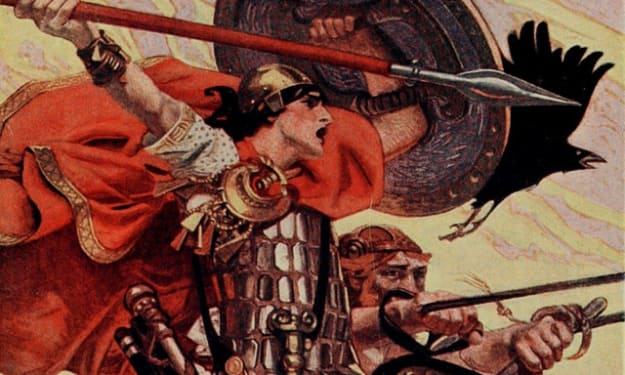
In the old times, one day, the mightly warrior Fionn mac Cumhall and his band of warriors, the Fianna, were hunting deer on the shores of Loch Léin in Kerry when towards them across the waters they saw a vision: a lovely young woman with flowing golden hair, dressed in robes as blue as the summer sky, riding towards them on a white horse. Though she rose over the waters, neither her rich garments nor her horse's hooves were wet when she reached land. The men bade her greeting, and Fionn asked her "What is your name, and what land have you come from?"
By Sabrina Downey5 years ago in Fiction


Comments
There are no comments for this story
Be the first to respond and start the conversation.