
A Voodoo Conjuring.
A Tradition Forged in Slavery that still persists Today. The shape of the thing.

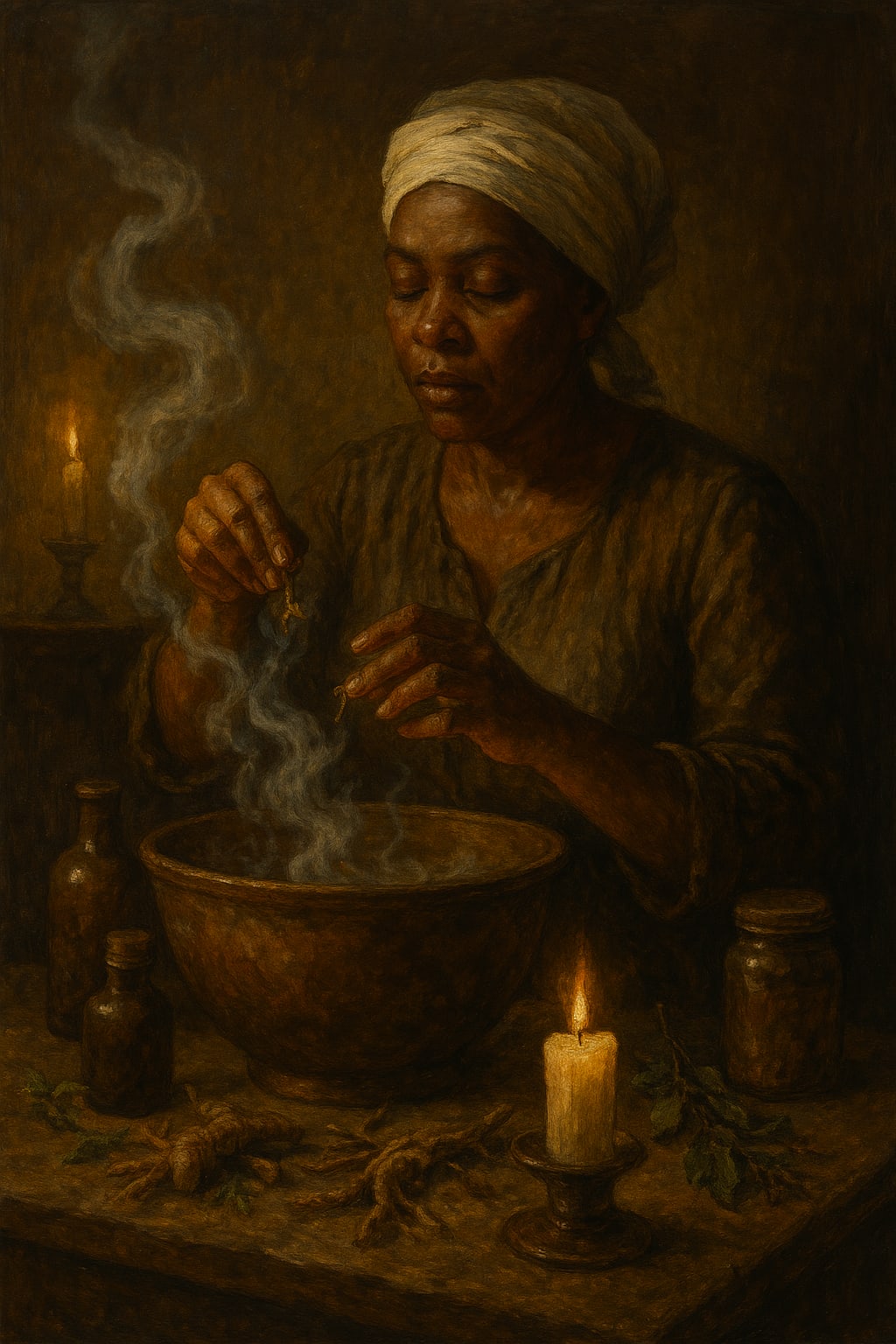
The serene conjure woman stands in ritual, her hands dancing above a bowl of smoldering herbs. Candles flicker, shadows stretch, and ancestral symbols curl upwards through the smoke. The palette glows with warm earth tones - brown, gold, and soft white - evoking reverence and quiet power.
Here, she weaves a tale that honors the sacred lineage of conjure, Nameda is its luminous vessel. She now begins her journey between the now and the ancient ones.
Nameda invokes the Smoke that dares to Remember
The modest moss-draped cabin lies nestled between cypress trees in a hidden patch of forest, Nameda stirred the smoke.
She was neither young, nor old - she was the age of knowing which exists between herself and the ancestors. Her hands, dark as river silt and lined with stories, moved above the bowl with a grace that made the air feel subdued. The herbs hissed and swirled, releasing scents that spoke in tongues which existed long before, and older than the enslaving English. Into the bowl went myrrh, cedar, mugwort, and a pinch of red clay from her grandmother’s grave.
Nameda did not conjure for spectacle. She conjured to remember, to exhort, admonish...to call upon those gone before.
Each flicker of candlelight cast shadows that danced upon the walls. The room was quiet, save for the crackle of flame and the low chant of her voice. Nameda called upon spirits whom she desperately tried to remember, hoping they had never forgotten her name. She wore a white headwrap, not for purity, but for protection - a wrap invoked and bound with prayers woven by women who had survived ships, shackles, and silence.
Tonight, she was calling on the spirit of Mama Lune, a conjure woman from the Sea Islands who once healed with saltwater and song. Nameda had found her name in a dream, engraved into a mirror that appeared only at a moonlit midnight. She had written her name in charcoal and tucked it into her altar, between the bones of a black hen and a bottle of Florida Water.
As the smoke thickened, Nameda spoke:
“I conjure not to control, but to commune.
I stir the bowl to stir the blood memory.
I light the flame to light the path back.”
She remembered the stories her mother told - of rootworkers who could stop bullets with a whisper, of women who buried their grief in jars beneath magnolia trees, of men who walked backwards to confuse death. She remembered the laughter, too, because conjure was never just solemn - it was sly, it was sweet, it was survival. It was the defiance of chains and the certainty of freedom.
Her form floated outside her body, here she could welcome the 'Others', outside, where the wind picked up, rustling the Spanish moss like a thousand skirts swaying in rhythm. Nameda smiled. The spirits were listening.
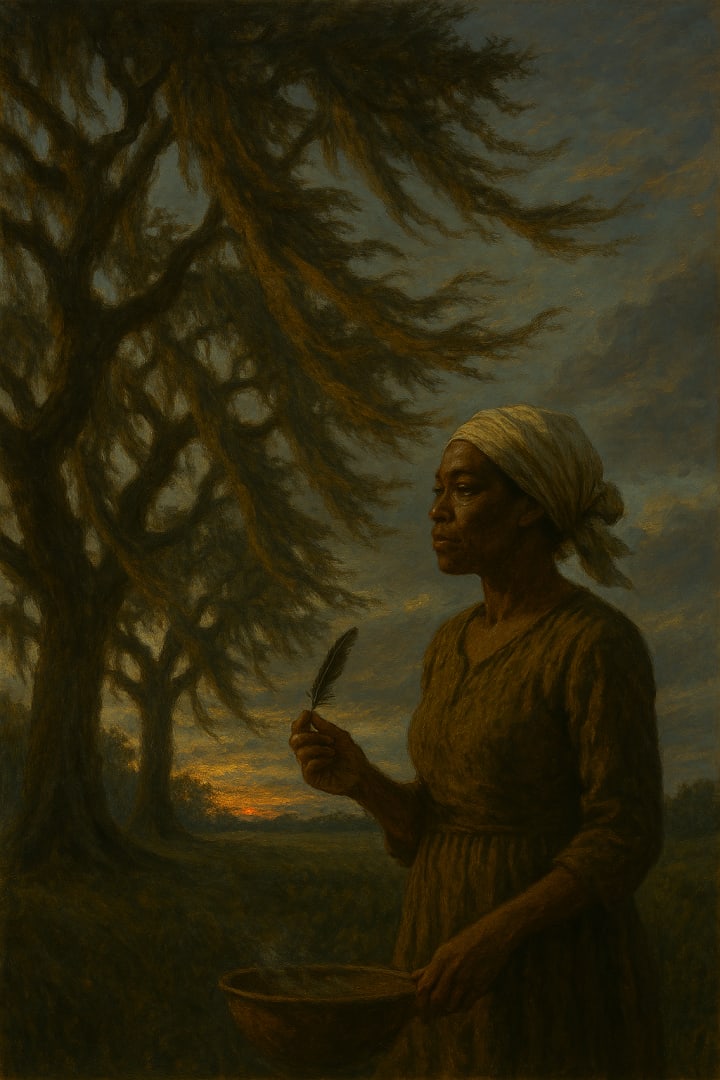
She reached into the bowl and pulled out a single black feather, slick with ash. It was a sign. Tomorrow, she would walk to the crossroads and leave it there, along with a copper coin and a poem written in her grandmother’s handwriting.
Nameda did not need to see the future. She was the future remembering itself.
Suddenly, the scene changes - A new reality enfolds - A Threshold Beneath the ancient 'Sacred Oak' appears.
The wind paused, as if holding its breath.
From the swaying curtains of Spanish moss, a shape rippled - like moonlight caught in water. The strands twisted, curled, and lifted, revealing a figure, a timeless, ghostly mist. She stepped forward, not walking but flowing, her body composed of shadow, and the purveyor of old prayers.
She was tall, regal, wrapped in ceremonial cloth that bore symbols - cowrie shells, feathers, and African lore. Her face bore the wisdom of centuries: cheekbones carved by grief, eyes deep as wells, lips painted ashen after a long silence.
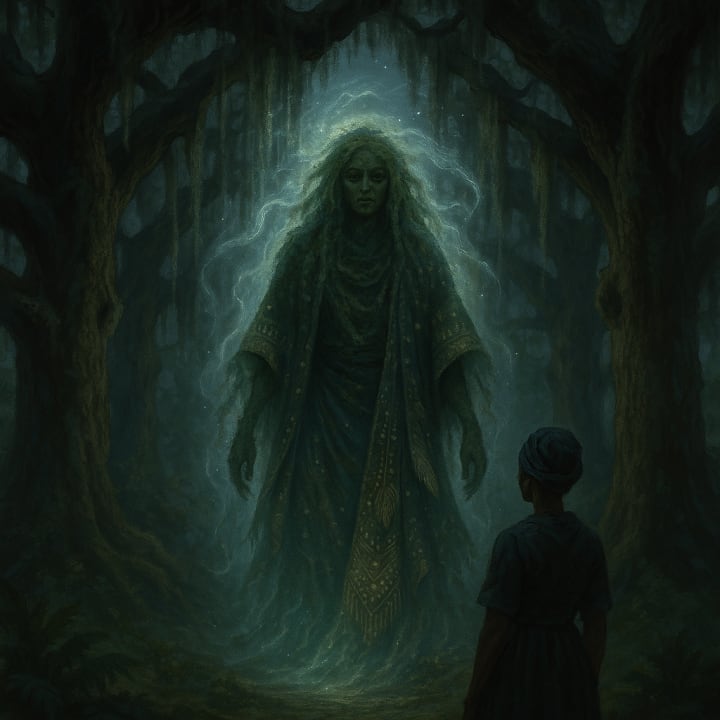
Nameda did not flinch.
The spirit’s voice was not sound, but sensation - the pause before a storm, the ache in the chest when remembering something unnamed...a reminiscence of the old ways rebirthed.
"Who calls upon me, for I have not been awakened in thousands of years".
Nameda stands unwavering before the mist-woven spirit - silently repeating an ominous chant that could crack the silence, or bring the flicker of a totem’s flame.
Rooted in awe beneath the oaks, arms unclasped, gaze steady, she finally finds her voice.
“I feel your breath in the moss. Who are you, spirit or half-remembered dreams?”
The air shivers across Nameda’s skin - a pulse of salt and silence that answers before words form.
The Spirit is (as sensation) - A cool wave in her chest; the thrum of distant drums; the weight of unspoken names.
Nameda: “Show me your true face. I bear no fear - only the need to remember.”
A ripple of moss drapes her shoulders, tightening like a cloak. Colors of dusk swirl where the spirit’s eyes would be.
There is a sudden ache behind her ribs, a voice in an unknown tongue, urging her forward.
Nameda: “Then guide me beyond the threshold. My heart is open.”
The courtyard of roots glow faintly. The spirit unfolds a hand of lichen - an invitation and a test.
"I do not recognize this place and time. Why have you called me forth child"?
"This place is called the Americas, Mother. I wish guidance to understand what has transpired".
"Explain". Spoke the Mother Spirit.
It is a terrible story which I shall tell, ancient one. I hope that I can do justice to the narrating:
From the very first forced voyage in 1526 until roughly 1867, European slavers embarked and enslaved approximately 12.5 million African men, women, and children across the Atlantic. Of these, about 10.7 million survived the horrific Middle Passage to reach the Americas - a mortality rate of roughly 12 percent before disembarkation.
Truth to tell, our own people were culpable in the part they played in aiding the downfall of our own society.
"How is that possible. How can a people do such injustice to their own kind".
"Greed and culture wars, caste imprinting...some thinking themselves more superior than others".
"Such shame. Continue". The Spirit said sadly.
The traffic of human lives swelled over time. By the 1690s, some 30 000 captives were shipped from Africa each year; a century later that number climbed to about 85 000 annually. More than eight out of ten enslaved people crossed the ocean between 1700 and 1850, with peak years in the 1820s seeing over 80 000 departures per annum.
Early expeditions were led by Portuguese and Spanish merchants ferrying captives to Atlantic islands, but by the mid-1600s the Dutch had become dominant traders. In the 18th century, English and French companies controlled roughly half the traffic, sourcing people mainly from West Africa’s coast between the Senegal and Niger rivers. Agreements like Spain’s Asiento de Negros (1713) granted Britain a monopoly on supplying Spanish colonies with tens of thousands of Africans each year.
Conditions aboard these vessels were engineered for profit, not survival. Men, women, and children were separated by sex, stripped naked, chained, and packed so tightly that disease spread rapidly. An estimated 12 percent of those who embarked perished en route, their lives extinguished by dehydration, dysentery, and the crushing weight of human cargo.
"How were such atrocities allowed to unfold...where was the decency of the rest of humanity as all this was permitted to happen". The startled Spirit wept in sorrow.
Once ashore, fewer than 6 percent of the captives were sent directly to what became the United States; the vast majority landed in the Caribbean and South America, especially Brazil, where demand for plantation labor was highest. In contrast, Brazil alone received nearly half of all enslaved Africans, overwhelmingly from regions like Angola, while British North America’s enslaved population grew more through birth than importation after 1800.
The human toll extended far beyond those counted in the holds of slave ships. African societies were destabilized by incessant raids and the loss of generations, leaving long-term scars on social structures and economies. In the Americas, the trade generated immense wealth for European colonists, bankers, insurers, and merchants - capital that fueled urban growth, industrial expansion, and entrenched racial hierarchies whose repercussions still echo today.
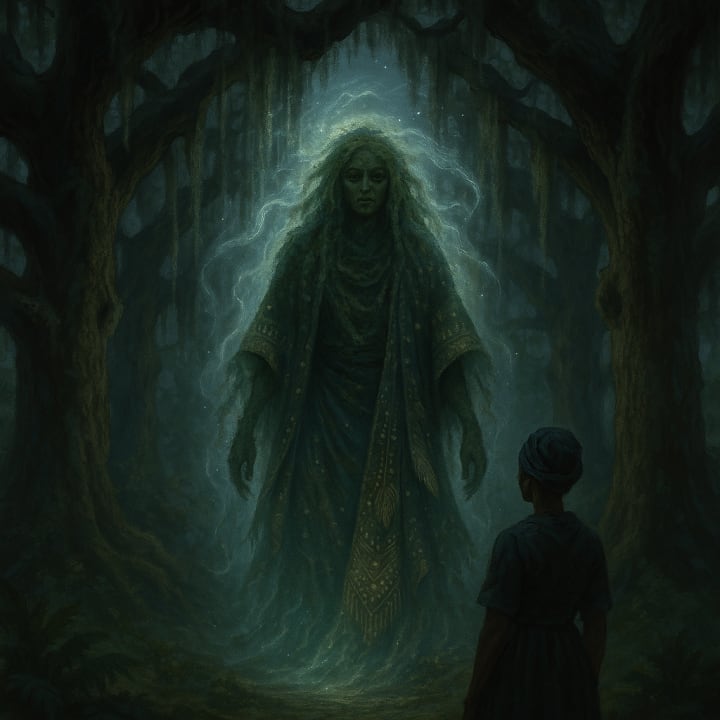
Horrified, the Spirit could not speak. Finally, she asked...
"What year is it now, my child". There was a dark sadness in her voice.
"It is 2025, Mother".
"And what has changed...why do you now call upon me. What can I do"?
Nameda: "Mother, in 2025 we breathe your memory back into the world. Where once silence strangled our stories, now we speak your names in classrooms and on city streets. We’ve built digital shrines - archives of song, testimony, and ritual - to honour each life lost to the Middle Passage.
In every protest banner, in every reclaimed festival, in every classroom lesson that refuses to gloss over our history, we carry your heartbeat forward. We call you because the reckoning has begun: monuments are toppling, apologies are uttered, laws are rewritten - and still the work of healing stretches before us.
You can guide us. We need your courage to hold space for grief and hope, to turn truth into ceremony. With your wisdom, we will plant new oaks of remembrance so that future generations will know whose bodies fed these soils and whose spirits still guard these lands".
"And, have you been keeping the Conjuring alive...for this is your heritage".
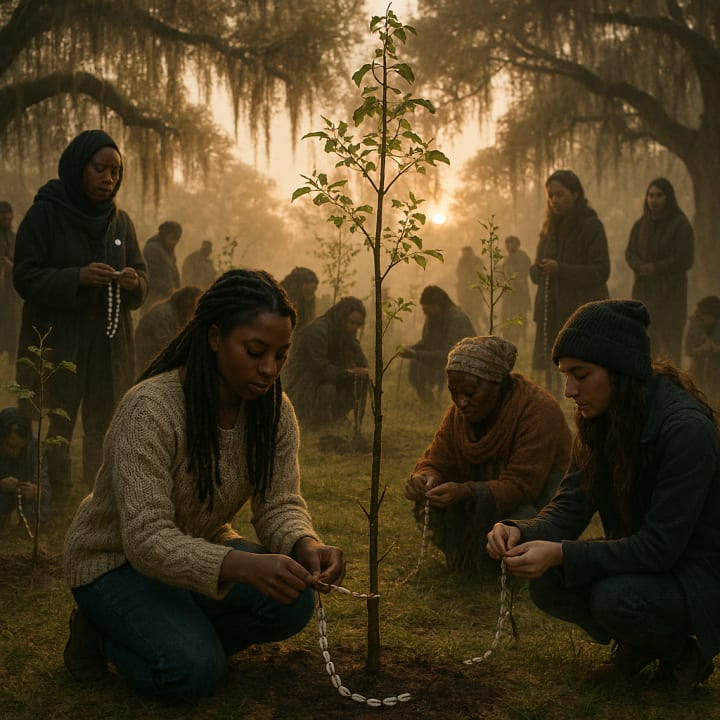
"Oh, yes, Mother. Conjure, in African and Afro-American folklore, is far more than spellwork or superstition - it's a rich spiritual technology rooted in ancestral wisdom, resistance, and survival.
The Ritual of Remembrance, is observed annually. ..At Dawn in the Sacred Grove:
As pale light seeps through moss-draped oaks, activists and descendants gather in a mist-shrouded clearing. Each person carries a small bundle of polished cowrie shells threaded on strips of braided grass, and stands beside a young oak sapling cradled in dark, rich earth.
For this we invoke a Gathering the Ancestors.
- A single drumbeat calls everyone to circle the saplings.
- The Real and Imagined Names of those lost to the Middle Passage are spoken aloud, echoing through the trees.
- Then comes the Lighting of the First Flame
- A torch of sacred grasses is passed hand to hand, sparking a small bonfire at the grove’s center.
- Participants offer a pinch of soil, mingling earth and ash as a bridge between past and present.
- Cowrie Shells are woven - Each person steps to their chosen sapling, pressing shells into the damp bark at knee-height.
- With braided grass they weave shells around the slender trunk, knotting each strand as a vow: "We remember".
- All are Planting Intentions of never forgetting.
- After the weave, a final shell is buried at the sapling’s base, covering it with a spoken promise of protection.
- Hands rest on the tree’s roots as collective breath rises in a shared prayer of Communion and Departure
- A soft chorus of ancestral songs drifts over the clearing.
- As dawn breaks, the circle slowly disperses, leaving behind rows of shell-adorned oaks - a living archive of remembrance".
Meaning of the Symbols
- Cowrie shells: polished white carriers of names and stories
- Braided grass: threads of lineage woven into living wood
- Oak saplings: symbols of endurance planted in reclaimed soil
- Morning mist: a veil between worlds, parting as memory awakens
- Drum and chant: heartbeat of ancestors guiding each step
"Conjuring has been enmeshed in American life for centuries. A hybrid practice rooted in religions from West and Central Africa, it has been shaped by influences from Christianity, Islam, and Indigenous groups in North America. Today, conjurers are not exclusively women. Still, most people familiar with its history associate the practice with us because it is largely a domestic art, carried forward through women’s hands and from their homes. Many conjurers believe the spirit world can be petitioned for healing and protection: They may commune with ancestors for guidance, seek remedies in nature, or perform rituals and spells to aid their communities".
"Still, you must be careful child... There is a Dual Power: Conjure could be used for both benevolent and malevolent purposes - healing or harming, blessing or cursing".
"Yes, Mother. This duality reflected the complexity of survival under slavery and segregation".
Mother: "Conjurers were, and hopefully are revered figures - sometimes feared, always respected".
Nameda: "Our Black scholar, W.E.B. Du Bois, described conjurers as, “the healer of the sick, the interpreter of the Unknown, the comforter of the sorrowing, and the supernatural avenger of the wrong”. They are spiritual leaders, protectors, and cultural memory-keepers".
Mother: "So it should be. Now let me see"!
The Spirit closed her eyes, reached out to touch Nameda...and the years between then and now spun like a vortex which threatened to swallow her whole. The drama of a wicked past played as upon a torrid scene in a movie. When Mother finally released her...Nameda staggered back in horror. The actual sensory details of slavery, though fast paced and blurred...made her want to puke.
The Horror of it all.
Mother touched her shoulder again...and she was launched into the future. The rumors of wars were beginning again. But not yet beyond redemption.
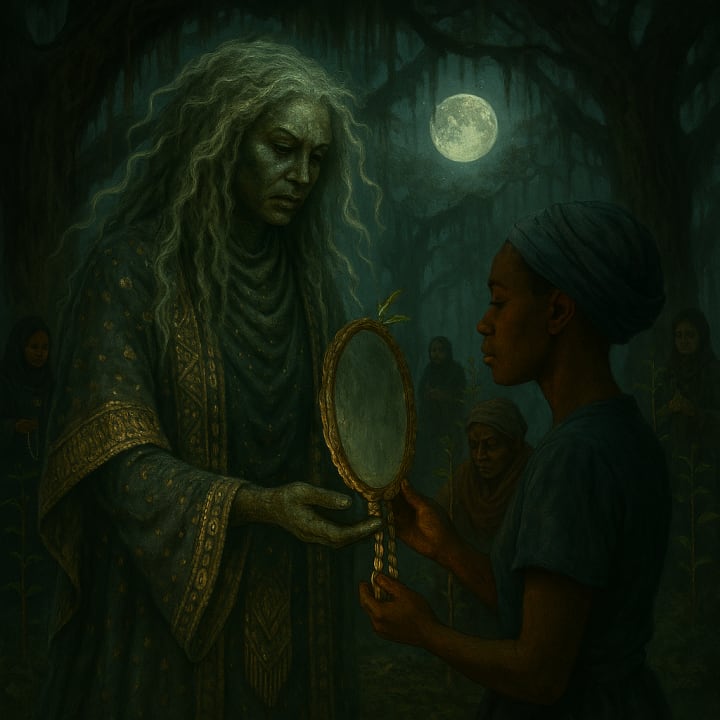
"It is up to the conjurers to work to prevent a repeat of the past". From thin air she unearthed a mirror, around her emerged many conjurers of old, coiling the future from unseen threads.
The Spirit’s voice sounded, like wind through bone:
“You have called me across centuries, child of ash and root. Why summon me now, when it seems we are no longer needed."?
Nameda, trying to steady herself firmly, as the earth undulated beneath her feet, answered...
“Because the silence has grown loud. Because unrest is rising like mist from the soil. We need your knowing - not to escape the past, but to face the future.”
The Spirit lifts a hand woven of moss and shadow. In her palm rests the mirror - oval, rimmed with splinters of a ship’s hull, its surface fogged in the moonlight.
Spirit:
"This was once part of the vessel that tore us from our homelands. It has seen the belly of the sea, the cries of the chained, the prayers swallowed by salt. Now it reflects more than pain".
Nameda reaches out, her fingers brushing the rim. The mirror pulses faintly, as if breathing.
Nameda:
"I will carry it. Not to forget, but to remember. To show the children what was endured, and what still blooms".
Spirit:
"Then take it, child of the threshold. Let it reflect not only what was broken, but what was never lost. Let it show the strength etched into your bones, the songs buried in your breath".
Nameda lifts the mirror to her chest. The moss around them stirs, not with wind, but with recognition. The oaks seem to lean closer.
Nameda:
"I see you, Mother. I see all of you. And I will not look away".
The Spirit begins to fade, her form unraveling into mist. But the mirror remains...warm, heavy, alive.
Both the mirror and the Conjurer had much work to do.
About the Creator
Novel Allen
You can only become truly accomplished at something you love. (Maya Angelou). Genuine accomplishment is not about financial gain, but about dedicating oneself to activities that bring joy and fulfillment.
Keep reading
More stories from Novel Allen and writers in Fiction and other communities.
The Price Of Elegance
Maree sat looking out at the lovely view from her balcony. A sort of grim nostalgic calm permeated her silent musing...how quickly time seemed to have passed. The realization dawned with a jarring pang of nostalgia - for with the thought came the reminder of the slowing down of her once mad dash into enjoying all the luxury that money had afforded her. She closes her eyes, inhaling the fragrance of the tea, and takes comfort in the gentle wind blowing from across the waters, welcoming her presence.
By Novel Allen4 months ago in Fiction



Comments (5)
😱 This was beautifully-crafted and breathtaking. Lord No you are doing the Lord's work! You certainly showed one of The fruits of the spirit from the word in this one. Namely, the word of wisdom. It is beautifully painted all over this piece. Get it no I loved everything about this piece. You also have a teaching gift as well. I felt like I was back in college listening to my favorite professor's History lecture. So edifying, elegant, intelligent, spiritual and hopeful. My hats off to you my friend! This one deserves to be on the Top Story feed for an entire year! Go gurl! 💪🏾🫶🏾🩷🥰
Absolutely beautiful description and narration. This is not a culture I'm familiar with but I found it fascinating, especially that you included historical facts in the story as you relayed them to the Mother. Simply brilliant and I really hope you place in the Challenge!
The past revisited in a narrative with an ancient spirit...we must remember our past, honor it...but not let it consume us. Well Met on the characters and the coming together of all to remember. Loved the sacred rites.
I especially loved how that spirit, the Mother was horrified to learn about everything that has happened across the centuries. Fantastic story!
I like all the attention to detail here. It really brings the cultural and historical aspects to life. The illustrations also make a nice accompaniment to the story. Nicely done.