
A Figment of My Imagination (Part Two)
The trials and tribulations of creating a fictional world from scratch!


So . . . now that I've laid out my plans for my fictional "Thompsonville" universe, those plans needed to have some flesh added to their bones. Here are some fictional details for my fictional town, which helps set a timeline, establish the geography etc etc etc
I hope this helps you, dear reader, in establishing in your own mind the background of the town and its people . . .

A BRIEF HISTORY OF THOMPSONVILLE
“Every town has its stories. Some make the history books; others are only whispered after dark.”
Overview
Nestled around a sheltered harbour and a beautiful inland lake, Thompsonville is a small coastal township with a long and colourful past. Beginning life as a pioneer settlement in the early 1820s, the dream of Henry Thompson and his sons, Cecil and Orville, the town was established with the idea of creating their own utopia.
In recent times, Thompsonville has become a thriving, colourful and diverse community; a far cry from those very early years when the town and surrounds saw more than its share of excitement. With ambition, scandal, disappearances, murder, and ghost stories aplenty, there is more than enough history to pique the interest of curious tourists, upon which the town now relies.
Even so, not all of Thompsonville’s history is the kind that makes it into tourist brochures. Some parts are quietly known and rarely spoken of, except in hushed tones behind closed doors, and if you ask the locals they will tell you that the land remembers everything!

Geography & Setting
Located on the mid-north coast of New South Wales, about twenty miles north of the populous city of Macquarie Harbour, Thompsonville sits where the Thompson River meets Thompson Lake, which itself flows into Thompson Harbour, which then meets the sea. The founding fathers had been keen to leave their mark, and their name, everywhere, it seems.
A ridge of land separates the lake from the ocean, which leads to Hospital Point, where the founders had built their original home, offering sweeping views in all directions.
With the town centre built on the land between lake and ocean, featuring many old style buildings that are excellent examples of early colonial architecture, including the local hotel and the Bank of New South Wales buildings, the roads then lead south, around the spectacular harbour, which is also home to the local fishing cooperative. Thompson Harbour provides sheltered anchorage — though offshore, the waters do conceal dangers of their own, with various shipwrecks scattered along the coastline, most of which came to grief before the building of a lighthouse.
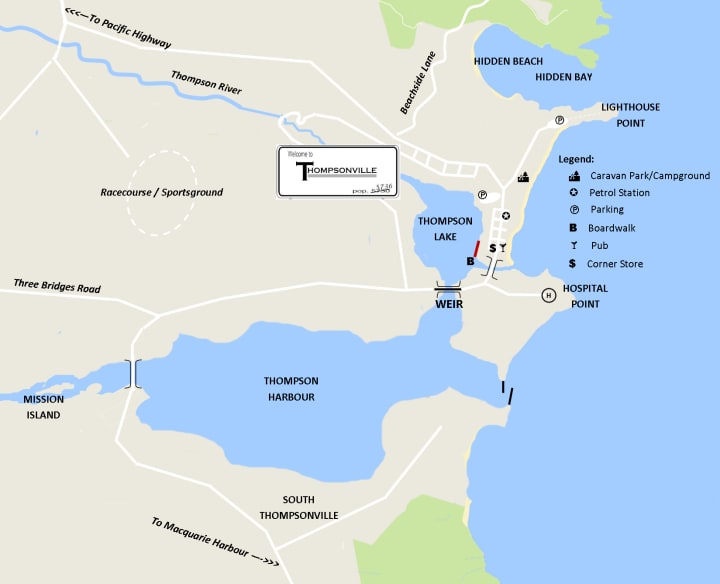
Then beyond the harbour lies South Thompsonville, an expanding residential community where many families who work in Macquarie Harbour have begun to make their home, given its proximity to the city.
Inland, the Thompson River winds through fertile flats, which still support a thriving livestock industry, before narrowing into steep, forested country. Dense stands of Blackwood, Stringybark, and Huon Pine once fed a thriving timber trade, and while there are those who still live by the old ways and continue to work as their parents and grandparents did, this too, seems to be a dying trade.

Pre-Settlement & Aboriginal History
Before European arrival, the land and waterways around Thompsonville were home to the local Aboriginal people for thousands of years; the Gumbaynggirr people and the Biripi people. They fished the lake and harbour, hunted in the forests, and moved seasonally between coastal and inland camps, which were located in the rugged New England ranges.
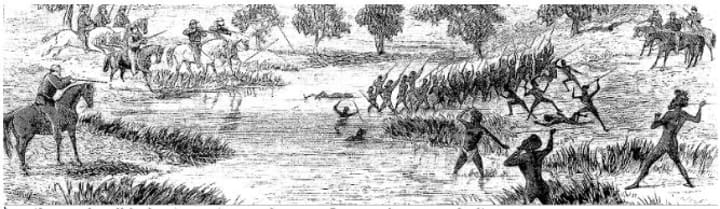
Relations with settlers soured quickly after 1820, marked by violence and dispossession. Many survivors were eventually forced onto Mission Island in Thompson Harbour — a rather bleak expanse of land located at the western end of the harbour — isolated from the main settlement. Here government rations and missionary oversight replaced traditional life for those unlucky enough to not escape deeper into the bush. Today, Mission Island is still inhabited by a few families, who are valiantly keeping their own traditions alive, as a stark reminder of the history of this place and the people who came before them.

Early Settlement (1820–1821)
Thompsonville’s European story begins with Henry Thompson and his sons Cecil (16) and Orville (13), who arrived in 1820 from Macquarie Harbour after hearing of “a place of abundance” to the north. They built a hut on the point and began farming, fishing, and trading.
In 1821, Henry was killed during a clash with the local Aboriginals. Cecil and Orville buried him near their home, on what is now known as Hospital Point, which subsequently became the site of the town’s hospital. His grave still lies in the hospital grounds — and some say his ghost still roams there.

The Thompson Brothers’ Rise — and a Dark Legacy (1821–1830s)
Cecil and Orville expanded their holdings aggressively. Outwardly, they were industrious pioneers. Privately, they were ruthless manipulators, of family and locals alike, while maintaining an incestuous relationship that would become the town’s most enduring and poisonous secret.
Over generations, that secret was quietly passed down through certain male lines of the Thompson family, whispered about but never confronted. In Thompsonville’s folk memory, this “family tradition” is blamed for a long history of disappearances — strangers, and sometimes locals, who refused to conform or threatened to speak out.

Rivalry and Murder (1830s)
Up-river lived James Baker and Dominic Garrett, posing as brothers but who were, in truth, lovers. They ran the district’s only timber-cutting and milling operation, floating logs from the dense forests downstream to the lake, where they were milled for timber, providing much of the timber needed to establish the township that was beginning to spring up on the shores of the lake.
When the Thompson brothers learned of the true nature of the timber-cutters’ relationship, they saw this as leverage that could be used to force a partnership, but the Bakers refused.
Days later, James and Dominic were found dead outside their hut — killed with an axe and with Aboriginal spears left nearby. Officially, the blame fell on local tribes, but many suspected the Thompsons. No charges were ever laid.
The Thompsons swiftly took control of the mill, cementing their dominance over the timber trade and the growth of the settlement, which they had already named Thompsonville.

Growth, Industry & Uneasy Peace (Mid–Late 1800s)
Through the late 19th century, Thompsonville thrived on timber, livestock, fishing, and river trade. The Thompsons remained the town’s leading family, though stories persisted of a dark side to the area; unexplained disappearances and harsh treatment of those who “crossed” them.

Notable Incident — The Abduction of the White Boy (1850s)
Following the death of a young Aboriginal child — reportedly in an accident involving settlers — the boy’s grieving mother is said to have taken a white infant from a homestead near the lake. The tribe immediately began their seasonal migration to the mountains, and for years, rumours circulated of a fair-haired boy living amongst them. Sightings were always second-hand, and no official confirmation ever came. Whether the child was ever returned, or lived his life entirely within the tribe, remains something of a mystery, however, the presence of fair-haired yet dark-skinned children amongst the tribe around twenty years later, seem to indicate the truth of one of Thompsonville’s great unsolved mysteries.

20th Century Changes
• 1954 – A teenage boy was fatally mauled by a bull shark in Thompson Lake, prompting construction of the Thompson Weir at the lake’s outlet to prevent large predators from entering. Some locals say the shark was not the only thing the weir was built to keep out.
• 1960s–1970s – Timber industry declines; fishing remains a mainstay. Mission Island is largely abandoned, apart from a few determined souls.
• 1970s–1980s – First small influx of “sea changers” and artists seeking a quieter life.
• 2010s–onwards – A new wave of “sea changers”, artists and members of the LGBTQ+ community make Thompsonville their home.

Legends Revived
• 1985 – The “Dare”: Local teens Eric and Chad Givens, Donnie Prescott, and Shawn Turner reignite the Bakers’ ghost legend when Chad and Shawn agree to spend a night in the old hut. Eric and Donnie follow to play a prank. Exactly what happened remains disputed, but the eerie tale has been told and retold ever since.

A New Era
In the early 2000s, novelist Tony Scott arrived in Thompsonville after being expelled from his Sydney home at the age of sixteen for being gay. Searching for his cousin, who he knew to be living in the township with his partner, Tony found family and a community that, much to his surprise, accepted him for who he was.
Tony’s novels, many set in a lightly disguised township called “Summerville,” brought the town national attention and a reputation as a place where outsiders could belong. Over time, his presence and influence attracted artists, writers, and LGBTQ+ visitors. Today, Thompsonville boasts a vibrant queer community and annual Pride events, along with a blend of heritage and creative culture.


Notable Figures
Just a few of the notable residents who have made Thompsonville what it is today. A visit to the local Historical Society will no doubt provide visitors with many more.
• Henry Thompson (1780?–1821) – Pioneer and town founder, killed in conflict with local Aboriginal people.
• Cecil Thompson (1804–??) – Strong, ruthless businessman; co-founder of the town’s fortunes and its darker legacies.
• Orville Thompson (1807–??) – Strategist and manipulator; keeper of the family’s most dangerous secret.
• James Baker (1805–c.1835) & Dominic Garrett (1806–c.1835) – Timber cutters, lovers, and ghost story icons.
• Tony Scott (1984– ) – Novelist whose works transformed the town’s image and helped attract a thriving LGBTQ+ community.
• Kurt Hewson (1982- ) – Australian representative Rugby League player.

Thompsonville Today
Modern Thompsonville is a curious blend of fishing families, sea changers, and visitors drawn by its history, legends, and natural beauty. The official tourist trail takes in Hospital Point, the timber wharf ruins in the harbour, bush tracks to the Bakers’ hut, the boardwalk by the lake, the settlement on Mission Island, and a spectacular lighthouse, which overlooks Main Beach and the township.
And, of course, they can hear all the old stories — told over beers at the pub or whispered around a campfire, always ending with: “But you just never know…”
The town’s culture has shifted in modern times, thanks in part to the influence of author, Tony Scott, although he will strongly deny that it was his doing. Thompsonville now has a thriving LGBTQ+ community, creative spaces, and annual Pride celebrations. Old-timers may grumble about the “city influence,” but most agree the town is more vibrant, more diverse — and more tolerant — than it has ever been.
If you are looking for a weekend getaway to a fascinating part of Australia, you won’t be disappointed with a visit to this charming little town.

For part one, follow this link:
https://shopping-feedback.today/fiction/a-figment-of-my-imagination-part-one%3C/em%3E%3C/p%3E%3C/div%3E%3C/div%3E%3C/div%3E%3Cstyle data-emotion-css="1x3zcuc-StoryContent">.css-1x3zcuc-StoryContent{pointer-events:none;}
About the Creator
Mark 'Ponyboy' Peters
Aussie, Queer & Country
LGBT themed fiction with an Aussie flavour, reviews, observations and real life LGBT histories.
W: https://ponyboysplace.wordpress.com/vocal-media-index/
https://www.facebook.com/mark.p.peters/
Keep reading
More stories from Mark 'Ponyboy' Peters and writers in Fiction and other communities.
A Figment of My Imagination (Part One)
One of the things I love most about fiction, both as a reader and an author, is that it gives you the ability to travel to anywhere, or to any time, to do anything, or to experience all that this world – or any other world for that matter – can offer.
By Mark 'Ponyboy' Peters8 months ago in Fiction


Comments
There are no comments for this story
Be the first to respond and start the conversation.