
A Figment of My Imagination (Part One)
The trials and tribulations of creating a fictional world from scratch!
One of the things I love most about fiction, both as a reader and an author, is that it gives you the ability to travel to anywhere, or to any time, to do anything, or to experience all that this world – or any other world for that matter – can offer.
From lush, forest-filled valleys, to snow-covered mountain peaks, or from barren, sun-scorched deserts to rocky shorelines being pounded by wild seas. From bustling cities, to ghost towns decaying in isolation, or from some place deep within the earth, where no light exists, to the vast nothingness of space; we can be transported simply thanks to the stroke of a pen, or the pressing of a few keys.
And as authors we are the ones who take you there, sometimes carrying you on a journey through familiar and actual locales, or perhaps letting you into the secret worlds we have created in our own minds; worlds we have moulded to our own liking or design, by blending our fiction with reality to create interesting and conceivable locations that befit our stories.
When I started writing again, a little over twenty-five years ago now, I was struck by something of a dilemma; specifically, should I use and describe actual places I know, or should I simply make things up as I go along, so that readers can use their own imagination when visualising the story? And if I do take the latter option, on what do I base my locations? Where does my world exist? What are its features, both good and bad? And most of all, can I create a universe that is believable?
After giving it some thought, I decided that what I needed to be doing was a little of both. I reasoned that some stories needed to be set in the real world, while others needed to be set in fictional places that are as close to the real world as possible, close enough that readers could see these places matching their own memories. That this idea seemed to work was borne out by an email that I received midway through writing and posting my first story online, After We Danced. The reader, Ian, who is still a friend to this day, advised that he could tell that the overall setting was fictional, but after some initial confusion when he was able to recognise specific elements from several different towns being used in the one location in my story, he realised exactly what I was doing; mashing together different features from different places, to create my own fictional world. I recall being rather impressed by that at the time.
Some of the other responses I received from readers about that story included questions about where this place was, but I had to break it to them gently that in reality it was a mishmash of places I had visited in my youth, where I had combined elements I liked on order to create what could, to me at least, be the perfect place to settle down.
After We Danced actually became the starting point of my Seachange series that I ended up writing, all set in and around my very own, fictional town of Thompsonville. There have been five stories in this series so far, with plans for another to be added in the future. When I go to this place it feels like coming home, but here’s the thing; I know that each time I visit I am going to find something new, or sometimes, even something that shouldn’t be where it is! And to put it simply, this is because I didn’t plan well enough ahead when I started.
In another of my earlier stories, The Mardi Gras Murders, which is far removed from the Thompsonville universe, the setting is in the modern-day Australian cities of Newcastle and Sydney, with just a few fictional geographic elements thrown in as required. As it had been quite a while since I had visited some of the locations used, I made an effort to better plan this story out. I even remember using Google Earth at times to help reinforce my memories, and to assist with descriptions. In one section I added a house on a block of land that Google Earth told me was vacant, and I was quite surprised when one reader messaged me and asked if there used to be a house there, or if I was just using that vacant lot for my own purposes – he was obviously doing some research into my locations! Other readers also thanked me for my very realistic descriptions as they were taken back to places in which they once lived, or they used to visit.
In addition to the primary Seachange series, I have also written a number of accompanying stories about the Thompsonville region, which I have grouped together under the title of Thompson River Tales. This is a series of shorter works featuring various locations, dating back as far as the 1800s, with some tales having intertwining characters and storylines, while others are more ‘stand-alone’. All of them are designed to link together using places and characters from other stories, all echoing the passing of time. As I move forward with additional stories for the series I will try to fill in the gaps, until eventually the two separate story series will – hopefully – offer a complete history of a place that only exists in my imagination, and perhaps the imagination of you, the reader.
My catalyst for this was from having read several novels over the years by James A. Michener, all of which detailed a particular area, following that region through many years – even centuries – as the place and its peoples changed over and over again. My favourite tale of his will always be Centennial.
I liked the concept and I wanted to try a little of that with these stories. I know I have made some mistakes along the way, and as I’ve edited and re-edited each story in the series, I have tried to correct some of these mistakes, which in itself is no easy task, given that the series – so far – covers a period of almost two hundred years. Eventually I realised that my mistakes were going to catch up with me, and so this is why I have now set about documenting my imaginary world. It still may not be prefect, and as time goes on there will be parts of the town and area that will change, as is the natural way of things, but for those who might be interested in the past, present and future of Thompsonville, you may find it interesting!
Some more background on my little town will come in Part Two though.
I have certainly learnt a few things along the way during this process, mostly from recognising the mistakes I have made, but also by searching online for various tips and online writing aids when I went looking for help. So, perhaps if I share some of these things, it may in some small way actually be of some use to those of you who are brave enough to give it a go.
So, first of all, I suggest that if you MAP IT OUT, your story will be halfway there. There are two parts to this statement, however; the first relates to your storyline, while the second relates to your location, or your world.
You may have a great opening or ending to your story, or some great chapters or scenes planned out in your head, so you work frantically to get these down on paper or screen. You’re happy with what you have, but what comes next? Where do you go from there? What about filling in the gaps for the rest of the story?
I’ve tried writing stories chapter by chapter and posting each chapter online as I write them, but what usually happens – time and time again, actually – is that I usually lose my place, or interest in the story, or just run out of steam, and in most instances that is because I simply didn‘t know where I was going.
So how do I fix that when it happens? The answer to that is actually quite simple. I simply map out a rough draft of where the story starts and where it finishes, with complete scenes, or even chapters if I have them. That will give me a rough skeleton to work with and from there I just start to fill in the blanks; with additional scenes or chapters, or even just dot points of ideas, if that’s all I have. Eventually I will know where I’ve started, where I’m ending, and what most of the steps will be along the way.
Keep in mind, though, that first the time around it will only be a rough draft. You can fine tune it, or shift the goalposts along the way if you need to, but that Start and Finish, if you’re happy with them, should remain fairly constant.
Anyhow, that’s just me!
The second part of the MAP IT OUT advice relates to your story location, and whether that is a town, a region, a state or an entire world, it refers to doing exactly that . . . create a map! Yes, a real one! It’s okay to have a general idea in your head of the layout of your special place, but sooner or later you will quite likely make errors with the placement of a street, or a building, or a river. I know I’ve done that on more than one occasion. So, the solution? Simply draw yourself a map. You’ve seen them in books that you’ve read, haven’t you?
It can be as simple or as rough as you like, or it can be as detailed as you want to make it. But the important thing is to create it, and make sure you know where the four points of the compass are, so you have reference points for when you are writing. And figure out just how big your world is, and where everything is in relation to each other. And even if it's just for your own reference, sketch out a few basic maps of your world and your chief locations, which help to make sure things like distances and travel times can stay consistent.
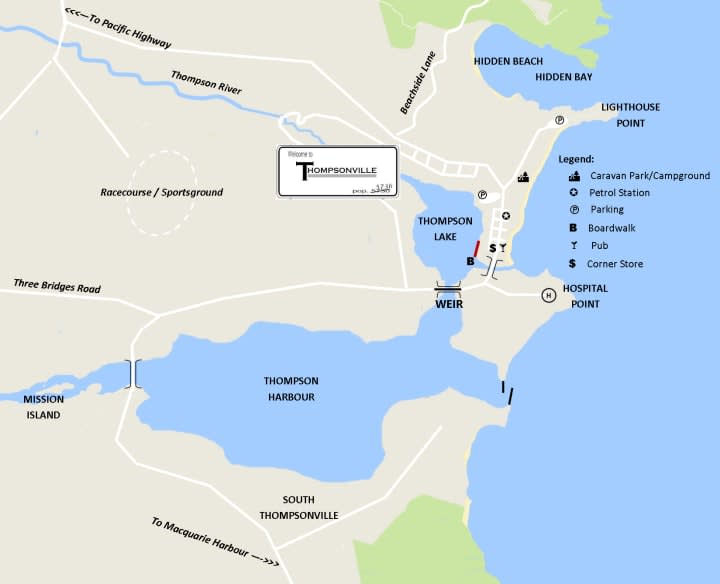
So, what’s next? Well, the next step is to MAKE IT REAL . . . or as real as you can. The physical features of the location need to be described as if they are real, as if you have actually been there. You don’t need to describe everything in minute detail, but sometimes the small things can actually help to add depth to the story.
Some back history is always a good idea. That will help to add depth to both the characters and the places described. Again, you probably don’t need every minute detail, but some details about the people and the features of the town will help to give it some history.
In the case of Thompsonville, the descendants of the founding fathers have something of a reputation around town, which is from behaviour that has been passed down through many generations. Just what did those old timers get up to that the current inhabitants have learned from them or mimicked? Well, all that and more can be explained in the early stories, piece by piece, and starting from right back at the time the township was founded. Each story will reveal another layer, and as these are peeled away, another part of history will be added, and once pieced together it all provides a much bigger picture.

I know that there are writers out there with far greater ability and experience than I possess, but for most of us, writing is a process whereby we simply learn as we go. If somebody gets some benefit from these few observations of my own experience, then I have achieved what I set out to do. If others have simply had their curiosity about my writing processes satisfied, then that’s another win.
There will be more to follow, including a fictional history of Thompsonville for Part Two.
Thanks for reading! Please enjoy!


PART TWO - A BRIEF HISTORY OF THOMPSONVILLE
https://shopping-feedback.today/fiction/a-figment-of-my-imagination-part-two%3C/p%3E%3C/div%3E%3C/div%3E%3C/div%3E%3Cstyle data-emotion-css="1x3zcuc-StoryContent">.css-1x3zcuc-StoryContent{pointer-events:none;}
About the Creator
Mark 'Ponyboy' Peters
Aussie, Queer & Country
LGBT themed fiction with an Aussie flavour, reviews, observations and real life LGBT histories.
W: https://ponyboysplace.wordpress.com/vocal-media-index/
https://www.facebook.com/mark.p.peters/
Keep reading
More stories from Mark 'Ponyboy' Peters and writers in Fiction and other communities.
Stockroom Secrets 15
The look of anger on Mike's face would have been enough to scare the bejesus out of just about anyone, I thought. It certainly had the desired effect on Troy and Dan, as they backed away. They wouldn’t have been quite the same age as Mike, who had told me he was twenty-five, but seeing as he was one of the managers within the store and they weren't, they knew when they were beaten.
By Mark 'Ponyboy' Peters11 months ago in Fiction
Real men drink, right?
He has a problem. He’s felt it for years now, but he refuses to face it. He doesn’t want to admit it, to himself or to the people around him. All his heroes were the same. He likes to recall the scene where James Bond sits in a dusty pub in Latin America, a glass of whiskey in hand, his gaze fixed on a scorpion crawling across the bar. When he first fell for literature, it was Post Office and Women, which he read over and over again. Without those cans of beer and bottles of cheap whiskey, Bukowski’s work wouldn’t have been so raw, so honest. Even Vaclav Havel spent most of his nights in Prague bars; without that, he wouldn’t have been who he was. Those were the real men.
By George Roast6 days ago in Fiction


Comments
There are no comments for this story
Be the first to respond and start the conversation.