
The Samanak Festival and Its Folkloric Songs: Women’s Role in Afghan Culture
Exploring the Role of Women and Folkloric Songs in Preserving Afghan Cultural Traditions


The Samanak Festival and Its Folkloric Songs: Women’s Role in Afghan Culture
By Islahmuddin Feroz, Former Professor, Department of Music, Faculty of Fine Arts, Kabul University
Abstract
Nowruz and the beginning of spring in Afghanistan are always accompanied by diverse celebrations and rituals that shape part of the cultural and social identity of the people of this land. Among these rituals, the Samanak Festival holds a special place; a celebration in which women play a central role. This ritual involves gatherings, social cohesion, music, singing, and folkloric songs, while also reflecting spiritual beliefs and the deep connection of people with nature and collective life. Samanak, as a symbol of birth, hope, and the continuity of life, has become more than a traditional food; it has evolved into a cultural phenomenon transmitted from generation to generation and has persisted to this day. This article analytically examines the cultural, social, and musical dimensions of the Samanak Festival and highlights its importance as a living, women-centered heritage in Afghanistan.
Keywords: Afghanistan, Nowruz, Samanak, cultural heritage, women, music, social ritual.
Introduction
The Samanak Festival, with the delightful aroma of traditional Samanak and the inspiring sound of music, is one of the ancient and mysterious Nowruz rituals in Afghanistan, rooted in the history and cultural memory of this land. This celebration is not only reminiscent of a sweet taste but also symbolizes social cohesion, artistic taste, and the emotional connection of people with the season of renewal and the rebirth of nature.
In the days and nights approaching Nowruz, women gather wearing colorful garments, play the daf (frame drum), sing folkloric songs, and cook Samanak together. For them, this ritual is not merely a culinary event or entertainment, but an opportunity to revive ancient traditions, strengthen social relationships, and reflect the cultural and social role of women in society.
The Samanak Festival has survived centuries and maintained its place as a living part of Afghanistan’s cultural heritage despite social and political changes. This article seeks to examine the various aspects of this ritual—from musical and folkloric dimensions to social and cultural values—to clarify how Samanak has become a symbol of hope, continuity of life, and people’s connection to spring.
The Social Role and Function of Festivals
Festivals, as popular rituals and celebrations, play an important role in the continuity of a society’s culture and history. They ensure that values, beliefs, and ancient traditions are passed from one generation to the next. On one hand, festivals keep the historical memory of a society alive and remind people of their shared past; on the other hand, they provide an opportunity to reproduce collective identity.
Festivals create spaces for social cohesion, reduce ethnic and class divides, and gather people around a common focus. In addition, music, songs, local foods, and cultural symbols are revived during these occasions, forming part of the spiritual heritage of the community. Historically, festivals serve as a link between the present and ancient rituals, demonstrating how a nation has preserved its culture and identity over time. Consequently, festivals not only bring joy and vitality but also constitute the pillars of a society’s cultural and historical continuity.
Tradition and Importance of the Samanak Festival
The Samanak Festival is one of the ancient Nowruz rituals in Afghanistan, rooted in agricultural traditions and the ancient beliefs of the people. This custom is celebrated across Afghanistan, especially in the central, northern, and western provinces, and is recognized as an inseparable part of Nowruz. Samanak is made from wheat sprouts, symbolizing growth, greenery, and the beginning of new life in spring. On this night, women and girls of a neighborhood gather, place large pots over the fire, and with collective songs like «Samanak dar josh ma kafche zanim», they recreate joy and social cohesion.

Beyond its culinary aspect, the Samanak Festival carries historical values; its roots trace back to Aryan agricultural rituals and pre-Islamic Nowruz celebrations. In this tradition, making wishes while cooking Samanak is a folk belief associated with hope and optimism. Socially, Samanak provides an opportunity for people to gather, strengthen family bonds, and foster neighborly relations. From an aesthetic perspective, the night fire, large pots, green sprouts, local music, and collective singing create a space full of color, sound, and movement. This ritual combines oral culture, ceremonial art, and social solidarity.
The Role of Samanak Songs
One of the most distinctive features of this festival is the Samanak songs, performed by women who bring the daf. These songs are usually composed of quatrains and reflect the memories, daily life, and social experiences of Afghan women. The lyrics, in addition to their cultural and literary value, serve an educational function and transmit traditions.
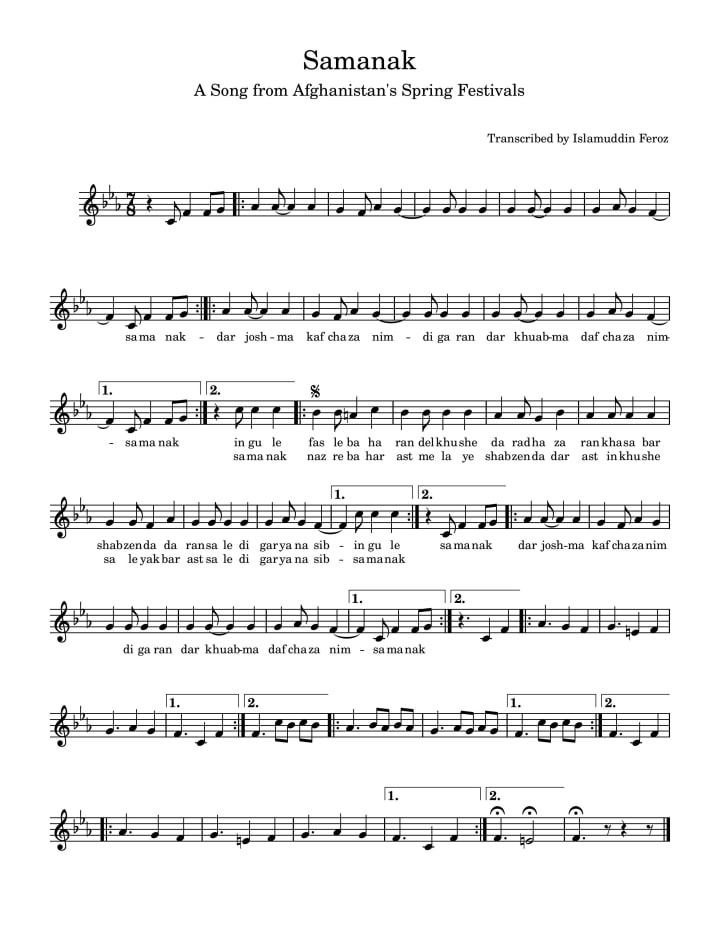
A sample of a Samanak song:
Samanak dar josh ma kafche zanim
Digarān dar khwab ma dafche zanim
Samanak nazre bahār ast
Mīlaye shab zende dār ast
In khoshi sāle yekbār ast
Sāle digar yā nasīb
Samanak dar josh ma kafche zanim
Digarān dar khwab ma dafche zanim
In gole fasle bahārān
Del khoshi dārad hazārān
Khāsah bar shab zende dārān
Sāle digar yā nasīb
Samanak dar josh ma kafche zanim
Digarān dar khwab ma dafche zanim
Translation of the Poem:
Semenk, we clap during its boiling
Friends, we play the daf in our gathering
Semenk is a springtime vow
The festival is a night of wakefulness
This joy comes once a year
The next year, may it be ours
Semenk, we clap during its boiling
Friends, we play the daf in our gathering
This flower belongs to the spring season
It holds thousands of joys
Especially for the night-watchers
The next year, may it be ours
Semenk, we clap during its boiling
Friends, we play the daf in our gathering
The Samanak Festival demonstrates how a traditional food and a folkloric song can become a symbol of a culture. Samanak and its songs, alongside other activities, are an inseparable part of the Nowruz celebration and connect generations. This festival is both a tangible and intangible tradition preserved over centuries and passed to new generations.
Furthermore, the music of the Samanak songs represents the musical taste of Afghan women. These songs are often accompanied by the rhythm of the daf and clapping, featuring a simple yet pleasant musical pattern transmitted across generations. Their value is not limited to music; they also convey experiences, memories, and social narratives of Afghan women.

These songs have not only increased the popularity of Samanak but have also spread to Iran and Tajikistan with Afghan migration. Historical records show that this song was performed on Afghan Radio in the 1950s by Mrs. Parwin and quickly became one of the most popular songs among Afghan women.
Conclusion
The conclusion demonstrates that festivals, particularly the Samanak Festival in Afghanistan, play a multilayered and vital role in preserving and sustaining the culture of society. Culturally, these rituals symbolize the connection of people with nature, ancient beliefs, and long-standing traditions, transmitting ethical and aesthetic values to future generations. Historically, festivals serve as a bridge between the past and the present, recalling Nowruz rituals and the spiritual heritage of the people of this land.
The social dimension of festivals is also highly prominent; they provide spaces for families and communities to gather and strengthen collective cooperation and solidarity. Music and collective songs play a special role in the appeal and beauty of these rituals. Songs not only bring joy and excitement but also carry stories, values, and collective memories, giving an artistic and literary expression to folk culture.
Furthermore, festivals go beyond mere entertainment and celebration; they act as a living medium for transmitting knowledge, art, history, and social identity. Music and songs help sustain and preserve an essential part of folk culture, demonstrating how a society can keep its traditions alive through beauty, art, and social cohesion, and pass them on to future generations.
Among these elements, women and their songs are key and indispensable components of these cultural and ancient festivals. Women’s active participation in cooking Samanak and performing collective songs highlights their role in preserving and transmitting cultural traditions. The songs, in addition to creating enjoyment and vitality, convey the experiences, values, and collective memories of the community. Through women’s engagement, intergenerational bonds and the continuity of folk culture are ensured, reinforcing their social and cultural position in society. In this way, without the role of women and their songs, festivals would lose a significant part of their cultural and social identity.
About the Creator
Prof. Islamuddin Feroz
Greetings and welcome to all friends and enthusiasts of Afghan culture, arts, and music!
I am Islamuddin Feroz, former Head and Professor of the Department of Music at the Faculty of Fine Arts, University of Kabul.
Keep reading
More stories from Prof. Islamuddin Feroz and writers in Feast and other communities.
The Ritual of "Wintry for the Bride": A Tale from the Heart of Afghanistan’s Ancient Culture
The Ritual of "Wintry for the Bride": A Tale from the Heart of Afghanistan’s Ancient Culture Author: Islamuddin Feroz, Former Professor, Department of Music, Faculty of Fine Arts, University of Kabul
By Prof. Islamuddin Ferozabout a month ago in Feast
My Tous les Jours Trip
As someone who lives in a rural area, I don't get the chance to visit fancy restaurants or bakeries that often. So, when a friend told me about a French-Asian bakery that's less than an hour away, I knew I had to check it out and grab some pictures for social media. Tous les Jours ended up providing an immersive experience that went above and beyond my expectations--although I did leave with a few reservations.
By Kaitlin Shanks16 days ago in Feast


Comments
There are no comments for this story
Be the first to respond and start the conversation.