
The Promise Still I Carry
Why the most profitable algorithm I ever found was a 70-year-old recipe.


I carry a promise that feels heavy in a world built on shortcuts. It isn’t written in a business plan, nor is it etched into the partnership agreement I signed three years ago. It is a quiet, stubborn vow I made to myself while standing over a trash can in a rain-slicked alleyway in Chinatown, the smell of stale grease and regret clinging to my jacket.
The promise is this: I will not sell a flavor that I have not earned.
In the startup ecosystem where I cut my teeth, “earning” is an outdated concept. You hack, you pivot, you fake it until you make it. But in the humid, chaotic reality of The Jade Garden, I learned that you cannot “hack” a broth that requires twelve hours of boiling. You simply have to wait.
The Audit
Three years ago, I walked into The Jade Garden with the swagger of a tech consultant and the vocabulary of a Silicon Valley founder. I had just acquired a controlling stake in the restaurant, a Cantonese institution that had been bleeding money for five years.
The founder, Mr. Liu, was a culinary genius and an operational nightmare. At sixty-eight, he was built like a fire hydrant — solid, immovable, and permanently stained with soy sauce.

Our first strategy meeting was a disaster. I slapped a spreadsheet onto the sticky round table.
“Mr. Liu, look at these labor costs,” I said, pointing to the red column. “You have three chefs whose sole job is to hand-pleat dumplings and skim fat off the master stock. That’s six grand a month just to watch water boil.”
Mr. Liu didn’t look at the paper. He was busy snapping the ends off snow peas, his rhythm hypnotic. Snap. Pull. Toss.
“The stock is the heart,” he said, his voice gravelly. “You stop watching it, and it turns cloudy. Cloudiness is laziness.”
“The customer doesn’t taste ‘cloudiness,’ Mr. Liu,” I countered, tapping the iPad. “They taste salt and umami. We can buy a concentrated base for one-tenth of the cost. It’s chemically identical. It’s scalable.”
He stopped snapping. He looked at me with eyes that had seen more kitchen fires than I had seen birthdays. “Young man,” he said, pointing a calloused finger at my chest. “You think business is math. Business is trust. You feed people. That is a sacred thing.”
I rolled my eyes internally. Sacred doesn’t pay the rent, I thought.
The “Ghost” Takeover
I took control of the back office and implemented what I arrogantly called “Restaurant 2.0.”
I fired the local butchers who delivered fresh pork daily and signed a contract with a massive broadline distributor. The next week, a generic white truck pulled up, unloading boxes of frozen, pre-peeled shrimp and plastic tubs of “High-Grade Poultry Booster.”
I remember the day the booster arrived. Mr. Liu opened the tub, smelled the yellow paste, and recoiled as if he’d been slapped. He didn’t say a word. He just walked to the back corner of the kitchen and sat down on an overturned milk crate.
With the labor costs slashed, I utilized our excess kitchen capacity to launch three “virtual brands” on delivery apps. We weren’t just The Jade Garden anymore; we were now also “Poke Paradise,” “Wing Wang,” and “Crazy Dumpling Bros” — all pumping out generic food from the same historic kitchen.
For six months, I felt like a god.
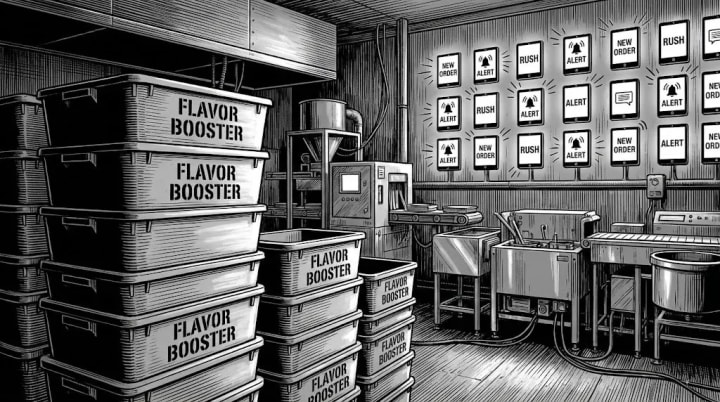
Revenue soared. The kitchen was a factory of efficiency. iPads were pinging constantly with Uber Eats orders. Drivers in motorcycle helmets were shoving past each other in the doorway.
“Look at the margins!” I shouted over the noise of the ticket printer one Friday night. I tried to show Mr. Liu the dashboard on my phone.
He was standing at the wok station, but he wasn’t cooking. He was wiping down a counter that was already clean. The fire in his eyes — that intense, manic focus I’d seen when he cooked the old way — was gone. He looked like a captain watching his ship being stripped for parts.
“It is busy,” he said softly. “But it is not alive.”
The Taste of Betrayal
The collapse didn’t happen on a spreadsheet. It happened in the dining room.
It started with Auntie Mei. She was a neighborhood fixture, a woman who had eaten Mr. Liu’s Wonton Noodle Soup every Tuesday for twenty years.
One Tuesday, I watched her. She took a sip of the soup — made with my efficient, cost-effective “Poultry Booster.” She paused. She took another sip, frowning. Then, she put her spoon down.
She didn’t complain. She didn’t ask for a refund. She just left a twenty-dollar bill on the table and walked out, leaving the bowl three-quarters full.
I ran after her. “Auntie Mei! Is everything okay?”
She stopped and looked at me with a pity that hurt more than anger. “The Wok Hei — the breath of the wok — is gone,” she said. “The soup lies. It tastes like a factory.”
She never came back.

But the breaking point came two weeks later. I was expediting orders, tossing frozen dumplings into the fryer, when a bowl of our “Supreme Broth” came back from table five. Untouched.
“Customer says it lacks depth,” the waiter mumbled.
Furious, I grabbed the bowl and stormed out the back door to the alley. Uneducated palates, I fumed. This is a scientifically formulated flavor!
I raised the bowl to dump it into the trash can. But something made me stop. I dipped a plastic spoon into the lukewarm liquid and tasted it.
It was salty. It was savory. It hit the taste buds. But it was hollow.
It lacked the sticky, collagen-rich texture that coats your lips. It lacked the subtle, smoky bitterness of the aged tangerine peel. It had no finish. It was a flat, one-dimensional lie.
I stood there in the drizzle, staring at the grease trap, and the realization hit me like a physical blow. I hadn’t optimized the buscientificallysiness; I had hollowed it out. I had traded a seventy-year reputation for a 15% increase in EBITDA.
I walked back inside, threw the plastic spoon in the bin, and found Mr. Liu.
“I ruined it,” I said.
He didn’t gloat. He didn’t say “I told you so.” He just stood up from his milk crate. “The tub,” he said, pointing to the booster paste. “Throw it out.”
“But the costs — “
“Throw. It. Out.”
The Return to the Fire
The next morning, I arrived at 4:00 AM.
“Teach me,” I said. “Not how to run the business. Teach me why the broth matters.”
For the next month, I became his apprentice. I learned that you don’t just boil bones; you blanch them first to remove the blood. I learned that the Jinhua ham must be sliced paper-thin to release its oils.
I watched Mr. Liu stare at the pot for hours. “Why are we just standing here?” I asked on the third day, my legs aching.
“We are not standing,” he whispered. “We are listening. Can you hear the bubbles change? Fast bubbles mean the liquid is angry. Slow bubbles mean the flavor is marrying. You cannot rush a marriage.”

It was a masterclass in patience. And it hit me: In a world of instant gratification, “Time” is the only luxury left.
My internet brain had been trying to remove friction. But for a heritage brand, the friction is the value. The suffering involved in making the soup is the flavor.
However, the math remained. We couldn’t afford to run this way and keep the prices low. We couldn’t survive on $12 noodles if the process cost us $20 in labor and time.
“We have the best product,” I told Mr. Liu one night, watching the steam rise. “But we are selling it like it’s fast food. We need to sell it like it’s a limited edition sneaker.”
Mr. Liu looked at me, confused. “Sneaker?”
“Trust me,” I said. “You handle the fire. I’ll handle the story.”
The “Drop”
I realized that the internet wasn’t the enemy; my application of it was. I had used tech to cheapen the product. Now, I would use tech to glorify the process.
We killed the delivery apps. No more “Poke Paradise.”
I hired a videographer. “Don’t make the food look pretty,” I told him. “Make it look hard.”
We filmed Mr. Liu arriving in the dark. We filmed the raw, bloody bones. We filmed the sweat dripping off his nose as he worked the wok. We posted a sixty-second reel on TikTok and Instagram, not of the finished dish, but of Mr. Liu skimming the scum off the broth at 5:00 AM.
The caption read: We only make 50 bowls a week. Because that’s all the time we have.
We launched the “Sunday Supreme Drop.”
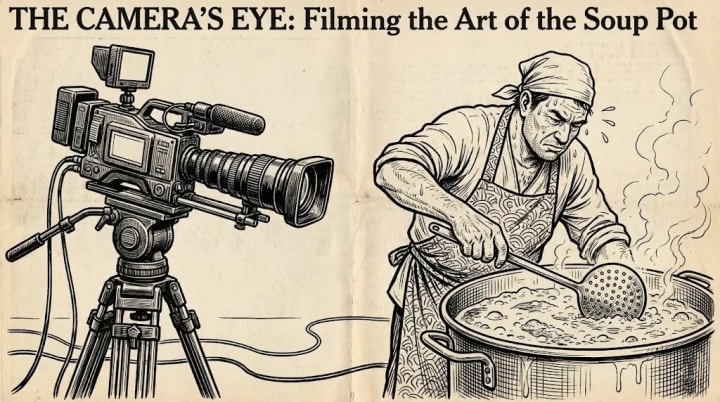
The deal was simple: The Supreme Broth was no longer on the regular menu. You had to pre-order it via a link released on Thursday at noon. You paid $48 a bowl — four times the old price.
“Forty-eight dollars?” Mr. Liu looked at me like I was insane. “For soup?”
“Not for soup,” I said. “For your time.”
Thursday noon arrived. I sat on the iPad, sweating.
12:01 PM. A notification dinged. Then another Instagram, in the afternoon. Then a continuous, singular trill, like a slot machine hitting the jackpot.
Sold out. In eight minutes.
People didn’t just buy the soup; they posted screenshots of their confirmation emails like they had won the lottery. They weren’t buying calories; they were buying admission to a ritual.
The Promise Still I Carry
Tonight, The Jade Garden is loud, but it’s a good loud. It’s the sound of clattering porcelain and excited chatter, not the ping of delivery tablets.
I stand by the pass, watching the dining room. At the corner table, a young couple is filming their bowl of Supreme Broth. But then, they put the phones down. They lean in. They smell the steam. They take that first sip, and I see their eyes widen.
It’s the look of people tasting something they thought didn’t exist anymore. Real, unhurried depth.
Mr. Liu walks past me, carrying a crate of fresh scallions. He pauses and looks at the couple, then looks at me. A small, almost imperceptible smile cracks his face. He nods once and heads back to the fire.
I touch the pocket of my apron, feeling the weight of the promise I now carry every day.
I will not sell a flavor that I have not earned.

I realized that innovation isn’t about replacing the old with the new. It’s about building a new vessel to carry the old fire. The internet didn’t kill tradition for us; it allowed us to find the specific people who were starving for it.
We don’t sell food anymore. We sell time, served in a porcelain bowl. And as long as the world keeps speeding up, that is a business that will never go obsolete.
About the Creator
Cher Che
New media writer with 10 years in advertising, exploring how we see and make sense of the world. What we look at matters, but how we look matters more.
Eat During Chinese New Year
The Chinese New Year feast is traditionally abundant with meat dishes, but these 15 vegetarian recipes prove that plant-based eating can be just as festive, flavorful, and meaningful. Each dish carries auspicious symbolism while delivering incredible taste that will have everyone reaching for seconds—even the meat lovers at your table. From crisp greens to creative vegetable transformations, these recipes are designed to impress.
By yue . shuia day ago in Feast


Comments
There are no comments for this story
Be the first to respond and start the conversation.