
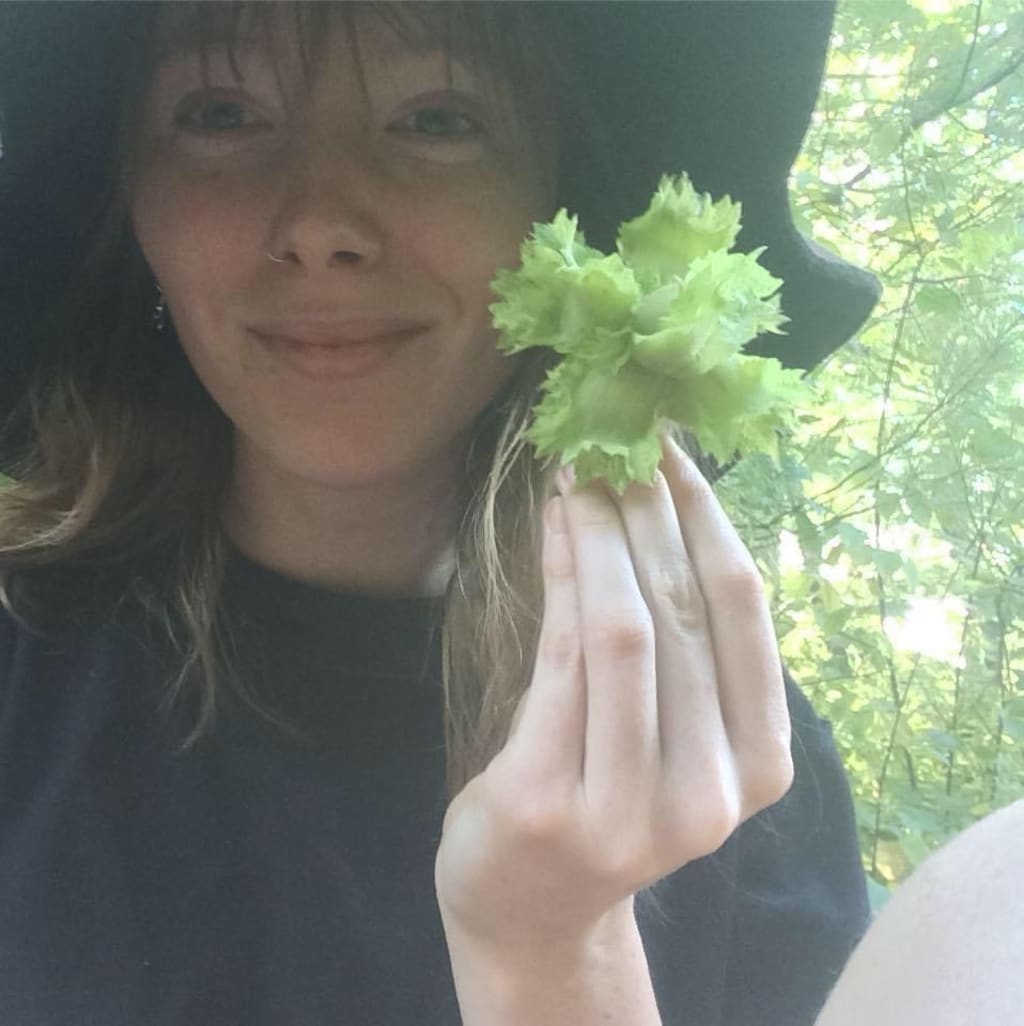
Blink and you'll miss the chance to taste some of nature's finest nuts. As much as I love them, so do our bushy-tailed foraging friends. American Hazelnut, or Corylus Americana, ripens in late August in New England. 'Cor' is the Latin word for heart. They grow in abundance, lining both sides of a walking trail near my house with their showy, heart-shaped leaves.
You know they're about to ripen when you start seeing the left-behinds of the fuzzy, green sheaths (called involucres) that encase the nuts and empty nutshells along the hedgerow. The next few days we keep an eye on them, looking for rust colored splotches to appear on the green clusters. The race begins to pick some before the gray squirrels strip the bushes bare. When it comes to most native plants, I believe there is enough for humans and animals to share, but in the case of the American Hazelnut, you have to get there first.
Although American hazelnuts are much smaller than the European varieties we're used to, the big clusters they grow in make for fast and easy picking. As with most wild food, American hazelnuts may come in a smaller package, but the flavor is more concentrated and intense than their grocery store counterparts. To pick we need: a container of some sort with a neck strap to free up both hands, gloves to avoid getting pesky spines stuck in our hands, and a good pair of scissors to make clean cuts that won't harm the plant.
The bushes often grow upwards of eight feet tall. They have surprisingly pliable branches that you can bend down to your height so you can snip clusters off with ease. Keep a sharp eye out for fuzzy white caterpillars inching along the branches at the same time of year. One simple brush with their spiky hairs can send you spiraling in immense, stinging pain-- totally not speaking from experience or anything...
Nuts at the grocery store are expensive, come packaged in plastic, and are trucked in from who knows where. Imagine my delight in happening upon such a large stand of free, nutritious food practically in my backyard! After I filled my buckets to my hearts content, still leaving plenty for the squirrels and the weevils, I walk back home brimming with excitement thinking about the recipes I'll make with them.
The heavenly aroma of roasted American hazelnuts is something of a dream. Coffee and chocolate beg to be acquainted with it. In two years of foraging I have made hazelnut infused cream then used it for coffee, and used the same cream to make ice cream. I have also made hazelnut biscotti to enjoy with hot coffee. This year one of my goals is to make a wild foraged version of the ever-popular chocolate and hazelnut spread we all grew up with.
But first, I needed to find out how to remove the husks. I researched and found you have to cure the hazelnut clusters for a few weeks in a warm spot to be able to strip off the involucres easily. So how do the gray squirrels unwrap the nuts? They bury them in the ground for safe storage and so the leaf wrappers rot away, leaving just the hazelnut inside it's shell. Such efficient little creatures! I was too afraid of burying such precious gems and losing them to the squirrels that I opted to unwrap them by hand. This step was much more labor intensive than originally imagined. I quickly realized the trade off of free nuts: while you're not spending money for the nuts, you're spending a lot of time between picking, unwrapping and cracking. Maybe that's why I can't find a decent bag of cashews for under $10. To eat for free and not worry about money; those squirrels are on to something.
About the Creator
Keep reading
More stories from Allison Johnson and writers in Feast and other communities.
My Tous les Jours Trip
As someone who lives in a rural area, I don't get the chance to visit fancy restaurants or bakeries that often. So, when a friend told me about a French-Asian bakery that's less than an hour away, I knew I had to check it out and grab some pictures for social media. Tous les Jours ended up providing an immersive experience that went above and beyond my expectations--although I did leave with a few reservations.
By Kaitlin Shanks23 days ago in Feast
Orange Market Size and Forecast 2025–2033
Orange Market at a Glance (Renub Research) The Global Orange Market is expected to reach US$ 53.74 billion by 2033, up from US$ 38.45 billion in 2024, expanding at a CAGR of 3.79% from 2025 to 2033. Rising consumer demand for vitamin C–rich foods, the rapid growth of juice and beverage categories, health-conscious lifestyles, and the expanding use of oranges in cosmetics, pharmaceuticals, and functional foods are the primary growth engines. Export opportunities and favorable cultivation conditions across major producing regions further reinforce long-term market expansion.
By Aaina Oberoi5 days ago in Feast




Comments
There are no comments for this story
Be the first to respond and start the conversation.