
Soybean Market Trends & Summary
Global Demand for Plant-Based Protein, Expanding Feed Industries, and Renewable Applications Drive Steady Market Growth Through 2033

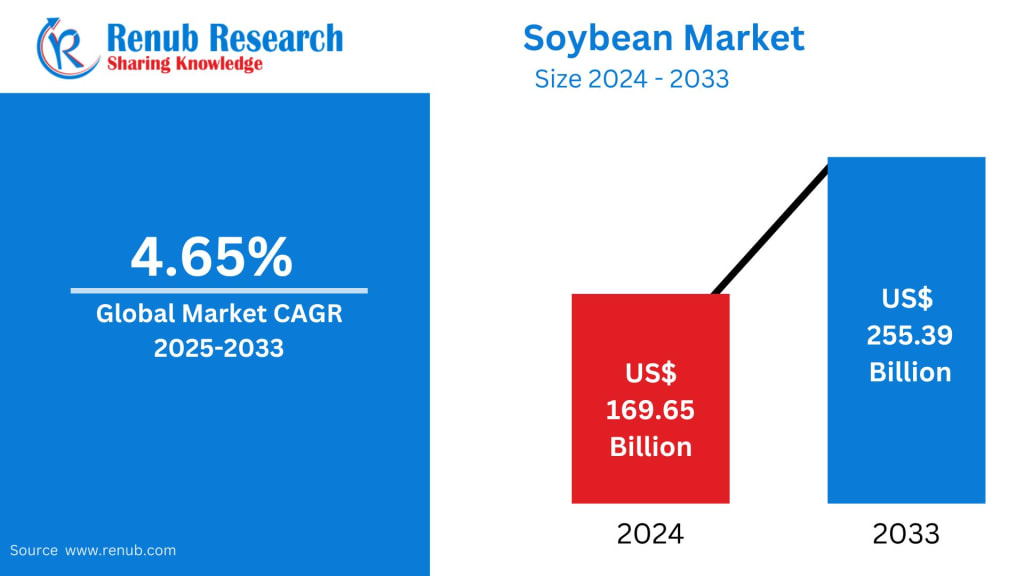
The global soybean market continues to demonstrate resilient growth as shifting dietary habits, industrial demands, and expanding livestock production reshape global food and agribusiness systems. According to Renub Research, the market—valued at US$ 169.65 billion in 2024—is projected to rise to US$ 255.39 billion by 2033, growing at a CAGR of 4.65% during 2025–2033. This steady expansion is fueled by heightened demand for soy-derived food items, accelerating adoption of soy as a plant-based protein, and increasing utilization in biofuels and sustainable industrial materials.
As governments pursue lower-carbon energy pathways, consumers shift to health-conscious diets, and emerging economies scale up livestock production, soybeans remain one of the most strategically vital crops in the world. From tofu and soy milk to biodiesel and plastics, soybeans continue to dominate multiple supply chains that shape global nutrition and sustainability efforts.
Understanding the Role of Soybeans in Global Agriculture
Soybean is a highly versatile legume originally cultivated in East Asia and now grown extensively across North and South America, Asia-Pacific, and parts of Europe. Known for its exceptional protein content and rich oil profile, soybean serves as a foundation for food production, livestock nutrition, and an expanding list of industrial applications.
Commercial soybeans typically come in yellow varieties, though green and black soybeans exist as specialty cultivars. Their primary uses can be broadly grouped into:
Food processing: soy milk, tofu, tempeh, soy sauce, soy flour, protein isolates, meat substitutes
Oil production: cooking oil, margarine, processed foods
Animal feed: soybean meal as a high-protein feed for poultry, swine, and aquaculture
Industrial applications: biofuels, bioplastics, solvents, adhesives, and lecithin
Soybeans are valued not only for their nutritional benefits but also for their contribution to sustainability. As global consumers demand more eco-friendly and plant-based foods, soy continues to find new relevance in modern food systems and renewable industries.
Key Drivers of the Global Soybean Market
1. Rising Global Demand for Plant-Based Protein
One of the most significant growth engines for the soybean market is the worldwide shift toward plant-based diets. Consumers—especially across the U.S., Europe, and increasingly parts of Asia—are prioritizing protein sources that are sustainable, nutritious, and environmentally friendly.
Soy products like tofu, soy milk, and textured vegetable protein have become mainstream in grocery aisles and restaurants. Meanwhile, food companies continue to develop soy-based meat alternatives with improved texture and flavor.
Industry Snapshot:
November 2024: DAIZ Engineering and ICL Food Specialties introduced ROVITARIS® SprouTx™, a next-generation soy protein ingredient designed to enhance sensory quality in plant-based seafood and meat. Leveraging patented germination technology, this innovation delivers superior taste and nutritional profiles compared to traditional plant-based proteins.
As plant-forward eating gains momentum, soy’s role in supplying high-quality, sustainable protein will continue to expand.
2. Rapid Growth of the Global Livestock Industry
Soybean meal—produced after oil extraction—is one of the world’s most consumed animal feed ingredients, powering poultry, livestock, and aquaculture sectors. As incomes rise in developing nations, consumption of meat and dairy continues to increase, driving demand for protein-rich feed.
Asia-Pacific and South America, in particular, rely heavily on soybean imports to sustain their growing livestock populations.
Market Development:
July 2024: Benson Hill, Inc. announced advancements in soybean traits engineered for animal feed, oil, and biofuels. With several innovations entering field trials, these varieties promise higher nutritional value and improved agricultural efficiency, reinforcing soy’s importance in feed markets.
With global protein consumption projected to rise steadily, soybeans remain indispensable to the world’s livestock production capacity.
3. Expanding Industrial Applications, Especially in Renewable Energy
Beyond food and feed, soybean oil is increasingly utilized in biofuels, especially biodiesel—an essential renewable alternative in many countries' energy transition plans. Its ability to serve as a biodegradable, renewable industrial input increases its relevance in manufacturing bioplastics, adhesives, and eco-friendly materials.
Government policies encouraging greener fuels have significantly boosted demand for soybean oil.
Industry Update:
July 2024: BASF expanded its Xitavo soybean seed portfolio to 46 varieties for the 2025 growing season, providing enhanced options for growers focused on high-yield, high-oil-content crops suited for biodiesel and industrial markets.
With sustainability initiatives accelerating globally, soybean-based industrial products will continue to gain prominence.
Key Challenges Impacting the Soybean Market
1. Price Volatility and Trade Uncertainties
Soybean markets are highly sensitive to:
Climate conditions
Geopolitical tensions
International trade agreements
Tariff disputes—particularly between the U.S. and China, two of the largest producers and consumers—have historically disrupted market flows and caused significant price volatility. Farmers and exporters remain vulnerable to these fluctuations, as market stability often depends on unpredictable global events.
2. Environmental Concerns and Deforestation
Soybean cultivation, particularly in South America, has been linked to:
Deforestation
Biodiversity losses
Soil degradation
Environmental advocacy and stricter land-use regulations aim to limit deforestation in regions like the Amazon. While these policies promote sustainability, they also present compliance challenges for producers and exporters.
Sustainability certifications and traceability programs are increasingly becoming prerequisites for international trade.
Market Breakdown by Segment
Conventional Soybean Market
Conventional (non-GMO) soybeans form the backbone of the global supply chain, particularly in emerging markets where affordability is a priority. These soybeans are widely used across:
Food processing
Animal feed
Industrial applications
Although demand remains strong, the segment faces competition from organic and non-GMO specialty markets, especially in Europe and North America.
Processed Soybean Market
Processed soybean products—including soy oil, soy protein isolates, concentrates, and soy flour—serve both consumer and industrial sectors.
Growth in processed soy is driven by:
Rising processed food demand
Increased consumption of biodiesel
Advancements in soy protein extraction technologies
As consumers seek higher-quality protein alternatives, processed soybean products remain integral to food innovation.
Food & Beverages Soybean Market
This segment includes:
Tofu
Soy milk
Meat alternatives
Soy yogurts
Protein powders
Demand is largely driven by:
Health-conscious consumers
Growing vegan and vegetarian populations
Innovations in taste and texture
As soy-based foods continue to evolve, this segment is expected to expand rapidly.
Animal-Feed Soybean Market
Soybean meal leads the global protein feed market due to its essential amino acid composition and cost-effectiveness. Poultry, aquaculture, and swine industries rely heavily on soybean meal.
Increasing livestock production in Asia, Latin America, and Africa ensures long-term demand for this segment.
Country-Level Market Highlights
United States
As one of the world’s largest soybean producers and exporters, the U.S. plays a pivotal role in global supply chains. Domestic demand for biofuels and animal feed continues to enhance market stability.
February 2024: Pioneer launched Z-Series soybeans in the U.S. and Canada, offering improved disease resistance and yield advantages for growers.
Germany
Germany's market is increasingly aligned with organic, sustainable, and non-GMO trends. With limited domestic production, the country heavily imports soybeans but is actively promoting local cultivation to reduce dependency.
June 2024: Feed producers expanded capacity and began recruiting additional soybean growers to strengthen the domestic supply chain.
China
The world’s largest importer of soybeans, China depends heavily on global suppliers to fuel its massive livestock and food processing sectors. Despite geopolitical challenges, China continues to secure long-term import relationships to stabilize supply.
UAE
A rapidly growing market driven by:
Rising demand for plant-based foods
Expansion of livestock feed requirements
National food security initiatives
January 2024: Benson Hill announced progress toward doubling its soybean seed portfolio by 2025, supporting global feed and food markets—including high-demand regions like the UAE.
Market Segmentation Overview
By Nature
Conventional
Organic
By Form
Processed
Raw
By End User
Food & Beverages
Animal Feed
Others
Key Geographies
North America: U.S., Canada
Europe: France, Germany, Italy, Spain, U.K., Belgium, Netherlands, Turkey
Asia Pacific: China, Japan, India, Australia, South Korea, Thailand, Malaysia, Indonesia, New Zealand
Latin America: Brazil, Mexico, Argentina
Middle East & Africa: South Africa, Saudi Arabia, UAE
Key Players Covered
Kerry Group plc
Fuji Oil Co., Ltd.
House Foods Corporation
Danone North America
DuPont de Nemours, Inc.
CHS Inc.
Cargill, Inc.
Scoular
Archer-Daniels-Midland Co. (ADM)
Each company is assessed through:
Overview
Key Personnel
Recent Developments
Financial Insights
Final Thoughts
The global soybean market stands at the intersection of agriculture, food innovation, sustainability, and global trade. As Renub Research projects strong growth through 2033, soybeans will continue to play an increasingly influential role in meeting the world’s nutritional needs, supporting livestock production, and advancing renewable industries.
From plant-based diets and biofuels to emerging industrial applications, soybeans offer versatile solutions that align with global priorities—health, sustainability, and economic resilience.
With ongoing innovation, improved varieties, and expanding global demand, the soybean market is positioned to remain a cornerstone of global agriculture for decades to come.
About the Creator
jaiklin Fanandish
Jaiklin Fanandish, a passionate storyteller with 10 years of experience, crafts engaging narratives that blend creativity, emotion, and imagination to inspire and connect with readers worldwide.
Keep reading
More stories from jaiklin Fanandish and writers in Feast and other communities.
Vegan Food Market Trends & Summary (2025–2033)
Introduction: Global Vegan Food Market Set for Transformative Growth The global Vegan Food Market, valued at USD 20.06 billion in 2024, is undergoing a dynamic transformation driven by shifting consumer values and unprecedented innovation. According to Renub Research, the market is projected to reach USD 46.09 billion by 2033, advancing at a CAGR of 9.68% from 2025 to 2033.
By jaiklin Fanandishabout a month ago in Feast
My Tous les Jours Trip
As someone who lives in a rural area, I don't get the chance to visit fancy restaurants or bakeries that often. So, when a friend told me about a French-Asian bakery that's less than an hour away, I knew I had to check it out and grab some pictures for social media. Tous les Jours ended up providing an immersive experience that went above and beyond my expectations--although I did leave with a few reservations.
By Kaitlin Shanks16 days ago in Feast
Organic Baby Food Market Companies Analysis (2025–2033)
Introduction: A New Standard for Infant Nutrition The global Organic Baby Food Market is undergoing a transformative shift as modern parents increasingly demand clean, transparent, and sustainable nutrition for their children. Organic baby food—made without synthetic fertilizers, artificial preservatives, genetically modified organisms (GMOs), or chemical pesticides—has moved from a niche category to a mainstream necessity. Rising awareness of food safety, health outcomes, and environmental sustainability is reshaping consumer behavior worldwide.
By Aaina Oberoiabout 3 hours ago in Feast




Comments
There are no comments for this story
Be the first to respond and start the conversation.