

Bare, slipper, and boot-covered feet crackled upon fallen branches while mud-stained, razor-sharp machetes cut down overgrowth, forging a path through the sprawling ma’omaga (plantation) until it was clear to the la’au niu (coconut trees). Makeshift stakes were planted and most of us sat down, bronzed and sweaty under the south pacific sun while the two lightest of our group lithely scaled the tall trees. One by one they cut down the coconuts, falling like tropic hail strong enough to probably kill someone who was directly underneath. Several coconut husks were then speared and opened on the stake before the tips of the outer layers were cut revealing a small hole. The coconut water was heavenly, and nothing tasted more perfect in that moment, on that day, enjoying a brief respite before the long march back to school.
We loaded the coconuts in freshly hand-weaved baskets and met the other group who collected fafie (firewood) then trudged back to campus, passing quaint fale (houses) and friendly villagers. When we arrived, we stacked the fafie and coconuts in the falekuka (kitchen), ready for tomorrow’s umu (traditional baking). With work time complete the rest of the day was for study and leisure. Some of us hit the weights, others sparred, while the rest played rugby or showered. In the evening we studied and strummed ukulele, another long week complete.
At 3am the next morning one of the senior students shook me awake, it was time to do the umu. The campus was dark save for the falekuka where a few students began the lengthy process of prepping. We set up the umu by placing tin sheets on the ground bordered by four logs. The center was filled with wood, coconut husks, cardboard and paper pieces topped with rocks. A fire was lit, and the rocks were heated for thirty minutes. During that time, prep consisted of weaving baskets, peeling taro and ulu (breadfruit) using the jagged bottoms of cut tuna cans to scrape off the skin, scraped coconuts using a seated scraper, and used the coconut fiber to squeeze the copra into coconut milk. The milk was then used for the traditional lu’au dish, scooped in taro leaves with chicken, pork, or lamb then wrapped and placed in foil. Once heated, the logs were removed and the mound of rocks were spread out evenly on the tin sheets. The lu’au, taro and ulu were then placed on the hot rocks and covered in more rocks before being blanketed by banana leaves and a sheet where the food would cook for about three hours. After that, the sheet and leaves were removed and the food was placed in the baskets ready to serve.
During my time in the south pacific umu lu’au with taro has been my favorite dish. The hearty taro scooped into the delicious blend of taro leaf and coconut milk with or without meat is a taste without equal, both filling and satisfying. Though the dish can also be made with modern stoves and ovens, the unique flavor and experience from cooking on an umu cannot be emulated. Having had the opportunity to study and be part of the work put into traditional preparation has given me a deep appreciation for pacific island culture, from marching daily to the source, the plantation and planting and reaping food from the earth, to the meticulous prep, learning the skill it takes to husk, crack, and scrape coconuts properly, to lighting a fire, making sure the wood and paper is placed so it can burn well, and to the umu itself, a way of life for generations that still fortunately exists today.
About the Creator
My Tous les Jours Trip
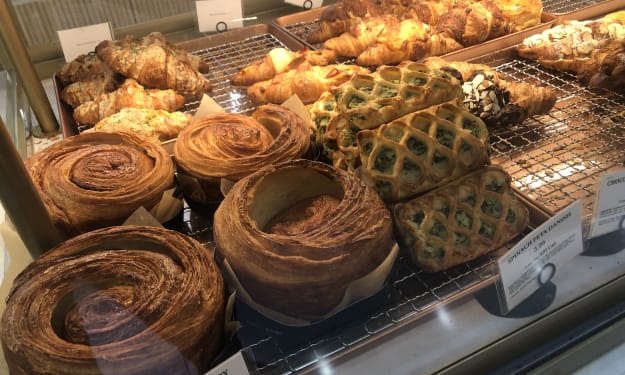
As someone who lives in a rural area, I don't get the chance to visit fancy restaurants or bakeries that often. So, when a friend told me about a French-Asian bakery that's less than an hour away, I knew I had to check it out and grab some pictures for social media. Tous les Jours ended up providing an immersive experience that went above and beyond my expectations--although I did leave with a few reservations.
By Kaitlin Shanks22 days ago in Feast
North America Pasta Market Size & Forecast 2025–2033
Introduction Pasta has quietly transformed from a traditional Italian staple into a universal comfort food across North America. Once associated mainly with classic recipes and home cooking, it now appears in gourmet menus, meal kits, microwaveable bowls, and plant-based diets. According to Renub Research, the North America pasta market was valued at US$ 6.23 billion in 2024 and is projected to reach US$ 8.91 billion by 2033, expanding at a CAGR of 4.05% from 2025 to 2033.
By Janine Root 5 days ago in Feast



Comments
There are no comments for this story
Be the first to respond and start the conversation.