
Megalopolis: Francis Ford Coppola’s Ambitious But Flawed Masterpiece
"A Visually Stunning Epic That Falls Short on Story and Performances"

Francis Ford Coppola, the legendary director behind classics like The Godfather and Apocalypse Now, has finally released his long-anticipated project, Megalopolis. This film, which he has been imagining for decades, is a visual masterpiece set in a futuristic version of New York, inspired by the grandeur of ancient Rome. With a stunning $120 million budget funded by Coppola himself, Megalopolis is a breathtakingly beautiful movie. However, despite its visual allure, the film ultimately falls short in terms of storytelling, performances, and coherence.
A Story of Ambition and Power
The film centers around Cesar Catilina, played by Adam Driver, an ambitious architect and visionary who dreams of turning New Rome into a utopia. Standing in his way is Mayor Franklyn Cicero, portrayed by Giancarlo Esposito, who represents the old, corrupt ways of the city. Meanwhile, Cicero’s daughter Julia, played by Nathalie Emmanuel, finds herself caught in the middle, torn between her love for Cesar and her loyalty to her father. On paper, the storyline seems promising, offering a dramatic clash of ideals and a personal love story mixed into the political turmoil. Unfortunately, the execution leaves much to be desired.

A Beautiful But Confusing World
There’s no denying that Megalopolis is visually stunning. The movie’s futuristic New York is a dazzling blend of ancient Rome and modern architecture, with lavish rooms, glowing light, and an unearthly beauty to everything. The cityscape, particularly the Chrysler Building gleaming against a deep indigo sky, is a sight to behold. Coppola has always had an eye for detail, and the film’s world-building is proof of that.
Costume designer Milena Canonero also deserves credit for her work, particularly in the clever references to Roman togas in the characters’ wardrobes. Driver, in several scenes, sports a dramatic black cape, which he wields with more confidence than his dialogue. The costumes add an extra layer of grandeur to the film, making the characters feel like they belong in this strange, futuristic world.
But despite its beauty, Megalopolis quickly becomes a mess. The story is hard to follow, with confusing elements that don’t seem to fit. Cesar’s character, for example, has bizarre superhero-like powers—he can stop time, but only sometimes—and randomly spouts Shakespearean lines. It’s unclear why these choices were made, and instead of adding depth to the character, they leave the audience puzzled.
A Star-Studded Cast, But No Spark
One of the most disappointing aspects of Megalopolis is the cast. With big names like Laurence Fishburne, Dustin Hoffman, and Aubrey Plaza, you would expect dynamic performances. Instead, most of the actors seem lost in the material, delivering their lines without any real emotion or energy. Adam Driver, in particular, struggles to bring Cesar to life, reciting his lines mechanically and failing to connect with the character’s larger-than-life ambition. **Giancarlo Esposito** does his best as Mayor Cicero, but even his performance feels flat at times.
Aubrey Plaza, known for her quirky, offbeat roles, seems especially out of place here. Her character doesn’t fit well into the story, and her performance feels disconnected from the rest of the film. It’s a shame because Megalopolis had the potential to showcase these actors in a unique and powerful way, but instead, it feels like a wasted opportunity.

A Filmmaker’s Ambition Gone Astray
At 85 years old, Francis Ford Coppola still has plenty of creative ideas, but Megalopolis seems to suffer from an overload of them. The movie is filled with strange sequences that feel more like distractions than meaningful additions to the story. There’s an endless circus scene that doesn’t seem to have a purpose, a random switch to a three-way split screen, and even a moment when a character speaks directly from the theater’s audience. These moments, while visually interesting, come off as gimmicks rather than thoughtful storytelling techniques.
It’s clear that Coppola was swinging for the fences with Megalopolis, trying to create something epic and meaningful. But unfortunately, the film’s ideas don’t come together in a cohesive way. The story, while promising in theory, doesn’t have enough substance to sustain the film’s lengthy runtime, and the characters never quite feel real or engaging. By the time the movie reaches its conclusion, many viewers may find themselves checking the time, wondering when it will finally end.
A Dream Better Left Undreamt
While Megalopolis is a visual feast, it’s hard not to feel that the film is a missed opportunity. There’s beauty in its grand, futuristic world and in Coppola’s clear passion for the project, but the film never quite finds its footing. The story is muddled, the performances are lifeless, and the many creative flourishes feel more like distractions than meaningful contributions to the film.
Perhaps this is a movie that would have worked better in Coppola’s dreams, where his vision could have remained untarnished by the practicalities of filmmaking. It’s admirable that he took such a bold swing with Megalopolis, but in the end, it’s more of a beautiful disaster than the masterpiece he likely envisioned. While some may find joy in its ambition, others will walk away wondering what could have been.
About the Creator
My Tous les Jours Trip
As someone who lives in a rural area, I don't get the chance to visit fancy restaurants or bakeries that often. So, when a friend told me about a French-Asian bakery that's less than an hour away, I knew I had to check it out and grab some pictures for social media. Tous les Jours ended up providing an immersive experience that went above and beyond my expectations--although I did leave with a few reservations.
By Kaitlin Shanks18 days ago in Feast
The Food Pyramid Has Been Flipped. Here’s What the New One Really Means.
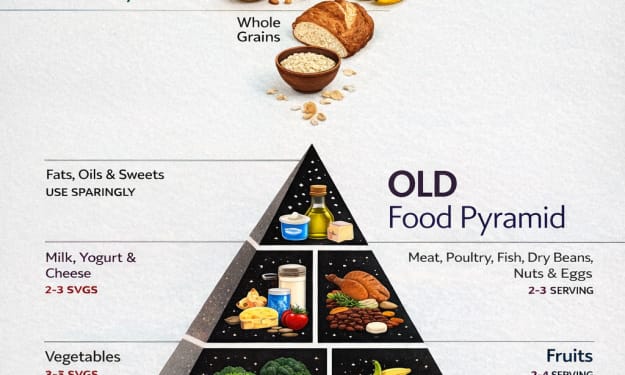
For decades, we were taught to eat from the bottom up. Grains formed the foundation. Bread, rice, cereal. Protein and fats hovered higher, almost suspiciously. Sugar sat at the top like a guilty secret we all pretended not to touch.
By Aarsh Malik3 days ago in Feast



Comments
There are no comments for this story
Be the first to respond and start the conversation.