
Lion Dance in Layers: China’s Edible Artistry Unveiled"
"From hand-carved ‘fur’ to 100+ buttery folds, explore the hypnotic craft of Xingshi Su—the Cantonese pastry turning dough into cultural storytelling, one golden strand at a time
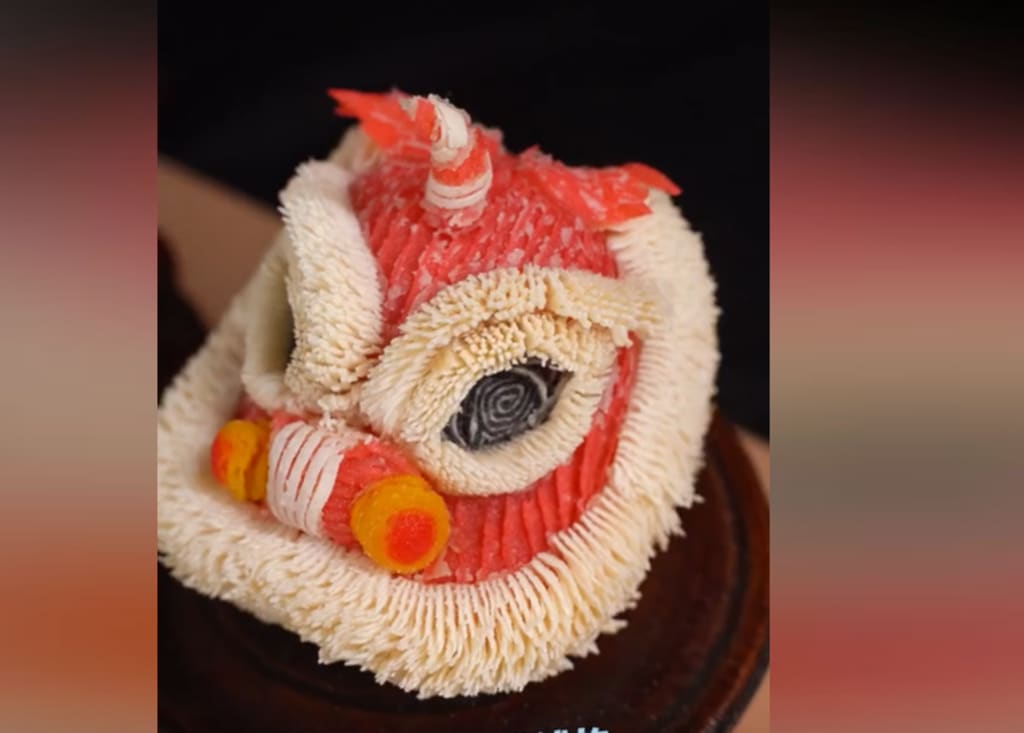
The Art of Xingshi Su: A Masterclass in Chinese Pastry Craftsmanship
When people think of gourmet artistry, their minds often drift to French pastries or Italian delicacies. But let me tell you—China has its own treasures, and Xingshi Su (Awakening Lion Pastry) is a dazzling example. This intricately layered, hand-sculpted pastry isn’t just food; it’s a cultural emblem, requiring skill, patience, and an artistic eye. As someone who’s learned directly from its creators, I’m here to pull back the curtain on this edible masterpiece.
The Foundation: Mastering the Lamination
At the heart of Xingshi Su lies the lamination process—a test of any pastry chef’s基本功 (jīběn gōng, foundational skills). The dough is folded and rolled repeatedly to create hundreds of delicate layers. My apprentice Jianbo recently practiced this very step. “How many layers does this have?” he asked, squinting at the dough. “Around a hundred, maybe? Honestly, it’s hard to keep count!”
For Xingshi Su, we prepare four types of laminated dough: two straight-layered (直酥) and two spiral-layered (圆酥). The straight-layered dough, with its parallel lines of pastry, is similar to the technique used in swan-shaped pastries (Tian’e Su). The spiral-layered version, resembling a fingerprint, adds depth and texture. If this sounds complex, don’t worry—I’ll share a full tutorial on lamination later. But for now, just know this: achieving these layers is a dance of precision and temperature control. Too much pressure, and the butter melts; too little, and the layers won’t separate when fried.
The Devil’s in the Details: Handcrafting Each Component
Once the dough is ready, the real challenge begins: sculpting the lion’s features. Every element—from the tufted mane to the expressive eyebrows—is shaped by hand. We start with a base made of lotus seed paste, molded into a rounded head. Wrapping the dough around it requires a featherlight touch. “Work fast,” I remind my apprentice. “The warmth of your hands will soften the butter. One wrong move, and the layers stick together.”
Even the tiniest details matter. Take the eyes, for instance: we wrap a speck of lotus paste in a mix of black and white dough, then slice it into paper-thin discs. When fried, these puff into perfect spheres, their marbled patterns resembling pupils. “Why the lotus paste?” a viewer once asked. “It’s the secret to the shape,” I explained. “The filling expands during frying, creating that rounded, lifelike curve.”
But perhaps the most awe-inspiring step is carving the lion’s “fur.” Using a razor-sharp blade, we slice the dough into hair-thin strands, each cut deliberate. “Look at those layers!” Jianbo marveled. “It’s like a topographic map!” One misjudged angle, though, and the strands clump or tear. “This part takes four minutes per piece,” I noted. “And that’s with a machine.”
Assembly: A Puzzle of Precision
After hours of prep, we face the final test: assembly. Each component must align perfectly—both visually and structurally. The laminated layers, for example, dictate the direction of the lion’s “fur.” Attach a piece sideways, and the illusion shatters.
Adhesion is another hurdle. We use egg white as glue, but applying it is a Goldilocks dilemma: too much, and the layers fuse shut; too little, and they fly apart in the fryer. “Imagine spending hours on a piece, only to watch it disintegrate in the oil,” I sighed. “That’s why competitions rarely feature Xingshi Su. Even in six-hour contests, there’s no time. One head alone takes ten minutes. Ten heads? Impossible.”
The Final Act: Frying with Finesse
With the lion fully assembled, we turn to the fryer. Temperature control is critical—140°C (284°F) is ideal. Too hot, and the pastry scorches; too cool, and the layers separate. “141°C… perfect,” I muttered, adjusting the dial. As the lion sank into the oil, the room held its breath. Slowly, the layers unfurled: the mane bloomed, the eyes gleamed, and the once-flat dough transformed into a三维 sculpture.
More Than a Pastry: A Cultural Legacy
As we plated the golden lion, I reflected on the journey. Xingshi Su isn’t just a technical feat—it’s a symbol of Chinese pastry chefs’ innovation. For too long, global gourmet discourse has overlooked our traditions, reducing Chinese baking to “just baozi and mantou.” But dishes like this prove otherwise. Every slice, every layer, carries centuries of craft.
So next time you admire a croissant’s flakiness or a cannoli’s crispness, remember: China’s pastry arts have their own stories to tell. And with each Xingshi Su, we’re adding a new chapter—one delicate layer at a time.
About the Creator
Keep reading
More stories from yue . shui and writers in Feast and other communities.
Plant-Powered China: 10 Vibrant Vegan Bites You Can’t Resist
10 Nutritious Veggie Pancakes Every Busy Mom Needs (Kids Will Beg for Seconds!) As a parent, keeping breakfast both healthy and exciting can feel like a daily challenge. But fear not—these 10 veggie-packed pancake recipes are here to save your mornings! They’re quick, loaded with nutrients, and guaranteed to make your kids’ taste buds (and growth spurts!) happy. Let’s dive in!
By yue . shui9 months ago in Feast
My Tous les Jours Trip
As someone who lives in a rural area, I don't get the chance to visit fancy restaurants or bakeries that often. So, when a friend told me about a French-Asian bakery that's less than an hour away, I knew I had to check it out and grab some pictures for social media. Tous les Jours ended up providing an immersive experience that went above and beyond my expectations--although I did leave with a few reservations.
By Kaitlin Shanks21 days ago in Feast



Comments
There are no comments for this story
Be the first to respond and start the conversation.