
Guy Fieri and the Paradox of America’s Flavor King
Exploring how a TV chef in flames and sunglasses became an unlikely cultural touchstone — and why I’ve come to appreciate him far more than I expected.


Guy Fieri was never supposed to be cool. He showed up on Food Network in the early 2000s like a living cartoon — bleached hair, wraparound shades, and that chaotic bowling-shirt energy that radiated off the screen. For years, I couldn’t stand him. He felt like the embodiment of everything loud and unserious about American television: the volume turned all the way up, the jokes too corny to land, the enthusiasm too big to feel sincere. I used to joke that watching Diners, Drive-Ins, and Dives was like getting trapped in an endless reel of dad energy. But somewhere along the way, my irritation gave way to something else — something approaching admiration.
The turning point came when I realized that Fieri isn’t pretending. The man on TV — the “Mayor of Flavortown” himself — isn’t a caricature designed to manipulate audiences, though he easily could have been. He’s a guy who genuinely loves small-town diners, mom-and-pop barbecue joints, and hole-in-the-wall taco trucks with a childlike fascination that borders on reverence. In the age of ironic detachment, that kind of unfiltered joy looks revolutionary.
When I started paying closer attention, Diners, Drive-Ins and Dives began to look less like empty entertainment and more like cultural documentation. Through his spiky hair and exaggerated slang, Fieri was archiving the labor and passion of everyday cooks across America — the sort of people who will never have Michelin stars but who are feeding entire neighborhoods with quiet dignity. The show’s premise was simple: celebrate those stories, one greasy plate at a time.
It’s easy to dismiss a man who shouts “off the hook!” at a plate of brisket. But when you strip away the noise, Fieri’s enthusiasm is democratic. He doesn’t worship fine-dining royalty. He doesn’t talk about foam sauces or foraged minerals. He elevates truck stops, soul food kitchens, and family-run diners with the same seriousness that other shows reserve for French gastronomy. Watching him, I noticed I started craving not just the food, but the sense of belonging that each restaurant radiated — that mix of chaos, warmth, and exhaustion that defines so much of the American experience.
There’s something profoundly class-conscious about what Fieri does, even if the man himself rarely frames it that way. When I see him biting into a cheeseburger in Boise or a plate of enchiladas in Albuquerque, I think about how food TV has traditionally been about aspiration — about escaping one’s current life. But Fieri’s America isn’t about escape. It’s about embracing what’s already ours. His diners and dives aren’t romanticized; they’re real, imperfect, unpolished, run by people hustling to survive.
I used to think of Guy Fieri as a loud distraction from more “serious” chefs. Now I see that his empathy sneaks up on you. During the pandemic, when restaurants were shuttering by the thousands, Fieri helped raise tens of millions of dollars for laid-off restaurant workers. He didn’t do it for applause — though the headlines eventually caught up. He did it because the people he highlights every week were suddenly erased from the picture, and someone had to show up for them. I remember watching that unfold and thinking: the same guy everyone mocked for “Trash Can Nachos” turned out to be one of the most effective advocates for working cooks in the country.
What fascinates me most now is that Fieri’s persona works as both armor and amplifier. His flamboyant style deflects intellectual snobbery — people underestimate him automatically — but it also makes him unforgettable. That’s the paradox: the very thing that made him a meme also made him iconic. The flames and bleached tips are like a shield against pretense. He can go anywhere — to a Native-owned frybread stand or a family-run falafel shop — and meet people without hierarchy. The energy that once seemed performative now reads as disarmingly human.
If I sound like I’m defending him, it’s because I’ve learned to measure cultural impact differently. Fieri’s TV empire, for all its kitsch, is one of the few corners of pop culture that consistently treats working-class creativity with reverence. His shows don’t look down on fast food culture; they understand its context. They see culinary art not in the curated stillness of a tasting menu but in the hustle of a line cook pulling a double.
I sometimes think about what it must feel like to be Guy Fieri — a man so relentlessly himself that he became a symbol long before anyone realized it. He occupies a strange place in American iconography: mocked by the elite, beloved by the masses, and increasingly recognized as the genuine article. He’s proof that sincerity, no matter how loud, can outlast irony. He didn’t change to earn respect; the rest of us simply caught up.
There’s a quiet lesson buried in that realization — one that has nothing to do with food and everything to do with authenticity. Fieri’s unapologetic weirdness is a mirror for anyone trying to live earnestly in a culture that rewards cynicism. Watching him laugh too hard at a slice of pizza or beam at a line cook’s story feels like a refusal to let irony dictate what’s worthy of feeling good about.
As I write this, I still don’t own a single Guy Fieri T-shirt, but I’ll admit it: I understand the cult now. Not because I’ve been seduced by “Flavortown” or by the spectacle, but because I see how beneath it lies a kind of radical kindness — a belief that greatness can come from anywhere, served on a paper plate.
Guy Fieri may not be subtle. He may not fit anyone’s definition of “refined.” But he understands the American palate and, more importantly, its heart. That might not sound like high cuisine, but it tastes like something better: truth.
About the Creator
Trend Vantage
Covering the latest trends across business, tech, and culture. From finance to futuristic innovations, delivering insights that keep you ahead of the curve. Stay tuned for what’s next!
Keep reading
More stories from Trend Vantage and writers in Feast and other communities.
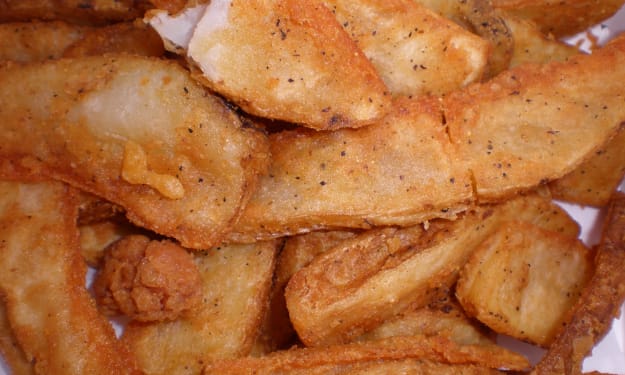
KFC Potato Wedges: A Crispy, Flavorful Favorite
Introduction KFC, or Kentucky Fried Chicken, is renowned worldwide for its delicious fried chicken and a variety of side dishes that complement its main offerings. Among these sides, the KFC Potato Wedges have gained immense popularity for their crispy texture, savory flavor, and satisfying crunch. This article delves into the origins, preparation, flavor profile, variations, and cultural significance of KFC Potato Wedges, providing a comprehensive overview for enthusiasts and curious readers alike.
By Trend Vantage6 months ago in Feast
My Tous les Jours Trip
As someone who lives in a rural area, I don't get the chance to visit fancy restaurants or bakeries that often. So, when a friend told me about a French-Asian bakery that's less than an hour away, I knew I had to check it out and grab some pictures for social media. Tous les Jours ended up providing an immersive experience that went above and beyond my expectations--although I did leave with a few reservations.
By Kaitlin Shanks29 days ago in Feast
Global Ready to Drink Tea and Coffee Market Size and Forecast 2025–2033
Introduction: A Beverage Revolution in a Bottle The global beverage industry is undergoing a significant transformation, driven by changing lifestyles, rising health awareness, and the growing need for convenience. At the center of this evolution is the Ready to Drink (RTD) Tea and Coffee Market, which has emerged as one of the fastest-growing segments within the food and beverage industry.
By Marthan Sir6 days ago in Feast
Autonomy Is The Real Privilege
Good morning, freedom-seekers! Today we’re gonna be looking at autonomy. A strange word, I know; one many would probably look at blankly and run away from on sight. We’re gonna figure out what it actually means, consider how it’s achieved, and decipher just how deeply most of us are tangled up in dependence without realising it.
By That ‘Freedom’ Guy4 days ago in Humans



Comments
There are no comments for this story
Be the first to respond and start the conversation.