
Food Processing Automation Market Size and Forecast, 2025–2033
How Smart Technologies Are Redefining Efficiency, Safety, and Scale in the Global Food Industry

Introduction
The global food industry is undergoing a historic transformation as automation reshapes how food is processed, packaged, and distributed. Rising consumer demand for processed and ready-to-eat products, strict food safety regulations, labor shortages, and the push for operational efficiency are accelerating the adoption of automated technologies across the value chain.
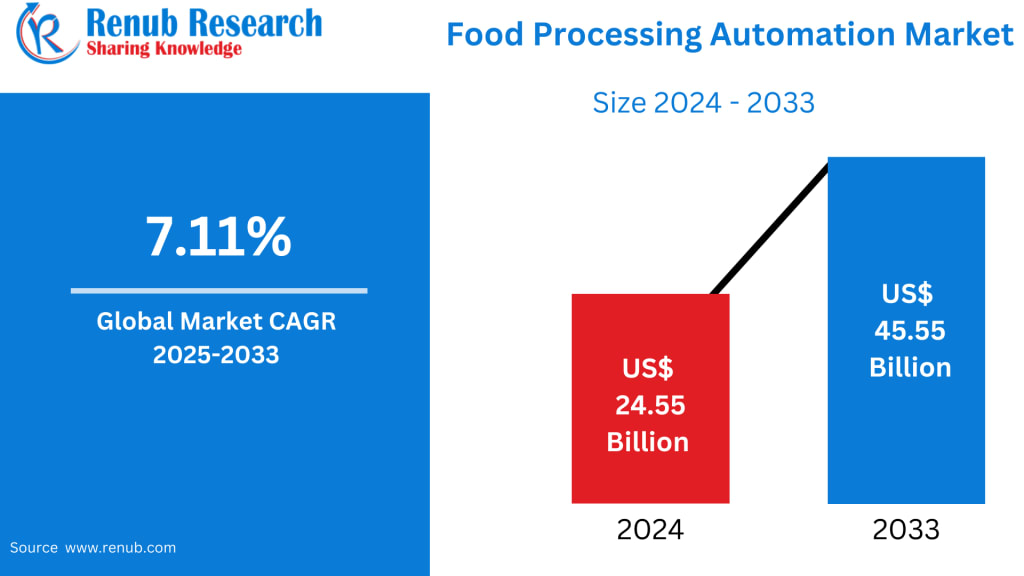
According to Renub Research, the Food Processing Automation Market is expected to expand from US$ 24.55 billion in 2024 to US$ 45.55 billion by 2033, registering a strong CAGR of 7.11% during 2025–2033. This growth reflects a fundamental shift toward intelligent, technology-driven food manufacturing systems worldwide.
Food Processing Automation Market Outlook
Food processing automation refers to the use of advanced machinery, robotics, control systems, artificial intelligence (AI), and software solutions to optimize food manufacturing operations. These systems streamline activities such as sorting, grading, cutting, cooking, packaging, and palletizing—while maintaining consistent quality and hygiene standards.
Automation has become a strategic necessity rather than a luxury. Automated production lines enable food manufacturers to reduce waste, improve traceability, enhance food safety, and respond rapidly to changing consumer preferences. In an increasingly interconnected global supply chain, automation also ensures compliance with international food safety norms and regulatory frameworks.
Major agricultural economies such as the United States, China, and India are investing aggressively in automation to improve productivity and strengthen export competitiveness.
Key Growth Drivers
Rising Demand for Packaged and Processed Foods
Urbanization, busy lifestyles, and growing disposable incomes are fueling global demand for packaged, frozen, and ready-to-eat foods. Consumers expect convenience without compromising on quality or safety.
Automation enables high-speed, hygienic, and consistent production—essential for meeting this surge in demand. Reduced human intervention lowers contamination risks while improving throughput and cost efficiency.
Strategic industry activity highlights this momentum. In January 2025, JBT Corporation completed a US$ 3.5 billion acquisition of Marel, creating an integrated automation platform spanning protein processing and high-pressure pasteurization. Meanwhile, startups such as Chef Robotics and Sojo Industries are disrupting the sector through Robotics-as-a-Service (RaaS) models.
Stricter Food Safety and Hygiene Regulations
Governments worldwide are tightening food safety regulations to protect public health. Automation minimizes human contact with food, significantly reducing contamination risks.
Automated systems also integrate traceability features, enabling manufacturers to track ingredients and batches in real time. This is critical for recalls, compliance audits, and brand trust.
In 2025, World Food Safety Day, led by the World Health Organization and the Food and Agriculture Organization, emphasized the theme “Food Safety: Science in Action,” reinforcing the role of technology and automation in modern food systems.
Technological Advancements in Robotics and AI
The integration of robotics, AI, and machine learning is transforming food processing operations. Robots now handle complex tasks such as precision cutting, sorting, and packaging with exceptional accuracy.
AI-powered systems enhance predictive maintenance, quality inspection, and energy optimization, reducing downtime and operational costs. These technologies also improve flexibility, allowing manufacturers to adapt quickly to new product formats and packaging sizes.
In March 2024, Fortifi Food Processing Solutions launched a unified automation platform serving protein, dairy, and produce sectors across more than 15 countries, highlighting the growing convergence of digital intelligence and mechanical systems.
Market Challenges
High Initial Capital and Maintenance Costs
Despite long-term benefits, automation requires significant upfront investment in machinery, system integration, and infrastructure upgrades. Small and medium-sized enterprises (SMEs), which dominate the global food sector, often struggle to afford these costs.
Ongoing maintenance and the need for skilled technicians further add to financial pressure. While costs are declining over time, affordability remains a barrier in emerging markets.
Workforce Resistance and Skill Gaps
Automation raises concerns about job displacement, leading to workforce resistance in some regions. Additionally, operating advanced automated systems requires specialized skills, creating a talent gap.
Successful adoption depends on workforce upskilling, retraining programs, and fostering collaboration between humans and machines—ensuring automation enhances productivity rather than replacing human value.
Key Market Segments
Valves and Actuators
Valves and actuators play a critical role in controlling fluid flow, temperature, and pressure in food processing lines. Their automation ensures precision, cleanliness, and process consistency—particularly in dairy and beverage production.
Electric Motors
Electric motors power conveyors, mixers, grinders, and packaging machines. Modern automated systems increasingly rely on energy-efficient motors with variable speed drives, supporting sustainability goals and reducing operational costs.
Automation Hardware
Hardware—including robotics, sensors, PLCs, and conveyors—forms the backbone of food processing automation. Smart sensors and Industrial IoT devices enable real-time monitoring, quality control, and predictive maintenance, driving rapid adoption across facilities.
Application-Specific Insights
Dairy Processing Automation
Dairy processing demands strict hygiene and precision. Automation governs pasteurization, homogenization, and packaging with consistent quality while reducing contamination risks. Rising global consumption of milk, cheese, and yogurt continues to propel automation investments.
Food Packaging and Re-Packaging Automation
Packaging automation improves speed, accuracy, and sustainability. Smart packaging systems support traceability, extend shelf life, and enable flexible formats for retail and export markets—making this one of the fastest-growing application areas.
Fully Automated Food Processing Plants
Fully automated plants integrate robotics, AI, and sensors to manage end-to-end production with minimal human intervention. Though capital-intensive, they deliver superior productivity, hygiene, and scalability—positioning them as the future of large-scale food manufacturing.
Regional Market Analysis
United States
The U.S. market is driven by labor shortages, strict FDA regulations, and strong demand for convenience foods. The country leads in robotics and AI adoption, reinforcing its position as a global automation hub. In January 2024, FANUC America showcased advanced food processing robots at IPPE.
Germany
Germany’s engineering excellence and focus on sustainability fuel automation adoption across dairy, bakery, and packaged foods. In November 2023, Dematic completed a high-tech logistics automation project for Bünting SCM in Lower Saxony.
India
India’s market is expanding rapidly due to urbanization, rising incomes, and supportive government initiatives like Make in India. In May 2025, a ₹1,050-crore fully automated frozen potato processing plant was commissioned in Gujarat, marking a major milestone for the country.
UAE
Driven by food security priorities and high import dependence, the UAE is embracing automation aggressively. In December 2023, Pure Food Technology introduced a solar-powered hydroponic robotics system to boost domestic food production.
Competitive Landscape
Major players shaping the global food processing automation market include:
ABB Ltd.
Alfa Laval AB
Bosch Rexroth AG
Bühler Holding AG
Emerson Electric Co.
Festo SE & Co. KG
Endress+Hauser
These companies compete through innovation, global expansion, and integrated digital solutions.
Final Thoughts
The Food Processing Automation Market is entering a decisive growth phase as efficiency, safety, and scalability become non-negotiable in modern food manufacturing. Backed by strong investment, technological innovation, and regulatory support, automation is redefining the future of food production.
As Renub Research forecasts continued expansion through 2033, companies that invest early in smart automation, workforce upskilling, and digital integration will be best positioned to lead in an increasingly competitive global food ecosystem.
About the Creator
Marthan Sir
Educator with 30+ years of teaching experience | Passionate about sharing knowledge, life lessons & insights | Writing to inspire, inform, and empower readers.
Keep reading
More stories from Marthan Sir and writers in Feast and other communities.
Singapore Foodservice Market Size & Forecast 2025–2033
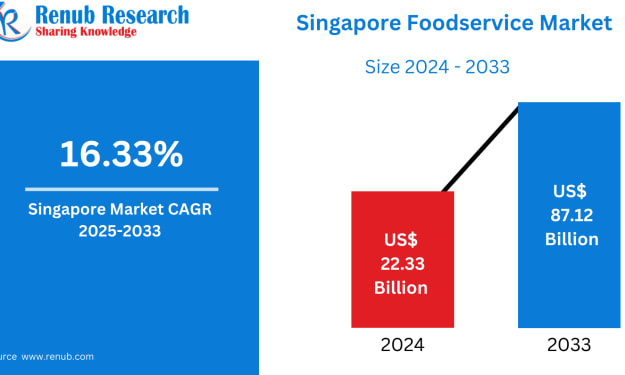
Singapore Foodservice Market Overview The Singapore Foodservice Market is entering a period of accelerated transformation, underpinned by changing consumer lifestyles, technological adoption, and the city-state’s growing appeal as a global tourism and business hub. According to Renub Research, the market is expected to expand substantially from US$ 22.33 billion in 2024 to US$ 87.12 billion by 2033, registering a remarkable compound annual growth rate (CAGR) of 16.33% during 2025–2033.
By Marthan Sir10 days ago in Feast
Cricket powder cinnamon banana bread
I lived in Mexico for some years, many Moons ago, twice. It was there when I saw for the first time fried crispy crickets (known as chapulines in Mexico) tacos seasoned with lime, garlic, salt, and chile. Cricket tacos are a traditional delicacy which is especially popular in the Oaxaca region of Mexico. You can find them as a street food optionat outdoor markets in Mexico (look for chapulines) or at speciality restauants in the U.S. (just make sure the crickets are for human consumption).
By Susan Fourtané 25 days ago in Feast
United States Smokeless Tobacco Market Size and Forecast 2025–2033
United States Smokeless Tobacco Market Overview The United States smokeless tobacco market continues to hold a stable and resilient position within the broader nicotine and tobacco industry. According to Renub Research, the industry was valued at US$ 4.02 billion in 2024 and is projected to reach US$ 5.3 billion by 2033, expanding at a Compound Annual Growth Rate (CAGR) of 3.12% from 2025 to 2033.
By Aaina Oberoi4 days ago in Feast
'20/20'
"Do It Again" the track that would ultimately open the Beach Boys final album on Capitol Records which was released on February 10th 1969 had originally been released as a single in August of 1968. The track was the first of many post-Pet Sounds era throwbacks to the early Beach Boys sound which would become continually more cliched and eventually lead the Beach Boys to the level of self-parody they would eventually succumb to in the 1980s while their closest contemporaries The Beatles nearing the end of their run in 1969 would go on to be viewed as the most influential band of all time. However, the song itself is not bad on its surface, and it opens with a futuristic sounding (for 1969) drumbeat captured by then-Beach Boys engineer Stephen Desper using tape delays on the drums performed by Dennis Wilson and John Guerin. The song has been re-recorded numerous times over the years on various Beach Boys-related projects most notably the 2011 re-recording at Capitol studios featuring the five surviving Beach Boys at the time backed instrumentally by various members of both the Brian Wilson Band and Mike Loves touring "Beach Boys" to promote the then upcoming Beach Boys 50th Anniversary reunion tour in 2012. The hammering and power drill sound at the end of the song was an excerpt from a track called "Workshop" that was to be a part of the uncompleted "SMiLE" album.
By Sean Callaghan6 days ago in Beat


Comments
There are no comments for this story
Be the first to respond and start the conversation.