
Europe Food Cans Market Trends & Outlook 2025–2033
Sustainability, Convenience, and Regulation Reshape Europe’s Metal Food Packaging Landscape

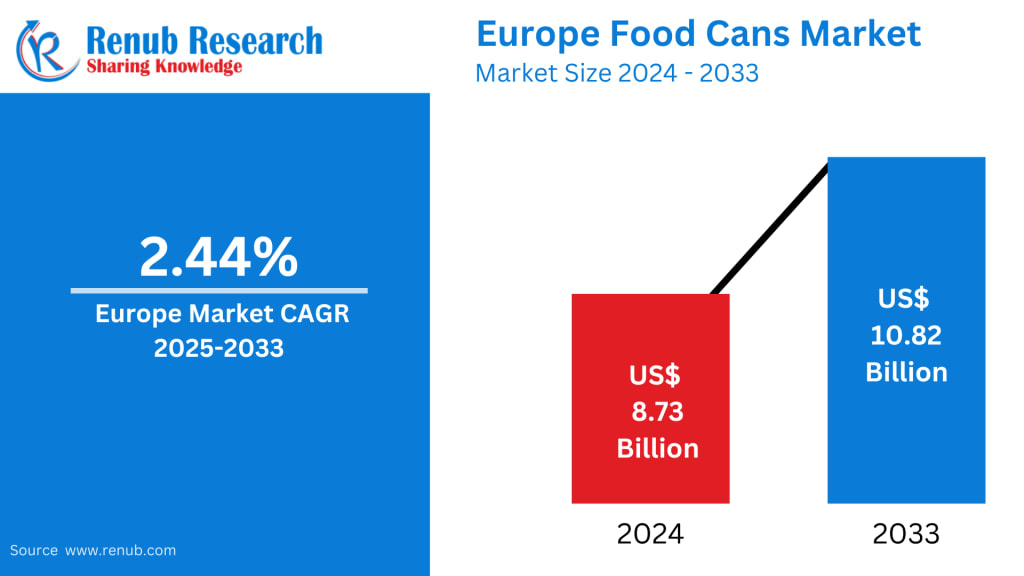
Europe Food Cans Market Summary
The Europe Food Cans Market was valued at US$ 8.73 billion in 2024 and is projected to grow steadily at a CAGR of 2.44% from 2025 to 2033, reaching US$ 10.82 billion by 2033, according to Renub Research. This moderate yet resilient growth reflects Europe’s mature food packaging ecosystem, driven by sustained demand for long-shelf-life foods, rapid urbanization, and a strong regulatory push toward sustainable and BPA-free packaging solutions.
Food cans continue to play a vital role across Europe’s food supply chain, ensuring product safety, nutritional integrity, and extended shelf life. With evolving consumer lifestyles, increasing preference for convenience foods, and heightened environmental awareness, metal food cans remain a cornerstone of Europe’s packaging strategy despite competition from alternative formats.
Europe Food Cans Market Overview
Food cans are sealed metal containers, typically made from aluminum or steel, designed to preserve food by protecting it from light, oxygen, moisture, and microbial contamination. Their ability to maintain food quality without refrigeration makes them essential for storing vegetables, fruits, meats, seafood, soups, pet food, and ready meals.
Across Europe, food cans are gaining renewed relevance as consumers seek affordable, safe, and easy-to-store food options. Modern canning technologies, improved coatings, and recyclable materials have strengthened the appeal of metal packaging. Moreover, strict European Union regulations promoting circular economy practices have positioned food cans as one of the most environmentally responsible packaging formats available today.
Key Growth Drivers in the Europe Food Cans Market
Rising Demand for Convenience and Long Shelf-Life Foods
Urban lifestyles across Europe are becoming increasingly fast-paced, leaving consumers with less time for daily meal preparation. As a result, ready-to-eat and ready-to-cook foods have witnessed strong demand. Canned foods offer unmatched convenience, requiring minimal preparation while delivering consistent taste and nutrition.
According to Eurostat, fast-food and convenience food spending in major European metropolitan areas grew by nearly 35% between 2022 and 2024, highlighting a clear shift in consumption behavior. Younger demographics, in particular, favor canned and packaged meals due to their time-saving benefits, reinforcing the long-term growth prospects of food cans.
Growing Emphasis on Eco-Friendly and Sustainable Packaging
Sustainability is no longer optional in Europe—it is a regulatory and consumer expectation. Aluminum and steel cans are infinitely recyclable, aligning perfectly with Europe’s circular economy goals. Governments and regulatory authorities are actively encouraging packaging solutions that reduce environmental impact.
In March 2024, the European Parliament and Council agreed on new packaging rules aimed at making all packaging recyclable, minimizing harmful substances, reducing excess packaging, and increasing recycled content. These regulations are accelerating the adoption of BPA-free coatings and low-impact materials in food cans, strengthening market confidence and consumer trust.
Expansion of Processed and Packaged Food Consumption
Europe continues to experience steady growth in processed and packaged food consumption, supported by urbanization, rising dual-income households, and evolving dietary preferences. Food cans are widely used to preserve vegetables, meat, fish, and fruits while retaining nutritional value.
Additionally, growth in pet food, baby food, and plant-based ready meals is supporting market expansion. In September 2022, UK-based alternative meat brand THIS™ launched plant-based canned ready meals in Tesco, reinforcing the role of food cans in emerging food categories that emphasize convenience and health.
Challenges Facing the Europe Food Cans Market
Concerns Around BPA and Chemical Coatings
Despite progress in BPA-free linings, consumer concerns around chemical exposure from can coatings persist. Regulatory scrutiny is increasing, forcing manufacturers to invest in new coating technologies that meet safety standards while maintaining product performance. These innovations often increase production costs, placing pressure on profit margins, particularly for smaller manufacturers.
Competition from Alternative Packaging Formats
Flexible pouches, glass jars, cartons, and paper-based packaging are gaining traction, especially among eco-conscious consumers. Lightweight, resealable, and visually appealing packaging alternatives present strong competition to traditional food cans. Advancements in preservation technologies further intensify competition by enabling extended shelf life without metal packaging.
Market Segmentation Analysis
Europe Aluminum Food Cans Market
Aluminum cans are widely used due to their lightweight nature, corrosion resistance, and high recyclability. They are commonly employed for soups, seafood, vegetables, and ready meals. As sustainability becomes central to packaging decisions, aluminum’s recyclability advantage positions it as a preferred material across Europe.
Europe Steel Food Cans Market
Steel cans dominate applications requiring durability, such as meat, vegetables, and pet food. Their superior barrier properties protect contents from oxygen and light, ensuring long shelf life. Innovations in lightweight steel and BPA-free linings are further enhancing their market appeal.
Europe Ready Meals Food Cans Market
Demand for canned ready meals is rising as consumers prioritize convenience. Products such as canned soups, curries, pasta dishes, and stews are gaining popularity both in physical retail and online channels, supporting consistent market growth.
Europe Vegetables Food Cans Market
Canned vegetables remain a staple across European households due to year-round availability and affordability. The growing preference for organic, preservative-free, and low-sodium options has encouraged manufacturers to innovate, aligning product offerings with health-conscious consumers.
Europe Pet Food Cans Market
The pet food segment represents a strong growth area within the food cans market. Wet canned pet food is favored for its moisture content, nutritional value, and palatability. Rising pet ownership and demand for premium, natural pet nutrition continue to drive this segment forward.
Country-Level Market Insights
France Food Cans Market
France’s food cans market benefits from strong demand for vegetables, seafood, and gourmet ready meals. Sustainability initiatives and BPA-free packaging adoption are reshaping industry standards. In March 2022, Gopuff expanded into France, enhancing access to canned and convenience foods across major urban centers.
Germany Food Cans Market
Germany holds the second-largest food cans market in Europe, driven by strict recycling regulations and strong consumer preference for sustainable packaging. In August 2023, Crown Holdings acquired Helvetia Packaging AG’s German facility, expanding its European production footprint and reinforcing Germany’s importance in the market.
United Kingdom Food Cans Market
The UK market is evolving rapidly, with consumers demanding healthy, organic, and additive-free canned foods. In January 2024, NOMOQ introduced digitally printed blank aluminum cans for UK brands, enhancing customization and supply-chain efficiency.
Spain Food Cans Market
Spain’s rich culinary heritage fuels strong demand for canned fish, olives, and vegetables. Premiumization and organic product trends are encouraging manufacturers to adopt sustainable practices while preserving traditional flavors.
Europe Food Cans Market Segmentation
By Product
Aluminum
Steel
By Application
Ready Meals
Meat
Vegetables
Fish
Fruits
Powder Products
Pet Food
Others
By Countries
France, Germany, Italy, Spain, United Kingdom, Belgium, Netherlands, Russia, Poland, Greece, Norway, Romania, Portugal
Company Analysis
Key players covered from four strategic viewpoints—Overview, Key Persons, Recent Developments, and Revenue—include:
Ardagh Group
Ball Corporation
Can-Pack S.A.
CPMC Holdings Limited
Crown Holdings Inc.
Nestlé S.A.
Zwanenberg Food Group
Silgan Holdings Inc.
Lucky Star Ltd. (Glenryck)
Sarten Romania SRL
Final Thoughts
The Europe Food Cans Market continues to demonstrate resilience amid changing consumer preferences and rising sustainability expectations. While growth remains moderate, the market’s alignment with recyclability, food safety, and regulatory compliance ensures its long-term relevance. Innovations in BPA-free coatings, lightweight materials, and premium canned food offerings will be instrumental in shaping the market through 2033.
As Europe balances convenience with environmental responsibility, food cans are set to remain a vital pillar of the region’s evolving food packaging ecosystem.
About the Creator
Janine Root
Janine Root is a skilled content writer with a passion for creating engaging, informative, and SEO-optimized content. She excels in crafting compelling narratives that resonate with audiences and drive results.
Keep reading
More stories from Janine Root and writers in Feast and other communities.
United States Olive Oil Market Trends & Growth Outlook
Market Overview The United States Olive Oil Market continues to experience steady and resilient growth as consumers increasingly shift toward healthier dietary choices and premium food products. Valued at US$ 2.99 billion in 2024, the market is projected to expand at a compound annual growth rate (CAGR) of 8.14% from 2025 to 2033, reaching an estimated US$ 6.04 billion by 2033, according to Renub Research.
By Janine Root 28 days ago in Feast
My Tous les Jours Trip
As someone who lives in a rural area, I don't get the chance to visit fancy restaurants or bakeries that often. So, when a friend told me about a French-Asian bakery that's less than an hour away, I knew I had to check it out and grab some pictures for social media. Tous les Jours ended up providing an immersive experience that went above and beyond my expectations--although I did leave with a few reservations.
By Kaitlin Shanks17 days ago in Feast
Gluten-Free Food Market Outlook: Growth, Innovation, and the Future of Clean Eating
Introduction: A Market That Has Moved Beyond Niche What was once a narrow category aimed at people with celiac disease has rapidly evolved into one of the most dynamic segments of the global food industry. Gluten-free foods are no longer limited to medical shelves or specialty stores—they now occupy prominent space in supermarkets, cafés, online platforms, and even fine dining menus.
By Marthan Sir24 minutes ago in Feast
Fair Exchange, No Robberies
Dark Memoirs - Index There are at least two kinds of people in the world: those who write this half-arsed kind of intro to a story that looks to separate the rare and the norm, and those who realise it's an overused framing device and don't.
By Paul Stewart7 days ago in Chapters


Comments
There are no comments for this story
Be the first to respond and start the conversation.