
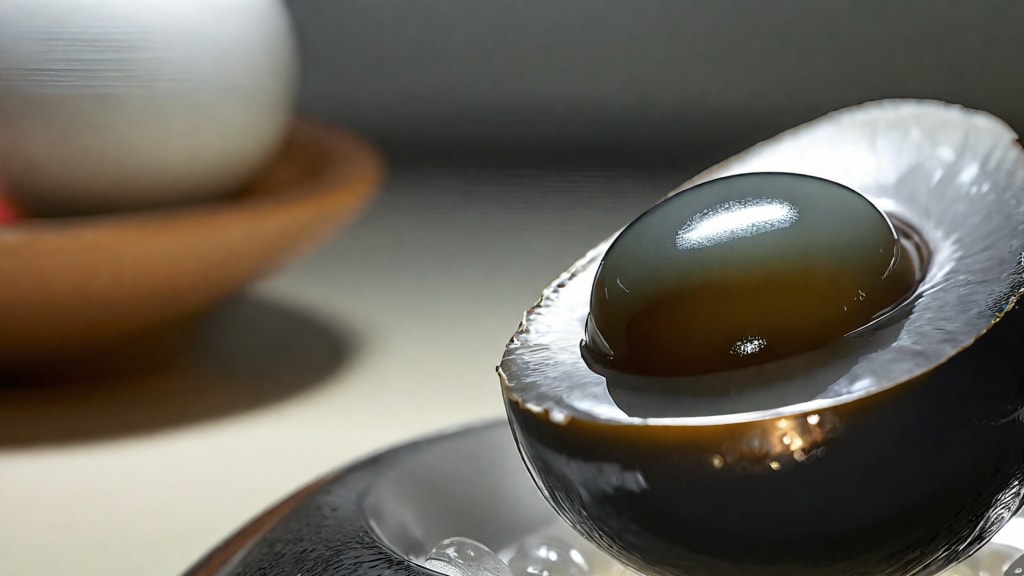
As a traditional Chinese delicacy, century eggs, also known as alkalized or preserved egg, have a long history. The exact time of its origin is not clear, but what is certain is that it is at least several hundred years old.
Some history
There are various legends circulating about the origin of the century egg, one of which says that during the Taichang years of the Ming Dynasty in a small teahouse in Wujiang County, Jiangsu Province, the owner inadvertently stored duck eggs in a pile of tea leaves and wood ash. He then later discovered that after a period of time these eggs turned black in the shell and the egg white became dark brown and transparent, with a delicious flavour, which was the original century eggs.
Another theory is that century eggs may have originated in Tianjin, where they were accidentally formed in lime and grass ash in the home of a wealthy family in a rural village about two hundred years ago. The method of making them has since been gradually spread through people's attempts and improvements.
In Guangdong, century eggs are an important part of a lot of traditional dishes. The most famous of which is the lean pork congee with century egg, a nutritious, smooth, and flavourful local dish. Lean pork congee with century eggs in Cantonese cuisine is not only popular with the locals, but has also become a well-known delicacy throughout China and around the world.
Century eggs play an important role in Cantonese cuisine and are an indispensable delicacy in both daily diet and traditional festivals. It also has some medicinal value and is used in traditional medicine to treat sore throat and constipation.
The production process of century eggs has evolved and improved over time, and the modern production of century eggs is more health- and safety-oriented, with innovative products such as lead-free century eggs.
How to make century eggs
The main raw material is duck egg, made through a special processing method.
It has a unique flavour and texture, and is a favourite food of many Chinese people. The process of making century eggs includes steps such as pickling and fermentation, which causes the internal structure and flavour of the egg to change, creating a unique flavour. Century eggs can be eaten on their own, and are often used as an ingredient in cold dishes, such as century egg tofu and century egg congee. However, since some chemicals may be used in the preparation of century eggs, it is important to eat them in moderation.
Century Eggs in Cantonese Cuisine
Cantonese cuisine, also known as Yue Cai, is one of the eight major cuisines of China, and is known for its culinary skills, light flavours, and emphasis on the freshness of raw materials. The century egg has its own unique place in Cantonese cuisine and a variety of cooking methods, such as the aforementioned century egg and meat congee, which is a very popular dish in the Guangdong region. However, as an ingredient, the century egg is used far beyond the scope of Cantonese cuisine, and can be found in dishes all over China.
Lean Pork Congee with Century Eggs
Lean pork congee with century eggs is a famous traditional Cantonese dish that belongs to the Cantonese cuisine. This congee is characterized by its rich nutrition, smooth texture and delicious flavour, making it a popular breakfast or midnight meal choice.
The base of the congee is usually simmered to a very fine and smooth consistency, with the rice grains almost completely cooked while the mellow aroma of the century egg and the freshness of the lean pork are perfectly combined, savory and fresh.
The congee is a good source of protein, carbohydrates, vitamins and minerals.
Due to the soft texture of the porridge, it is easy to digest and is suitable for all kinds of people.
The basic ingredients are:
- Rice (usually use sticky rice type, such as pearl rice)
- Century eggs (lead-free to ensure health)
- Lean pork (usually use loin or hind leg)
- Shredded ginger (to remove fishy smell and add flavour)
- Fragrant oil, salt, chopped green onion or cilantro (for flavour and garnish)
How to prepare (essential steps):
1. rice treatment: wash the rice, mix it with a little sesame oil and salt, marinate for 30 minutes, then wash it again.
2. cook the porridge base: add appropriate amount of water in the pot, put in the processed rice, boil over high heat and then turn to low heat and simmer until the rice grains bloom and the porridge base is thick.
3. prepare century egg and lean pork: peel the skin of the egg and cut it into small pieces; shred or mince the lean pork and marinate it with a little cornstarch, salt and cooking wine.
4. Cook the congee: After the bottom of the congee is simmering, add the century egg pieces and shredded ginger, and continue to cook for about 10 minutes to let the flavour of the century egg seep into the congee.
5. Add lean pork: slowly slide the marinated lean pork into the porridge, stirring quickly to avoid lumps, and continue cooking for a few minutes until the meat is cooked through.
6. Season to taste: Season with salt and chicken seasoning to taste and cook for 1-2 minutes to blend the flavours.
7. pot plate: finally add chopped green onion or cilantro to increase the aroma, drop a few drops of sesame oil, stir well, you can turn off the heat, served.
There are a lot of variations of recipe, which can be adjusted according to personal tastes and preferences. Some people like to add a small amount of soy sauce or fish sauce to the congee to enhance the flavour, or include some vegetables such as spinach or amaranth to improve nutrition and texture.
It is not difficult to make the congee, the key lies in the control of the fire and the combination of ingredients, so that the congee has a delicious and layered flavour.
New cooking techniques
In addition to the traditional way of cooking, there are also some innovative cooking techniques for preserved eggs in Cantonese cuisine, including the spinach with century eggs which utilizes the cooking technique of "dipping", similar to "boiling" in the North, in which the ingredients are first cooked in boiling water and then served in a prepared or cooked soup.
The dish is flavoured by steamed eggs, fried garlic cloves, boiled eggs and garlic cloves, and finally cooked with blanched spinach, which is fresh and crisp with the flavour of the eggs.
These innovative approaches reflect the spirit of continuous exploration and innovation in Cantonese cuisine, combining tradition with modernity to create new flavours and culinary experiences.
About the Creator
MM8787
I like to write about food and the stories about food.
If you find my pieces interesting, please consider leaving a ❤️, or even a tip. Your support means a lot to me as a writer!
Australia Fish and Seafood Market 2026: Sustainable Consumption, Aquaculture Growth & Premium Seafood Demand
Australia Fish and Seafood Market Australia’s fish and seafood market is expanding steadily as consumers increasingly prioritize high-quality protein sources and sustainable food options. Fish and seafood products—including salmon, tuna, shrimp, shellfish and other marine species—play a vital role in the Australian diet due to their nutritional value and culinary versatility. Growing awareness of seafood’s health benefits, particularly its omega-3 fatty acids, vitamins and minerals, is driving consumption across households, restaurants and foodservice channels.
By Amyra Singh7 days ago in Feast


Comments (1)
Hello, just wanna let you know that we have to choose the "AI-Generated" tag before publishing when we publish AI-Generated content 😊