
Things I Wish I Could Say at the Dinner Table
Because silence isn’t always golden — sometimes, it’s heavy.

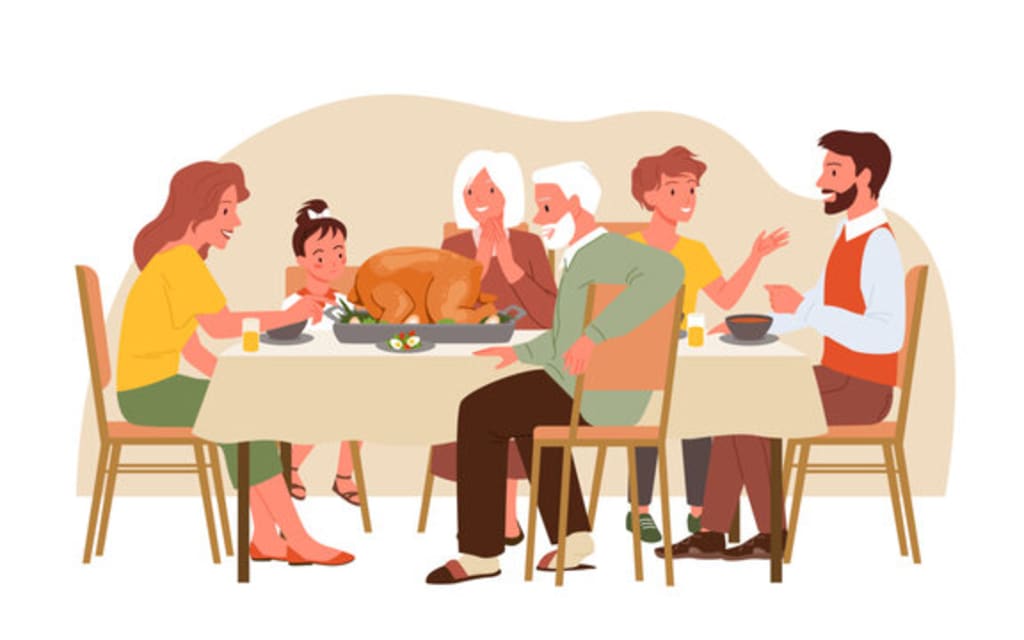
Dinner tables in brown households are their own kind of theatre. Everyone has a role: the talkative uncle with endless stories, the aunt with unsolicited advice, the parent who slips in reminders about grades or weight, the sibling who tries to disappear into their phone. And then there’s me, the one quietly calculating which version of myself will cause the least chaos.
I’ve spent so many evenings biting my tongue that it almost feels like part of the meal. Dal, roti, rice… and silence. Not the comfortable kind, but the heavy, awkward kind that presses down on your chest. It’s strange how something as ordinary as dinner can feel like walking across a minefield... one wrong word and boom.
The Questions That Never End
The classics always come first:
“How’s uni?” → Translation: Give us proof that you’re not wasting your life.
“When are you getting married?” → Translation: Your degree is nice, but rings matter more.
“Have you gained weight?” → Translation: We noticed your body before your smile.
These aren’t questions. They’re verdicts. And my replies are carefully rehearsed: “It’s fine.” “Not yet.” “I’ll be careful.” Nothing too sharp, nothing that might start an argument, nothing that shows how much it actually stings.
Because God forbid I answer honestly:
Uni is suffocating.
Marriage isn’t my priority right now.
My body is my business.
The Jokes That Cut Deep
Then come the jokes — the “just teasing” comments that never feel funny when you’re the punchline. Maybe it’s about my dreams being “too unrealistic.” Or my clothes being “too Western.” Or my personality being “too sensitive.” Everyone laughs, and I’m expected to laugh too.
But the truth? Each joke is like a paper cut. Small, maybe, but painful. And when they pile up over the years, they don’t heal, they scar.
The Silence That Speaks Volumes
What hurts most isn’t even what’s said. It’s what isn’t. The things no one asks. No one asks if I’m happy. No one asks what I’m passionate about. No one asks how I’m really doing.
It’s like the parts of me that don’t fit their script don’t even exist. And so I learn to shrink them. I sit at the table with a smile plastered on, all while swallowing whole pieces of myself.
What I Wish I Could Say
If I could really speak freely at the dinner table, I’d say:
Stop comparing me to my cousins.
Stop commenting on my body.
Stop calling my feelings “overreactions.”
Stop asking questions when you don’t actually want to hear the answers.
Stop dressing up control as “love.”
But here’s the thing: I don’t say any of this. Not because I’m weak, but because brown households train you early — keeping the peace is survival.
The Cost of Staying Quiet
But peace at the table doesn’t mean peace inside me. The words I don’t say sit like stones in my chest. They make laughter feel forced. They make food harder to swallow. They turn family time into a performance instead of a connection.
And I know I’m not alone in this. So many of us walk away from those tables feeling drained, not full. Carrying the weight of everything we didn’t say.
Learning to Speak, Slowly
I’m not going to pretend I’ve suddenly turned into the person who flips the table and storms out. I haven’t. But I’ve started testing small truths. A quiet, “I don’t find that funny.” A gentle, “That question makes me uncomfortable.” A calm, “I don’t want to talk about marriage right now.”
Sometimes the table goes silent. Sometimes people change the subject. Sometimes they look shocked that I even dared. But little by little, it feels lighter. Like I’m finally sitting at the table as myself, not just the version of me they prefer.
Final Bite
I used to think silence was the safest option. Now I see it for what it is: a slow erosion of self. And I don’t want to keep erasing myself just to keep the roti warm.
Family dinners should feed us, not starve us of our voices. And maybe the bravest thing I can do isn’t to stay quiet, but to finally say the things I’ve been swallowing for years.
About the Creator
Tavleen Kaur
🧠 Psychology student decoding the human brain one blog at a time.
🎭 Into overthinking, under-sleeping, and asking “but why though?” way too often.
✨ Writing about healing, identity, and emotion
Keep reading
More stories from Tavleen Kaur and writers in Families and other communities.
I Raised My Sibling — But No One Raised Me
There’s a strange ache that comes with being the eldest in a brown household. You’re born into a role you never signed up for, and before you even realise it, you’re balancing two identities: a child in your own right and a substitute parent for the one who came after you.
By Tavleen Kaur4 months ago in Families
Christmas Abroad: Celebrating the Holidays Without Family
I moved to South Korea in 2017. I was twenty-two years old and excited to start my career as an English Second Language Teacher. With a Bachelor's degree and six hundred dollars in my bank account, I set off for Busan.
By Kera Hollowabout a month ago in Families


Comments
There are no comments for this story
Be the first to respond and start the conversation.