
The Weight He Carried
A Story of an Ordinary Man and the Love That Made Him Extraordinary

1. Before the World Knew His Name
In the town of Millstone—a place where no one locked their doors and everyone still knew the mailman's name—there lived a man named Jacob Rowe. He was not famous, nor did he want to be. He worked as a mechanic, fixing the cars of people he’d grown up with, drinking the same coffee at the same diner every morning.
But to his three children—Eli, Nora, and June—he was the center of the universe.
Their mother, Anna, had passed when June was just a baby. Cancer. The kind that comes fast and leaves devastation in its wake. After the funeral, Jacob never really cried in front of the kids. He couldn't afford to. He was too busy holding everything else together.
And so, at thirty-seven, Jacob became a single father.
He packed lunches with shaky hands. He learned how to braid hair from YouTube. He showed up to every parent-teacher meeting, even when he was covered in grease and dog-tired from a ten-hour shift. When Nora needed a dress for the eighth-grade dance and they couldn’t afford a new one, he borrowed a sewing machine and taught himself to tailor an old one from Goodwill.
He never made a big deal of any of it.
He just did what needed to be done.
2. The Quiet Sacrifices
Jacob never bought himself anything new. His boots had holes in the soles, patched with duct tape. He drank instant coffee and reused his lunch bags until they nearly fell apart. Every extra dollar went toward piano lessons, school trips, and groceries.
When Eli turned sixteen, Jacob handed him the keys to the family’s beat-up Ford truck.
"You sure?" Eli asked, eyes wide.
Jacob nodded, smiling. "You need it more than I do."
He walked to work that entire year.
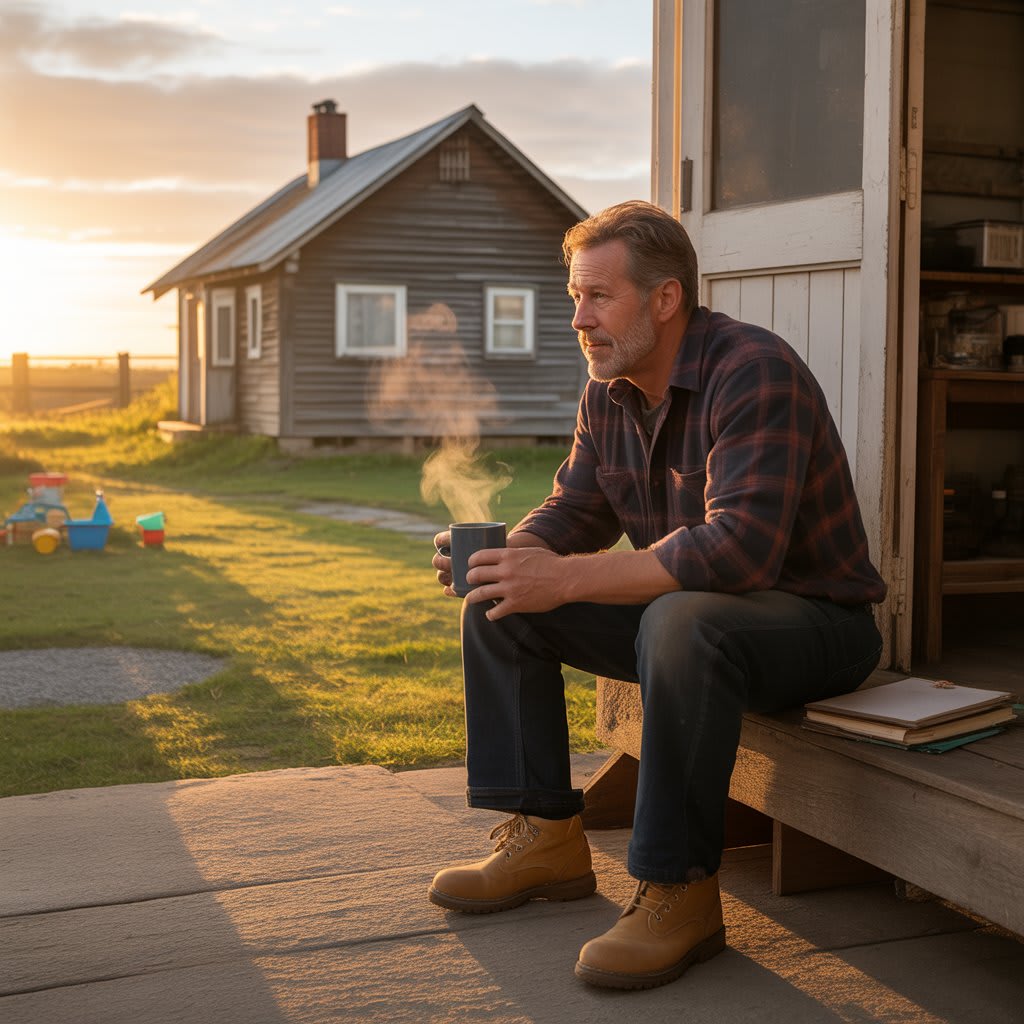
At night, when the house was quiet and the kids were asleep, Jacob would sit on the back porch with a worn journal in his lap. He wrote letters to Anna—not to be sent, but to be remembered. In those pages, he poured out the fear, the guilt, the aching loneliness. He told her how proud he was of the kids. How Nora had gotten an A in biology. How June finally learned to ride a bike without falling. How Eli was starting to look more like him.
And he always ended the letters the same way:
"I hope I’m doing this right. I hope they know how much I love them."
3. Storms and Roots
Life was not always kind.
Eli got into trouble one year—stayed out late, ran with the wrong crowd. He and Jacob had a screaming match in the driveway that ended with slammed doors and silence.
The next morning, Jacob made pancakes. He didn’t say a word about the fight. Just put a plate in front of Eli and poured him coffee.
That was his way. Not big speeches. Just presence.
Nora struggled with anxiety. There were mornings she couldn’t get out of bed. Jacob would sit beside her, silently holding her hand, waiting for the panic to pass. No pressure. Just love.
June once asked him why he never remarried.
He smiled softly. “I already found the love of my life. Now I’ve got you three. That’s enough for me.”
4. When the Kids Grow Up
Time marched on, as it does. Eli joined the navy. Nora went to college for social work. June stayed nearby and got a job at the elementary school.
Jacob never said much when they left, just helped pack their things and hugged them longer than usual.
The house grew quiet again. Not in a painful way, just... different. He filled the silence with radio shows, crossword puzzles, and those old letters he kept writing to Anna.
Sometimes, he’d drive out to her grave and sit with his thermos of coffee, telling her everything.
“They’re doing okay,” he’d whisper. “They’re strong. They remember.”
5. The Day They Remembered
When Jacob passed—peacefully, in his sleep at the age of seventy-three—the whole town came to the funeral.
Not because he was rich or powerful, but because he had fixed their cars, coached their kids, shoveled their driveways, lent them tools, and never asked for anything in return.
Eli spoke at the service.
"My father never raised his voice to be heard. He didn’t demand respect—he earned it. He taught us that being good isn’t about grand gestures. It’s about consistency. It’s about showing up when it’s hard, and loving quietly when no one’s looking."
Nora added, “He carried everything—grief, responsibility, love—and never once made us feel it was a burden.”
June held up the journal they had found in his closet, filled with decades of letters to their mother.
“He never stopped talking to her. Never stopped trying to be the best father he could.”
6. Legacy
Jacob Rowe’s legacy wasn’t built on achievements, but on moments.
The pancakes after a fight. The hand held during anxiety. The rides to soccer practice in the pouring rain. The quiet prayers at night when no one else could hear.
He didn’t need statues or accolades.
His children were his legacy.
And they lived their lives with the same gentle strength, the same relentless love, that he gave them every day without asking for thanks.
Because a good father doesn’t need to be perfect.
He just needs to be there.
And Jacob always was.
About the Creator
AFTAB KHAN
SUBSCRIBE ME AND READ STORY
Storyteller at heart, writing to inspire, inform, and spark conversation. Exploring ideas one word at a time.
Writing truths, weaving dreams — one story at a time.
From imagination to reality
Keep reading
More stories from AFTAB KHAN and writers in Families and other communities.
The Last Letter in the Desk Drawer
Emily hadn’t expected to inherit anything. Her grandmother, Eleanor Hawthorne, had been a woman of few words and fewer affections. She was known around the sleepy seaside town of Merrow Bay as a fierce gardener, a devout letter writer, and a woman who never remarried after her husband vanished during World War II.
By AFTAB KHAN6 months ago in Families
Wise~Guys
— Look Behind what's in Front of You ~ Make Good Choices — Hey, So how you Doin'..! Made~Men — Mobster Movies romanticise a distinctive, elegant appearance, impeccable attire style, along with the 'Families' expressive lingo. Making their 'Bones' gave them Panache — with vintage fedoras, tailored pin-striped suits, mirror-polished wing-tip shoes adorned with tassels; with their 'Gun Moll' gorgeous dates on their arms.
By Jay Kantor17 days ago in Families
So You Decided To Become a Nurse Practitioner:
So you decided to become an "Advanced Practice" nurse. Congratulations!... is what I would say if this was a good idea. Grad school? In this economy? What were you thinking? Likely it was something along the lines of either 1) “I've seen these other chucklefucks do it— Why can't I?” or even 2) “I've got a nice career, I should shake it up. I miss feeling like I have no clue what I'm doing.”
By Sandor Szaboa day ago in Fiction




Comments
There are no comments for this story
Be the first to respond and start the conversation.