
The Lost Letters: A Nostalgic Reflection
"From Paper to Pixels: The Evolution of Handwritten Letters"


Once, communication meant waiting for the postman’s knock or the whisper of a telegram. Songs like "Nai Telephone, Nai Re Piyon" were born from this era, weaving stories of longing and delayed connection. But those days are slipping through the cracks of modernity, fading into memories that today’s generation, raised amidst digital instantaneity, may never truly comprehend.
The heartfelt appeal of a son's letter requesting money from his father, or the tenderness of a mother writing to her child, are emotions now foreign to a world of texts and video calls. The raw, tangible intimacy of ink meeting paper has been replaced by cold, fleeting pixels on a screen.
In those bygone days, letters were more than mere communication—they were carriers of emotions, narrators of stories, and sometimes the only solace for a longing heart. A single letter had the power to make someone laugh, cry, or be overwhelmed with joy. Written words became treasures, folded and unfolded so often that the creases wore out, and the paper tore. Especially love letters—each was a saga of passion, brimming with an unmatched intensity.
The arrival of a letter was an event. Hearts would leap at the sound of the postman calling out, "The letter has arrived." Receiving a letter was a moment of unparalleled joy, a treasure in its simplest form—a piece of paper carrying the fragrance of love and care. The magic of a handwritten letter, penned on lined paper with a ballpoint or a red-lipped fountain pen, was unmatched. The opening words, steeped in etiquette, would read: "With divine reliance, dearest brother, accept my countless salutations. Convey my love to all, and in return, please write back at your earliest convenience."
A letter was not just a vehicle for words; it revealed various facets of life. A handwritten letter was a reflection of emotions, yearning, and affection. When parents read their child’s letter, it felt as though they were seeing their child's face in the folds of the writing. Unconsciously, they would press the letter to their chest, as if embracing their child.
And then there were love letters—unparalleled literary masterpieces in their own right. They were like novels in themselves. Pages filled with emotions, hopes, and feelings of love. The longest of love letters, often needing extra postage, were written to capture the depth of a lover's heart. At times, flower petals or a hint of perfume would be tucked into the folds of the letters. These letters were read again and again, each word becoming a melody in the heart.
In those days, no letter was ever discarded. Homes had bundles of letters tied with string or preserved in bicycle spokes, each a silent witness to life’s ebb and flow. These letters spoke of love, loss, and every shade of human emotion. A single letter could fill one’s heart with joy, bring tears to the eyes, or leave a longing ache that resonated for years.
But those days have faded into oblivion. The rhythm of life has shifted, and letters have been replaced by the beep of emails, the brevity of text messages, and the immediacy of video calls. Couriers now deliver official documents, not heartfelt words. We no longer wait for the postman; instead, instead, we chat on Skype or send texts on our phones.
Yet, the feeling of a letter can never be replaced by any technological medium. A handwritten letter was a language of the heart, an expression of emotion, and a unique example of waiting. For today’s generation, letters are a forgotten chapter, but for those who lived in that time, the music of those letters still resonates in their hearts. Letters were not just words; they were an extraordinary means of soul-to-soul connection.
About the Creator
Md. Solayman Hossain Sabuj
Hi, I’m Md. Solayman Hossain Sabuj, a teacher and a storyteller. I share stories to inspire and connect. Let’s explore self-discovery, overcoming challenges, and more together. Feel free to connect!
Keep reading
More stories from Md. Solayman Hossain Sabuj and writers in Families and other communities.
When Wealth Fails Humanity: A Brother's Silence, A Sister’s Pain
In the quiet corners of northern Bangladesh, two lives unfold with painful contrast. Almas, a retired banker from Thakurgaon, lives in comfort. With four houses already under his name and another in the pipeline worth 15 million taka, his days are spent in peace and prosperity. His children — two sons and one daughter — are growing up with every opportunity wealth can offer.
By Md. Solayman Hossain Sabuj10 months ago in Families
Wings of a Lioness: The Geology of Inherited Pride
People often ask me where I get the strength to pack my entire life into two suitcases and head into the unknown. Where do I get that step that never falters, neither in the cold Canadian North nor under the elegant skies of France? The answer doesn't lie in geographic maps, but in an old photo album, my mother's oversized ring, and that blue flight attendant's cap that is worth more to me than any crown. My courage is not my own doing – it is the dowry left to me by my mother, a woman who conquered heights with airplanes, and the earth beneath her feet with her unwavering character.
By Magma Starabout 11 hours ago in Families
Early March 2026: 4 Goals Accomplished
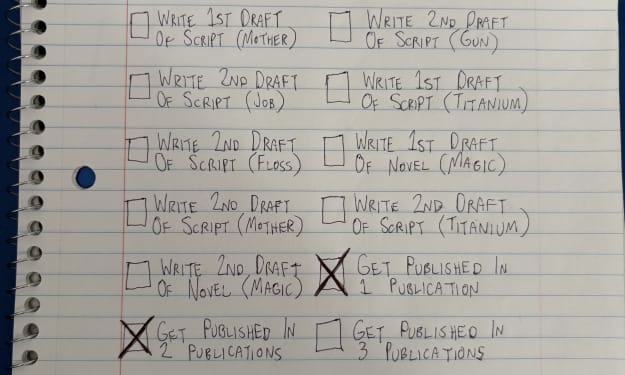
It's early March and I've now accomplished my 4th writing goal for the year of 2026. Before diving into the behind-the-scenes of it... why not tell you up front what that accomplishment was? I was published in a 2nd publication for this year. Published in Helix Literary Magazine out of Central Connecticut State University. You can read it for free right now!
By Stephen Kramer Avitabile7 days ago in Writers



Comments
There are no comments for this story
Be the first to respond and start the conversation.