
When Wealth Fails Humanity: A Brother's Silence, A Sister’s Pain
A Tale of Abundance Without Compassion

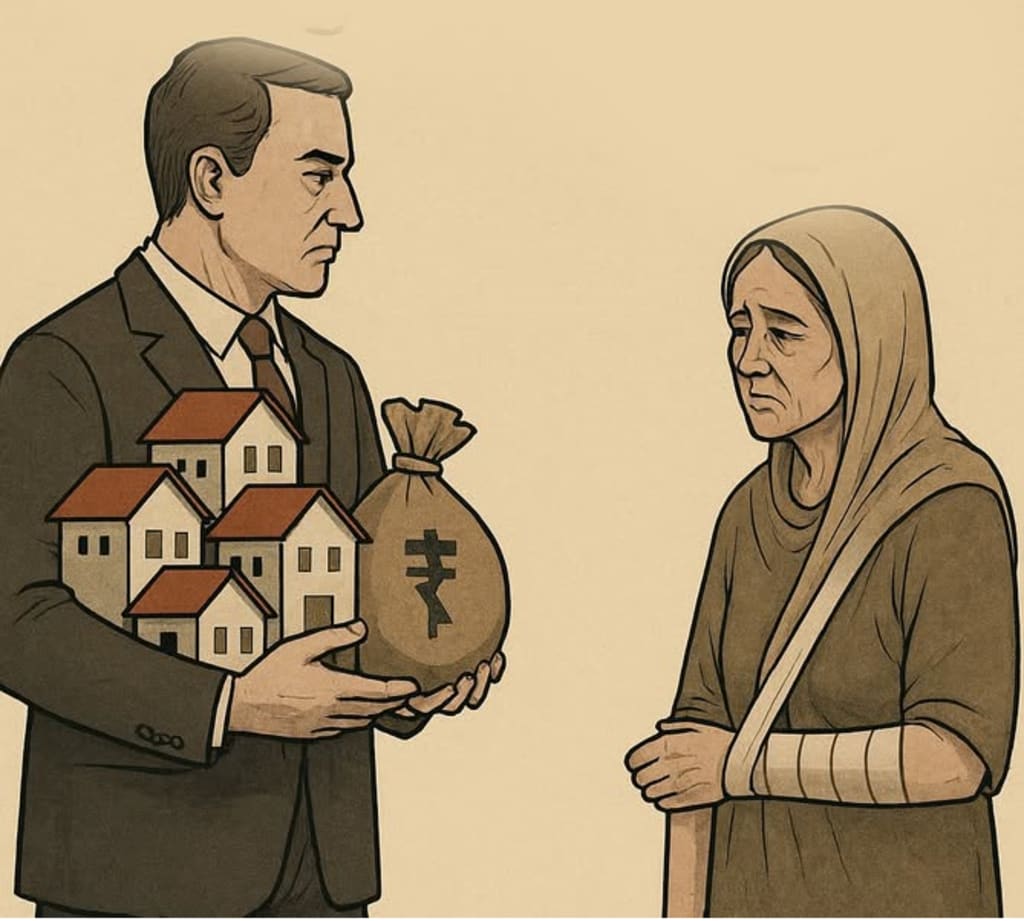
In the quiet corners of northern Bangladesh, two lives unfold with painful contrast. Almas, a retired banker from Thakurgaon, lives in comfort. With four houses already under his name and another in the pipeline worth 15 million taka, his days are spent in peace and prosperity. His children — two sons and one daughter — are growing up with every opportunity wealth can offer.
Just 60 kilometers away, in a humble village of Dinajpur, lives his only sister, Toiba — a woman who has lived her entire life in struggle. A simple housewife with no income of her own, Toiba raised her now 18-year-old son through hardship and sacrifice. Her husband? A man who once broke her hand in a fit of rage and now spends his days chasing illusions while offering her no support, neither emotional nor financial.
A few years ago, after that brutal assault, Toiba underwent surgery. A metal rod was inserted into her broken arm. That rod now needs to be removed through another operation — an urgent one, as the pain grows each day. The cost is not high. Just 30,000 taka, about the price of a wedding stage decoration in urban Dhaka.
Toiba, without anyone else to turn to, gathered the courage to call her only brother — Almas. Surely, blood would speak. Surely, the man who gives thousands in charity during Eid, who is preparing to spend lakhs of taka on his daughter’s wedding next month — surely, he would help. But the answer shattered her heart:
“I can’t give you that much. Do what you can.”
That was it. No sympathy. No follow-up question. No offer of partial help. Just a dismissal — as if her pain, her health, her existence, meant nothing.
This is the same Almas who gives 500 or 1000 taka to Toiba on Eid under the label of zakat — not from responsibility, but from condescension. A rich man throwing coins, not lending a hand.
Next month, hundreds of people will eat at his daughter’s wedding. Hundreds will praise the decor, the gifts, the food. But behind that celebration is a sister — in pain, in tears, with a metal rod still lodged in her arm. Will she be invited? Will she be fed? Even if she is, what will that meal mean to a body denied basic healing?
What kind of brotherhood is this? What kind of man lets his sister suffer while spending extravagantly for social status?
And to society — what kind of message do we send when such men are called "successful"? When family is neglected, but strangers are entertained with pride?
One day, Almas will stand before a grave. Not as a man of wealth, not as the father of the bride, not as the retired banker — but just as a soul, alone. That day, no house, no car, no guest list will matter. Only his deeds will speak.
We are not here to shame, but to awaken. If Almas’s family reads this, may they find the courage to remind him of his duty. If Almas himself reads this, may he remember the tears of the woman who once shared her food with him, cared for him in childhood, and who now needs only a sliver of his wealth to survive.
💡 Be human. Be responsible. Blood is not just biology—it’s duty. It’s love. It’s life.
About the Creator
Md. Solayman Hossain Sabuj
Hi, I’m Md. Solayman Hossain Sabuj, a teacher and a storyteller. I share stories to inspire and connect. Let’s explore self-discovery, overcoming challenges, and more together. Feel free to connect!
Keep reading
More stories from Md. Solayman Hossain Sabuj and writers in Families and other communities.
The Different Shades of Love
The small word “love” symbolizes the deepest emotions of human life. Its definition or form isn’t easy to explain, yet its impact is limitless. Love isn’t just for romantic partners. It can be for parents, siblings, friends, nature, or even the Creator. This multi-dimensional form of love binds humanity with an invisible bond—sometimes emotional, sometimes spiritual, and sometimes deeply friendly.
By Md. Solayman Hossain Sabujabout a year ago in Families
Wise~Guys
— Look Behind what's in Front of You ~ Make Good Choices — Hey, So how you Doin'..! Made~Men — Mobster Movies romanticise a distinctive, elegant appearance, impeccable attire style, along with the 'Families' expressive lingo. Making their 'Bones' gave them Panache — with vintage fedoras, tailored pin-striped suits, mirror-polished wing-tip shoes adorned with tassels; with their 'Gun Moll' gorgeous dates on their arms.
By Jay Kantor19 days ago in Families
Wild Card Weekend Recap: What Happens Now?
I think I figured out why I love Wild Card Weekend so much. It's because it's the first playoff anything of the calendar year. The NFL season starts in the fall, and once upon a time, the champion was crowned either on or slightly before New Year's. The evolution of the NFL schedule has resulted in the playoffs starting just into the New Year, and currently, the final week of the season falls on the first weekend of the New Year, with Wild Card Weekend coming a week after that. So yes, chronologically, the NFL's Wild Card Weekend serves as the first playoff anything of the calendar year.
By Clyde E. Dawkins7 days ago in Unbalanced



Comments (2)
Thank you so much for reading and feeling this story so deeply. Yes, this is a true incident — one that has pained me personally because it happened within my extended family. Through this piece, I wanted to give voice to a woman whose pain was quietly ignored by the very person she trusted most. I truly appreciate your reflection. Sometimes, literature must disturb us — only then can it awaken something real in us. May we all be reminded: compassion is worth more than celebration.
This story is heartbreaking. It makes you wonder how someone can be so callous to their own sister. You'd think family would come first, especially when she's in such a desperate situation. What do you think drove Almas to act this way? It's a sad commentary on human nature that he'd rather spend on a lavish wedding than help his sister in need. Makes you question the values we place on things.