
The Lie I Told Myself to Survive
A personal narrative about a belief the writer clung to in childhood that, while false, helped them cope—and what it meant to finally let go.

The Lie I Told Myself to Survive
By [waseem khan]
I used to believe that my father loved me.
Not just loved me in the obligatory, biological way — but truly saw me. That he stayed up at night thinking about the things I said at dinner. That my drawings on the fridge meant more to him than the labels on his beer bottles. That he missed me when I was at school, and that he came to my soccer games because he wanted to, not because my mom forced him to.
That was the lie I told myself.
And for years, it kept me safe.
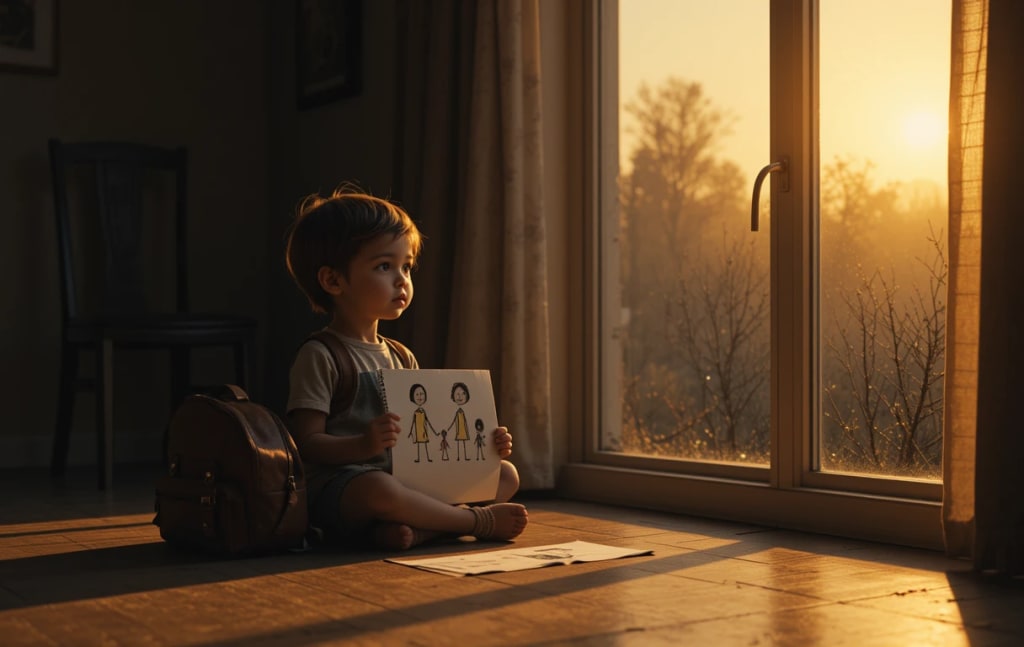
When I was six, I remember waiting by the window on Friday nights. My mom said he’d “try to come” after work. I didn’t know back then that try was adult code for probably not. I’d sit with my sneakers on, clutching a crumpled piece of paper I’d drawn for him — usually a crooked version of our family, with my stick-figure dad always smiling the widest.
Sometimes he’d show. Usually he didn’t.
But I still told myself he had good reasons.
"He got stuck in traffic."
"He had to work late."
"He didn’t want me to see him sad."
That last one was my favorite — it made him seem human. Vulnerable. Like me.
One time, he showed up an hour late with lipstick on his collar. I didn’t know what it was then, only that my mom looked at him like he’d brought poison into the house. They argued in the kitchen while I watched TV with the volume up, pretending not to hear.
Later that night, when he sat next to me on the couch and tousled my hair, I asked him, “Do you still like living with us?”
He laughed. “Of course I do, champ.”
That lie echoed in my chest for months — not because I believed it fully, but because I needed to. It was the story I told myself when he missed my birthday. When he forgot what grade I was in. When he called me by my cousin’s name.
Because if I let go of that lie, then I had to face the truth:
That the person I loved the most in the world was choosing not to be present.
And that truth was too big for an eight-year-old to carry.
As I got older, the lie matured with me.
When I was twelve, I convinced myself that he was just bad at showing love. That men of his generation didn’t say “I love you” or remember school events. That his silence was a form of strength, his absence a kind of sacrifice.
When I was sixteen and he didn’t come to my high school play, I told myself he would’ve been uncomfortable in a crowd. He wasn’t the “theater type,” I told my friends, trying to laugh it off. But when I stepped on stage and saw the empty seat in the second row where he promised he’d be, something cracked inside me.
That night, for the first time, I didn’t tell myself a lie.
I told myself the truth:
He’s not coming. He doesn’t come.
And yet, the ache didn’t kill me like I thought it would.
Healing didn’t happen in one glorious moment. It happened in layers — slow, uneven, like peeling wallpaper in an old room. I had to unlearn the lie. Grieve the version of him I had created. Forgive the child I had been for needing it so badly.
Now I’m twenty-seven. I haven’t spoken to him in three years.
Sometimes, I still think of the lie. It slips into my mind on birthdays or when I see dads cheering for their kids. I don’t resent myself for it anymore. That belief — even if false — held me together. It gave me the illusion of safety. A sense that I mattered, even when no one was showing up for me.
And that mattered.
But I’ve since learned a different truth — one that feels harder, but also more freeing:
Love isn’t real if it only exists in your imagination.
It has to be shown. Spoken. Practiced.
I’ve let go of the lie, not because it wasn’t useful once, but because I’ve outgrown it.
I no longer need to believe he loved me to love myself.
And that’s what survival looks like now:
Not needing the lie to feel worthy.
Not needing his presence to validate mine.
Just standing here — real, flawed, healing — and knowing I made it through.
About the Creator
Keep reading
More stories from waseem khan and writers in Families and other communities.
Wise~Guys
— Look Behind what's in Front of You ~ Make Good Choices — Hey, So how you Doin'..! Made~Men — Mobster Movies romanticise a distinctive, elegant appearance, impeccable attire style, along with the 'Families' expressive lingo. Making their 'Bones' gave them Panache — with vintage fedoras, tailored pin-striped suits, mirror-polished wing-tip shoes adorned with tassels; with their 'Gun Moll' gorgeous dates on their arms.
By Jay Kantor16 days ago in Families
DEEP HEIGHTS
I Love How He Loves Me GRACELLA NOV 19, 2025 (Just a Devotional): I am left in a sweet place here and had a wonderful time with my Lord, as I always do. But this was different. Unspeakably different. It is not really something I can share, because it is just one of those things that belongs to you; if you know what I mean.
By Kadee Grace7 days ago in Families


Comments
There are no comments for this story
Be the first to respond and start the conversation.